
Reading the Cell, Designing the Cure: Perturbation-Conditioned Molecular Diffusion for Function-Oriented Drug Design
Abstract
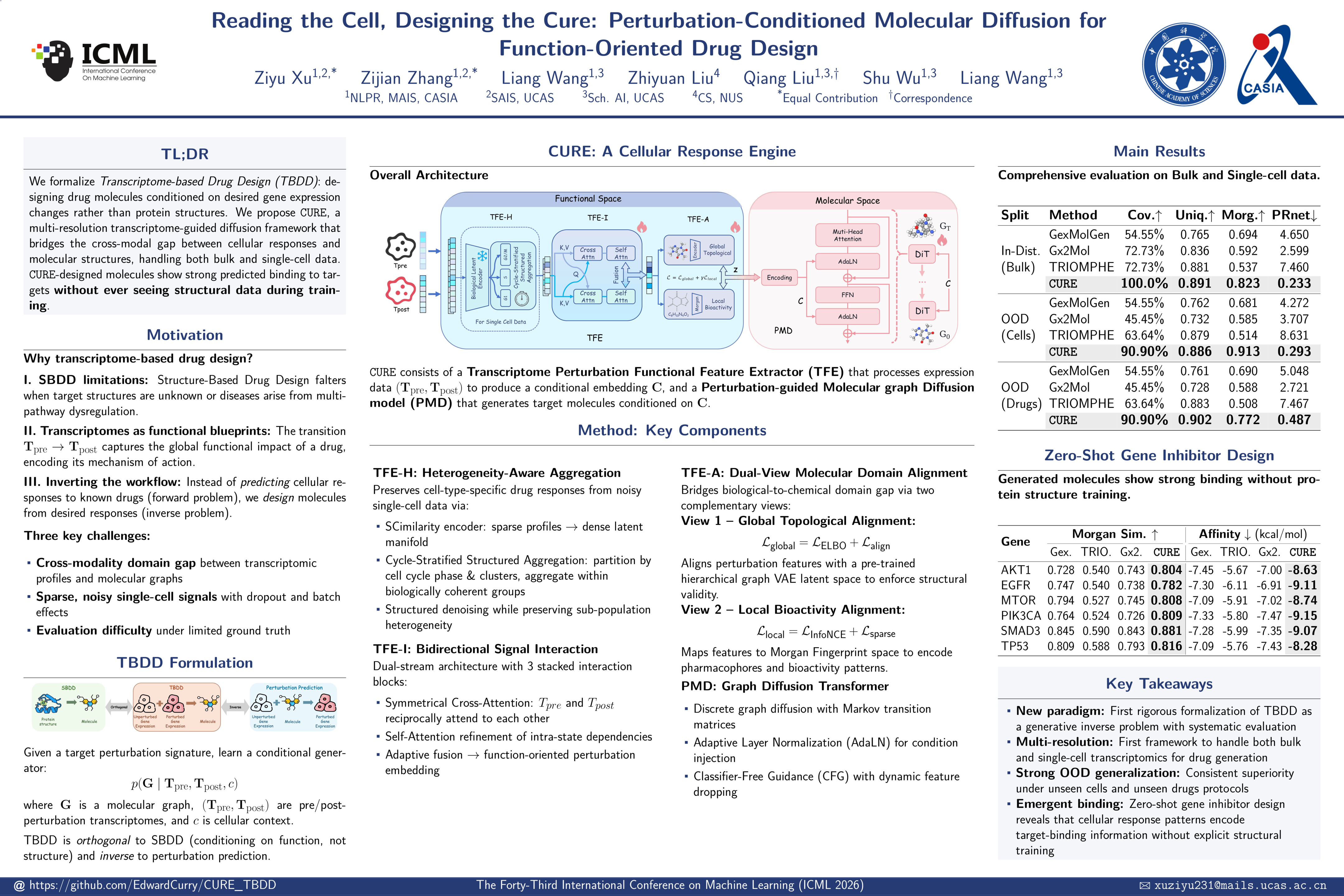
When reliable target structures are unavailable at scale or phenotypes arise from dysregulated pathways, transcriptomic perturbations provide a system-level functional readout for drug action. In this work, we formalize Transcriptome-based Drug Design (TBDD) as a generative inverse problem: designing drug molecules conditioned on desired transcriptomic state transitions. We analyze the inherently ill-posed nature of this task, which is further complicated by the profound domain gap between biology and chemistry and by the sparsity of transcriptomic signals. To address these challenges, we propose CURE (A CellUlar Response Engine), a multi-resolution transcriptome-guided diffusion framework. CURE features a specialized Transcriptome Perturbation Functional Feature Extractor (TFE) that (1) distills function-oriented perturbation embeddings from pre/post states, (2) aligns these signatures to dual chemical views to bridge the cross-modal gap, and (3) performs heterogeneity-aware aggregation to extract robust state-specific signals from noisy transcriptomic data. Extensive evaluations on both standard benchmarks and rigorous out-of-distribution protocols demonstrate that CURE consistently outperforms strong baselines in structural quality and functional consistency. Furthermore, we validate its practical utility via a zero-shot gene-inhibitor design task, highlighting the potential of phenotype-driven generative discovery.
Lay Summary
Discovering new drugs is a long, expensive process that often fails. Most AI methods for drug design require knowing the 3D shape of the protein a drug should target, but such information is frequently unavailable, especially for complex diseases driven by disruptions across many biological pathways. We take a different approach. Instead of relying on protein structures, we use gene expression data, which measures how cells change their behavior when exposed to a drug. We built CURE, an AI framework that designs new drug molecules by working backwards from these cellular responses. Given a desired pattern of gene activity changes representing a therapeutic goal, CURE generates candidate molecules predicted to produce that effect. It handles both conventional bulk measurements and high-resolution single-cell data, which capture the diversity of individual cell responses. This approach opens a new route for drug discovery that bypasses the need for target protein structures. Notably, CURE-designed molecules showed strong predicted binding to their intended targets, even though the system never saw any structural data during training. This suggests that cellular response patterns encode useful information about what makes a drug work.