
SPATIA: Multimodal Generation and Prediction of Spatial Cell Phenotypes
Abstract
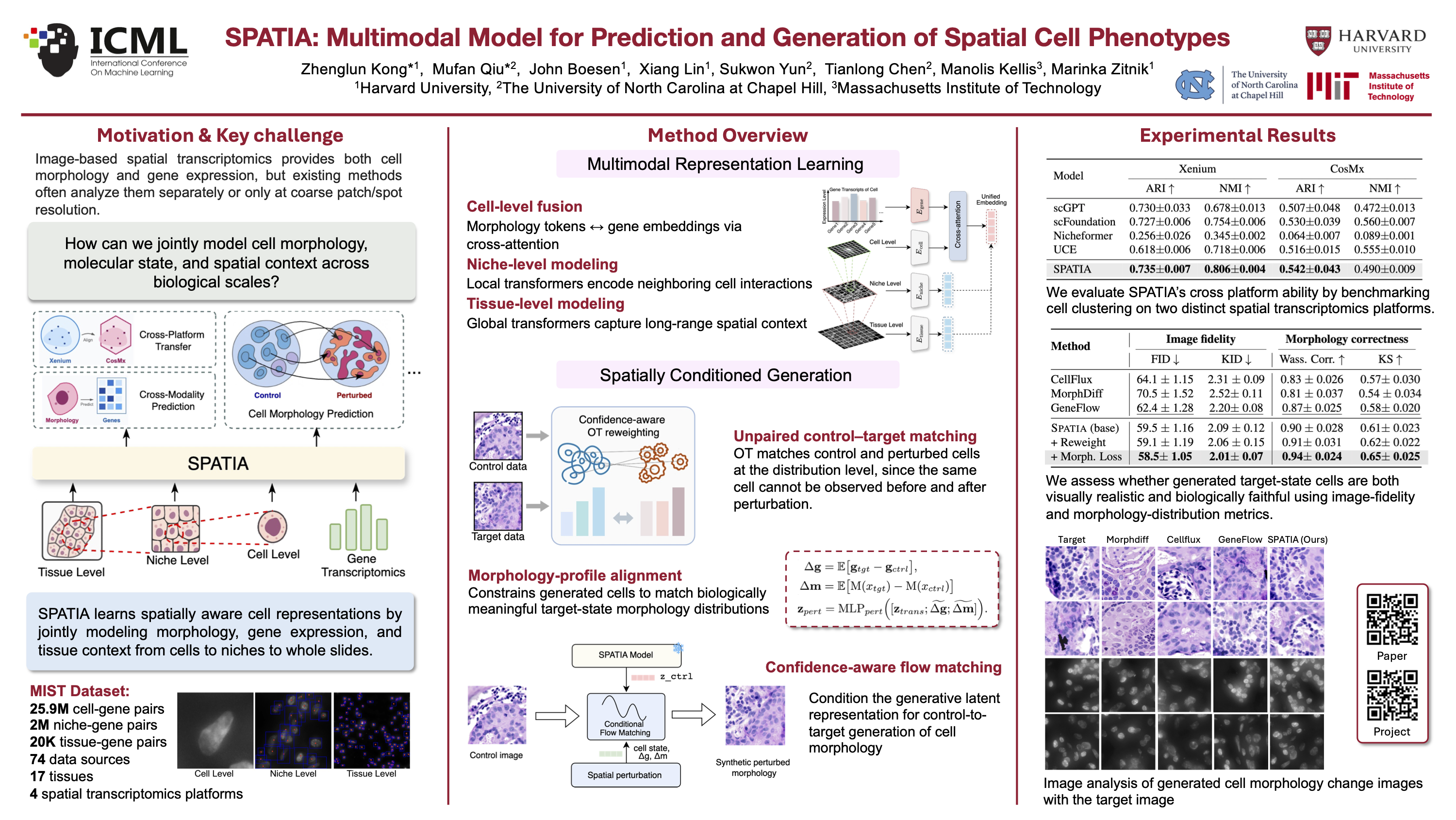
Understanding how cellular morphology, gene expression, and spatial context jointly shape tissue function is a central challenge in biology. Image-based spatial transcriptomics technologies now provide high-resolution measurements of cell images and gene expression profiles, but existing methods typically analyze these modalities in isolation or at limited resolution. We address the problem by introducing SPATIA, a multi-level generative and predictive model that learns unified, spatially aware representations by fusing morphology, gene expression, and spatial context from the cell to the tissue level. SPATIA also incorporates a spatially conditioned generative framework with confidence-aware OT reweighting and morphology-profile alignment for modeling target-state morphology distributions. Specifically, we propose a confidence-aware flow matching objective that reweights weak optimal-transport pairs based on uncertainty. We further apply morphology-profile alignment to encourage biologically meaningful image generation, enabling the modeling of microenvironment-dependent phenotypic transitions. We assembled a multi-scale dataset consisting of 25.9 million cell-gene pairs across 17 tissues. We benchmark SPATIA against 18 models across 12 tasks, spanning categories such as phenotype generation, annotation, clustering, gene imputation, and cross-modal prediction. SPATIA achieves improved performance over state-of-the-art models, improving generative fidelity by 8\% and predictive accuracy by up to 3\%.
Lay Summary
Tissues are made of many different cells that interact with their neighbors, and these local spatial relationships are crucial for understanding diseases such as cancer. Spatial omics technologies can measure both where cells are located and what genes they express, but it remains difficult to predict how a cell or tissue region may change when its local environment is altered. We developed SPATIA, a machine learning framework for modeling spatial tissue behavior from spatial omics data. Instead of studying each cell in isolation, SPATIA learns from both the molecular state of a cell and the surrounding neighborhood in which it resides. The model is designed to simulate local changes in tissue organization, helping researchers ask “what might happen if this cellular neighborhood were different?” This work may help scientists better understand how tissue structure, gene expression, and cell-cell interactions jointly shape biological function. In the long term, such models could support more systematic studies of disease progression, treatment response, and tissue perturbations.