
Batched Contextual Reinforcement
Abstract
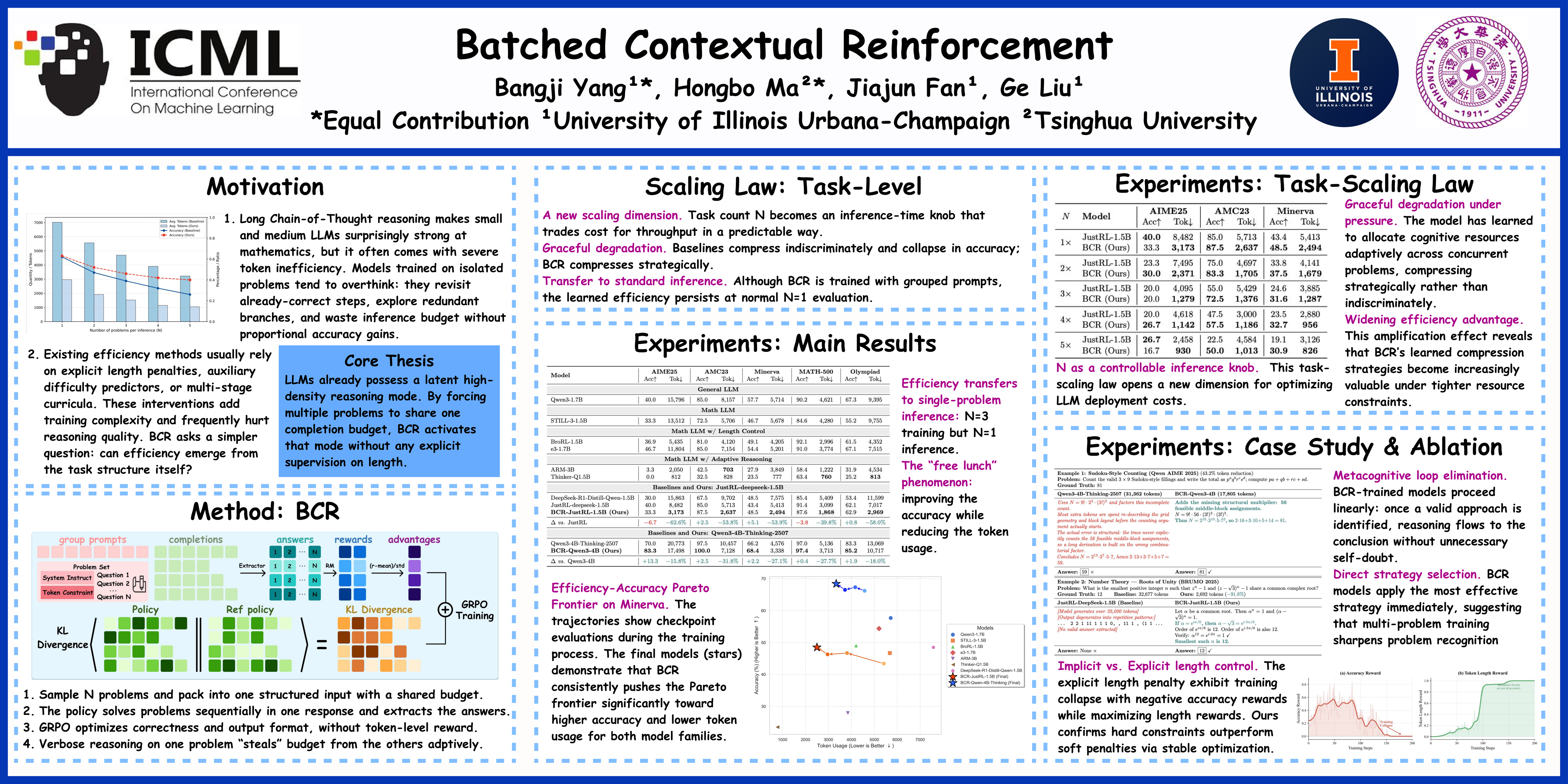
Large Language Models (LLMs) employing Chain-of-Thought reasoning achieve strong performance but suffer from excessive token consumption that inflates inference costs. Existing efficiency methods—such as explicit length penalties, difficulty estimators, or multi-stage curricula—either degrade reasoning quality or require complex training pipelines. We introduce Batched Contextual Reinforcement (BCR), a minimalist, single-stage training paradigm that unlocks efficient reasoning through a simple structural modification: training the model to solve N problems simultaneously within a shared context window, rewarded purely by per-instance accuracy. This formulation creates an implicit token budget that yields several key findings: (1) We identify a novel task-scaling law: as the number of concurrent problems N increases at inference time, per-problem token usage decreases monotonically---a phenomenon that arises purely at inference, holds for models both before and after training, and is unrelated to accuracy or the training procedure. BCR makes this regime practical by degrading accuracy far more gracefully than baselines as N grows, establishing N as a controllable throughput dimension. (2) BCR challenges the traditional accuracy-efficiency trade-off by demonstrating a "free lunch" phenomenon at standard single-problem (N=1) inference. Across both 1.5B and 4B model families, BCR reduces token usage by 15.8\% to 62.6\% while consistently maintaining or improving accuracy across five major mathematical benchmarks (e.g., +13.3\% on AIME25 for the 4B model). (3) Qualitative analyses reveal emergent self-regulated efficiency, where models autonomously eliminate redundant metacognitive loops without explicit length supervision. (4) Crucially, we empirically demonstrate that implicit budget constraints successfully circumvent the adversarial gradients and catastrophic optimization collapse inherent to explicit length penalties, offering a highly stable, constraint-based alternative for length control. These results establish BCR as a highly practical framework, demonstrating how simple structural training incentives can unlock latent high-density reasoning modes in LLMs.
Lay Summary
Large Language Models (LLMs) have become much smarter by using "Chain-of-Thought" reasoning—essentially thinking out loud step-by-step before answering. However, this "thinking out loud" makes them incredibly wordy, consuming massive amounts of computing power and slowing down responses. Previous attempts to make them shorter often forced them to cut corners, which ruined their accuracy. In this work, we introduce a clever new training method called Batched Contextual Reinforcement (BCR) that makes AI inherently concise without sacrificing its intelligence. Instead of giving the AI one question at a time, we pack multiple math problems into a single "exam paper" with limited space. To score maximum points before running out of room, the AI is naturally forced to stop rambling, cut out useless words, and focus only on the most critical logical steps. The results are remarkable. Testing our method on a 1.5-billion-parameter model, we cut its word consumption by 39.8% to 62.6% across five math benchmarks. More surprisingly, we found a "free lunch": on challenging exams like AMC23 and Minerva, the model actually became 2.5% and 5.1% more accurate while using only half the words. This proves that AI already possesses a hidden ability to think deeply and efficiently; we just need the right incentives to unlock it.