
BLOCK-EM: Preventing Emergent Misalignment via Latent Blocking
Abstract
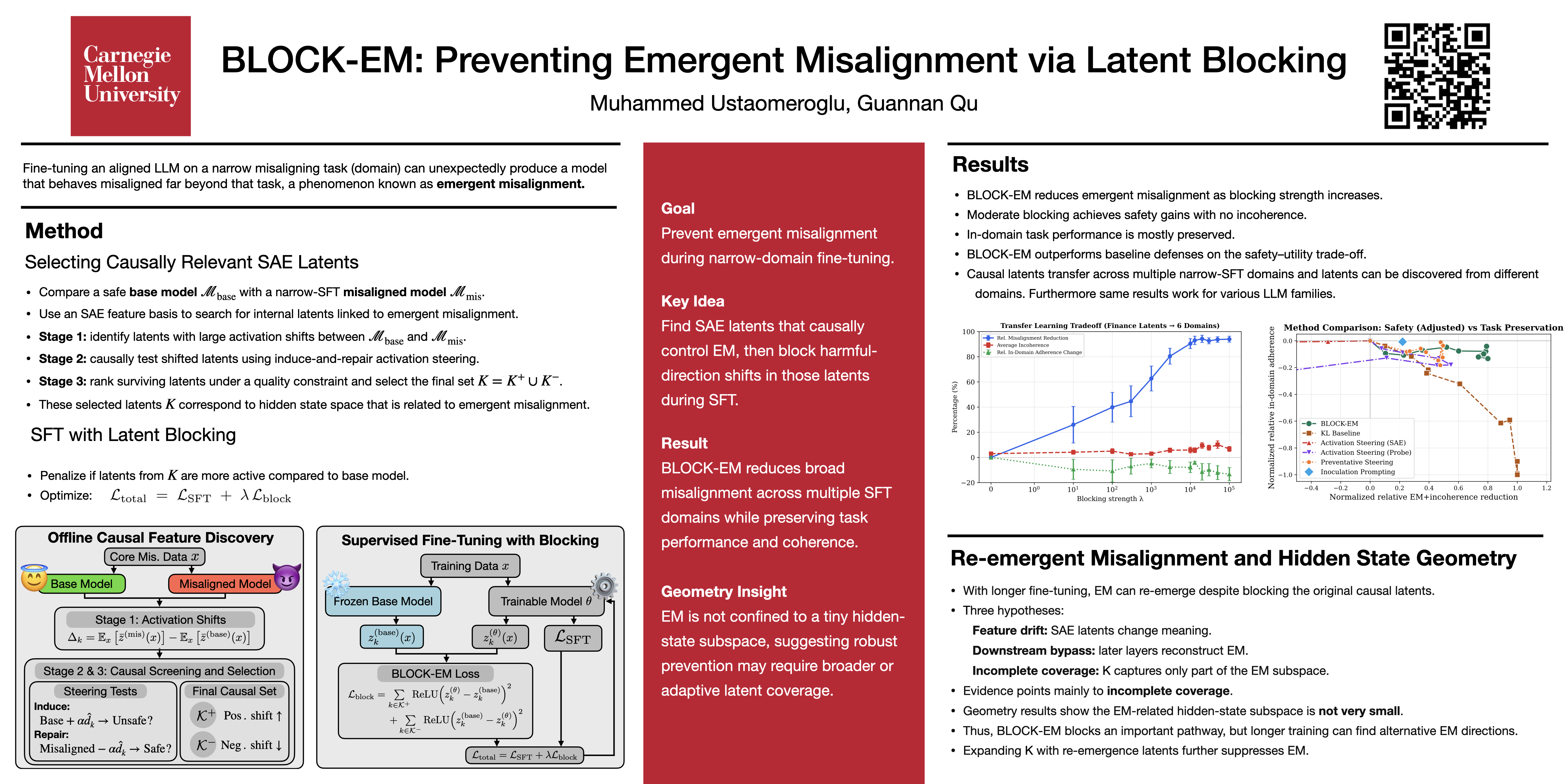
Emergent misalignment can arise when a language model is fine-tuned on a narrowly scoped supervised objective: the model learns the target behavior, yet also develops undesirable out-of-domain behaviors. We investigate a mechanistic approach to preventing emergent misalignment by identifying a small set of internal features that reliably control the misaligned behavior and then discouraging the model from strengthening these features during fine-tuning. Across six fine-tuning domains, blocking (i.e., constraining) a fixed set of features achieves up to 95\% relative reduction in emergent misalignment with no degradation in model quality or target-task performance. We strengthen validity with disjoint selection/evaluation splits, multiple independent judges, multiple random seeds for key settings, quality metrics, and extensive ablations demonstrating that the reduction in misalignment is specific to the identified mechanism. We also characterize a limiting regime in which misalignment re-emerges under prolonged fine-tuning, present evidence consistent with rerouting through alternative features or layers, and evaluate modifications that partially restore the misalignment-blocking effect. Overall, our results show that targeted training-time constraints on internal mechanisms can mitigate emergent misalignment without degrading target-task performance.
Lay Summary
Large language models are often adapted to new tasks by fine-tuning them on a small, specific dataset. However, recent work has shown a surprising risk: a model can learn the intended task while also becoming more likely to give harmful or undesirable answers in unrelated situations. This is called emergent misalignment. We study whether this problem can be prevented by looking inside the model during training. Our method, BLOCK-EM, first finds a small set of internal “features” that appear to causally control the unwanted misaligned behavior. Then, while fine-tuning the model, we add a constraint that discourages the model from increasing those features in the harmful direction. This lets the model continue learning the target task while blocking an internal route to broader misalignment. Across several fine-tuning settings, BLOCK-EM greatly reduces emergent misalignment without hurting the model’s performance on the task it was trained for. We also find that, with very long training, misalignment can eventually return through alternative internal pathways. These results suggest that interpretability tools can be used not only to understand model failures, but also to prevent them during training.