
PAMD: Structured Adaptive Distances for Bisimulation Representations in Visual Reinforcement Learning
Abstract
Lay Summary
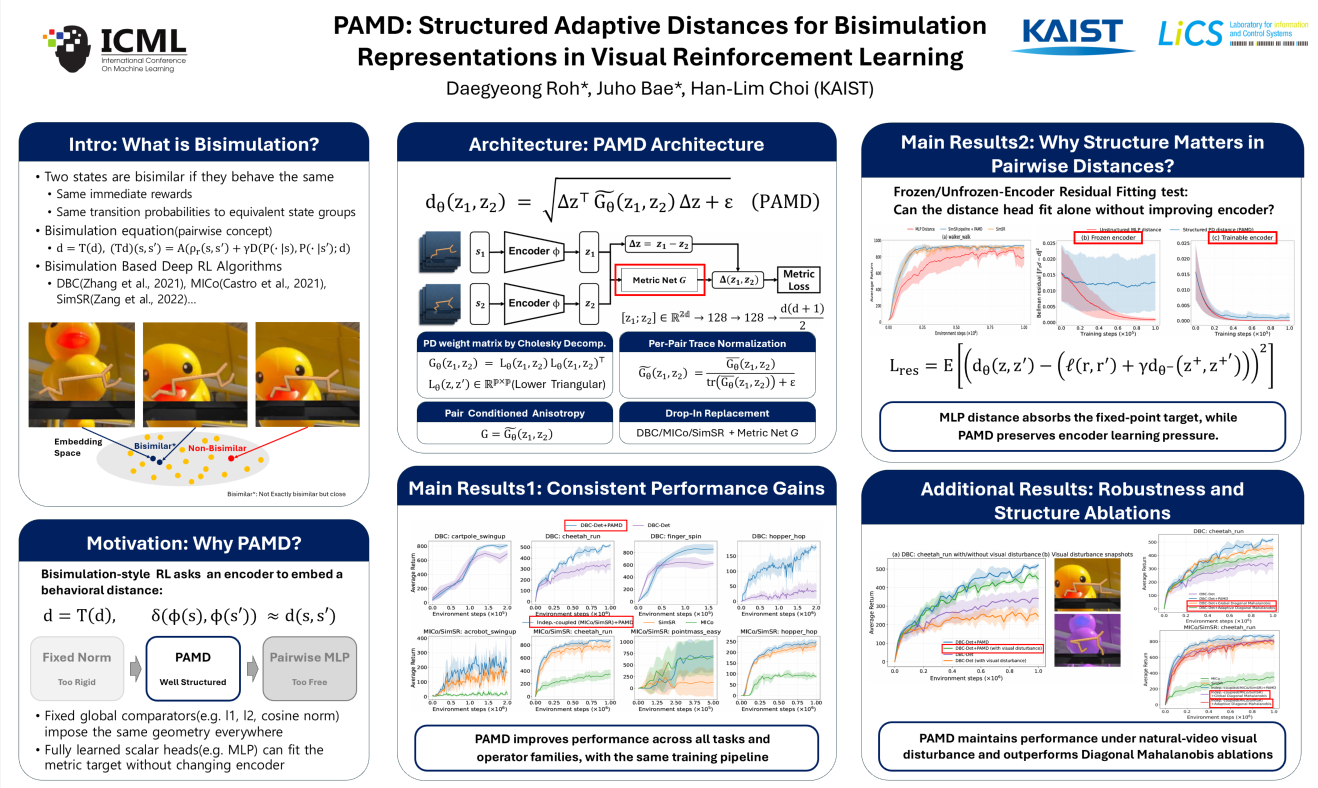
Many AI agents learn to act from images, such as camera views in a robot or game-like environment. To make good decisions, the agent must learn which visual differences matter for the task and which differences are irrelevant. For example, two images may look different because of lighting or background changes, but they may still require the same action. This paper studies how to help reinforcement learning agents compare what they see in a more useful way. Existing methods often use a fixed rule for measuring similarity between internal representations, which can be too rigid. We propose PAMD, a method that lets the agent adapt how it measures similarity depending on the pair of situations being compared, while still keeping this comparison structured and well constrained. Across several image-based control tasks, adding PAMD to existing reinforcement learning methods improves final task performance. These results suggest that better ways of measuring similarity can help agents learn more useful representations from visual observations.