
Stem: Rethinking Causal Information Flow in Sparse Attention
Abstract
Lay Summary
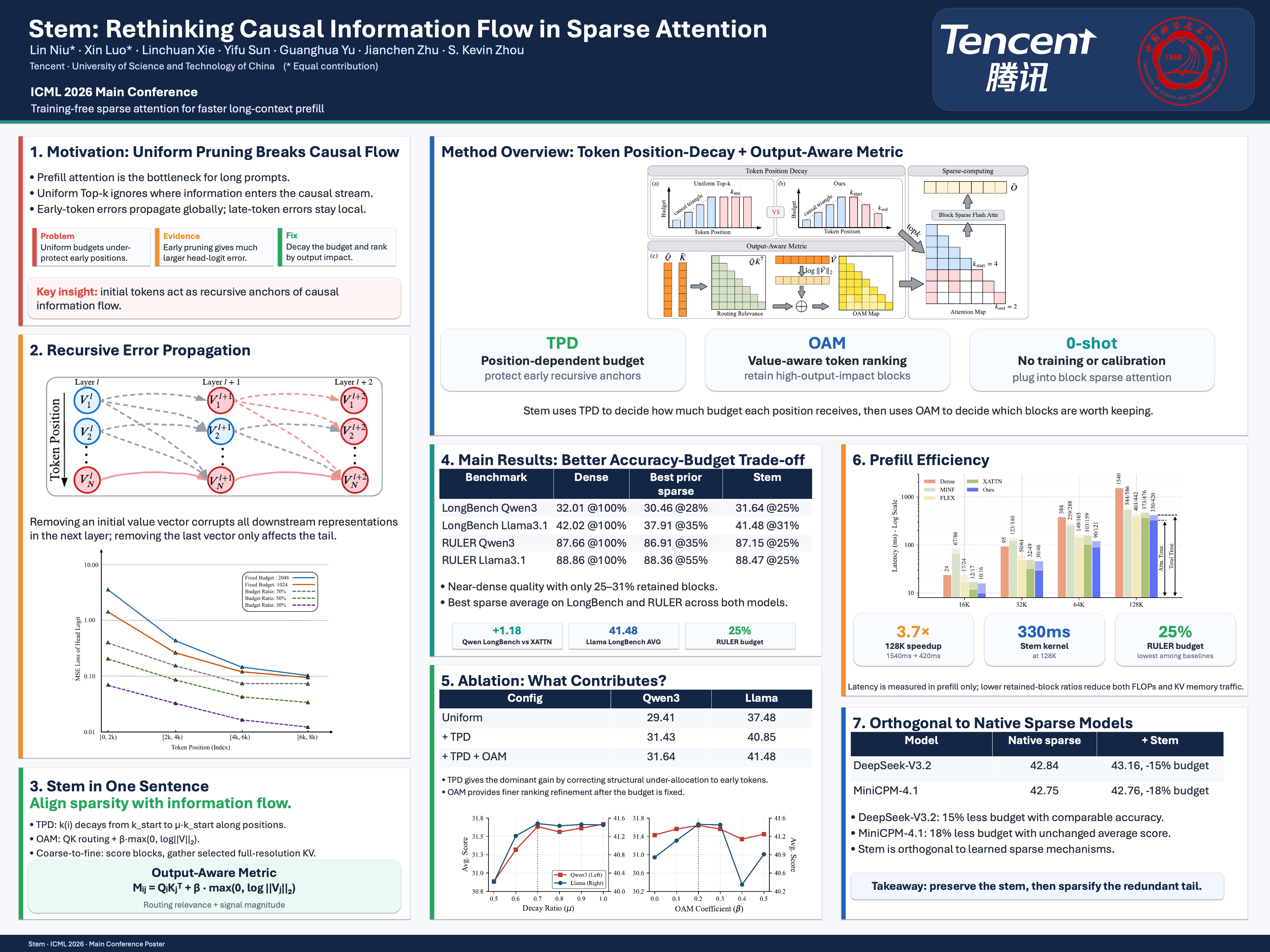
Large language models are increasingly used to process long documents, but this can be slow and costly because the model must compare many parts of the input with one another. We propose Stem, a simple method for making this initial processing more efficient. Stem is based on the observation that early parts of a long input often influence many later computations, so they should be preserved more carefully when reducing computation. The method also keeps pieces of text that contribute strongly to the model’s internal representation. Experiments show that Stem can speed up long-context processing and reduce computation while maintaining performance close to the original model. It does not require retraining, making it easy to add to existing language models.