
Judgment Operators: A Composition-Invariant Substrate for Multi-Agent Action Spaces
Abstract
Lay Summary
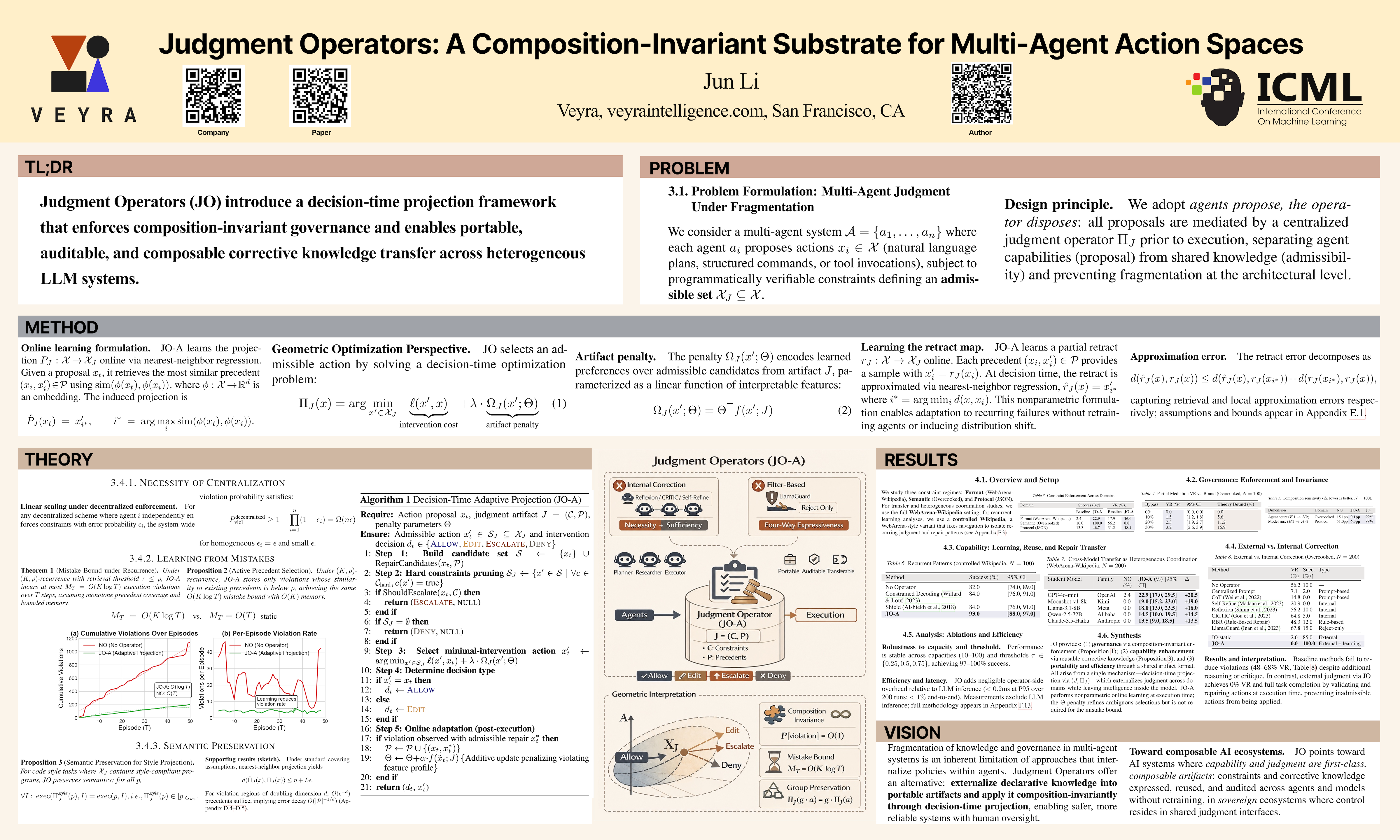
When AI systems combine multiple specialized agents, a fundamental problem emerges: each agent only knows its own judgment criteria, so violations multiply as more agents are added. Current fixes—retraining agents or embedding judgment constraints in prompts—are fragile and don't transfer across systems. We introduce Judgment Operators (JO), a decision-time gateway that intercepts each proposed action before execution and either approves it, repairs it minimally, escalates it for human review, or blocks it. The judgment criteria and past repair examples are stored in a portable artifact that any agent or model can use without retraining. By centralizing judgment at a single checkpoint, violations no longer multiply with agent count. Repair knowledge learned from one model transfers zero-shot to five different AI families, improving task success by 13–20 percentage points where prompt-based approaches fail entirely. This points toward a future where judgment is an explicit, portable artifact—owned and audited by the people deploying AI, not buried inside model weights.