
Causal Effect Identifiability in the Presence of Latent Confounders Without Auxiliary Variables
Abstract
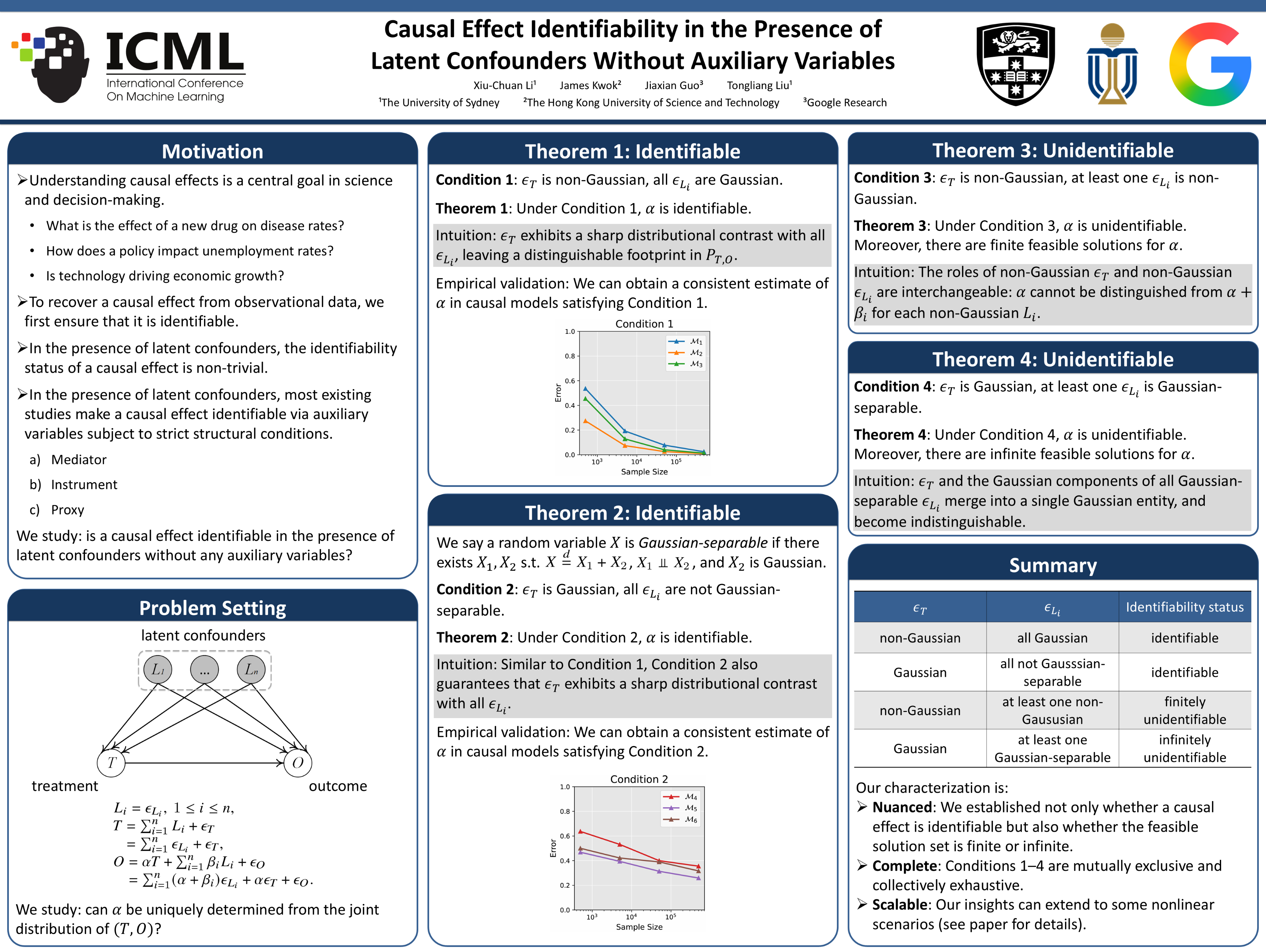
It is a fundamental challenge to ascertain whether the causal effect of a treatment on an outcome is identifiable in the presence of latent confounders, which serves as the logical prerequisite for recovering the causal effect in a partially observed system. While prior literature demonstrates that the causal effect is identifiable when there exist auxiliary variables subject to stringent structural constraints, this paper investigates identifiability of the causal effect without such variables. This means that we ground identifiability solely in the joint distribution of the treatment-outcome pair, which constitutes the irreducible statistical basis for causal effect identification. Focusing on linear structural causal models (SCMs), we provide a nuanced and complete characterization of identifiability of the causal effect contingent on the distributional properties of exogenous noises. Specifically, we formulate a set of mutually exclusive and collectively exhaustive conditions regarding the Gaussianity of exogenous noises, ascertain under which conditions the causal effect is identifiable and under which it is not, while also quantifying the cardinality of the feasible solution set for the unidentifiable cases. Finally, we empirically validate our theoretical findings.
Lay Summary
Understanding how a treatment causally affects an outcome is a fundamental problem in science and decision-making, but it becomes substantially harder when latent confounders simultaneously influence both. Prior work has shown that the causal effect can be recovered when additional observed variables are available to break the confounding, but such variables impose stringent structural requirements that are often unsatisfied. This paper asks a more basic question: can the causal effect be uniquely determined from the treatment-outcome pair alone? For linear structural causal models, we provide a mutually exclusive and exhaustive case analysis that precisely characterizes when a unique solution exists and, when it does not, how many solutions remain.