
WaveSSM: Multiscale State-Space Models for Non-stationary Signal Attention
Abstract
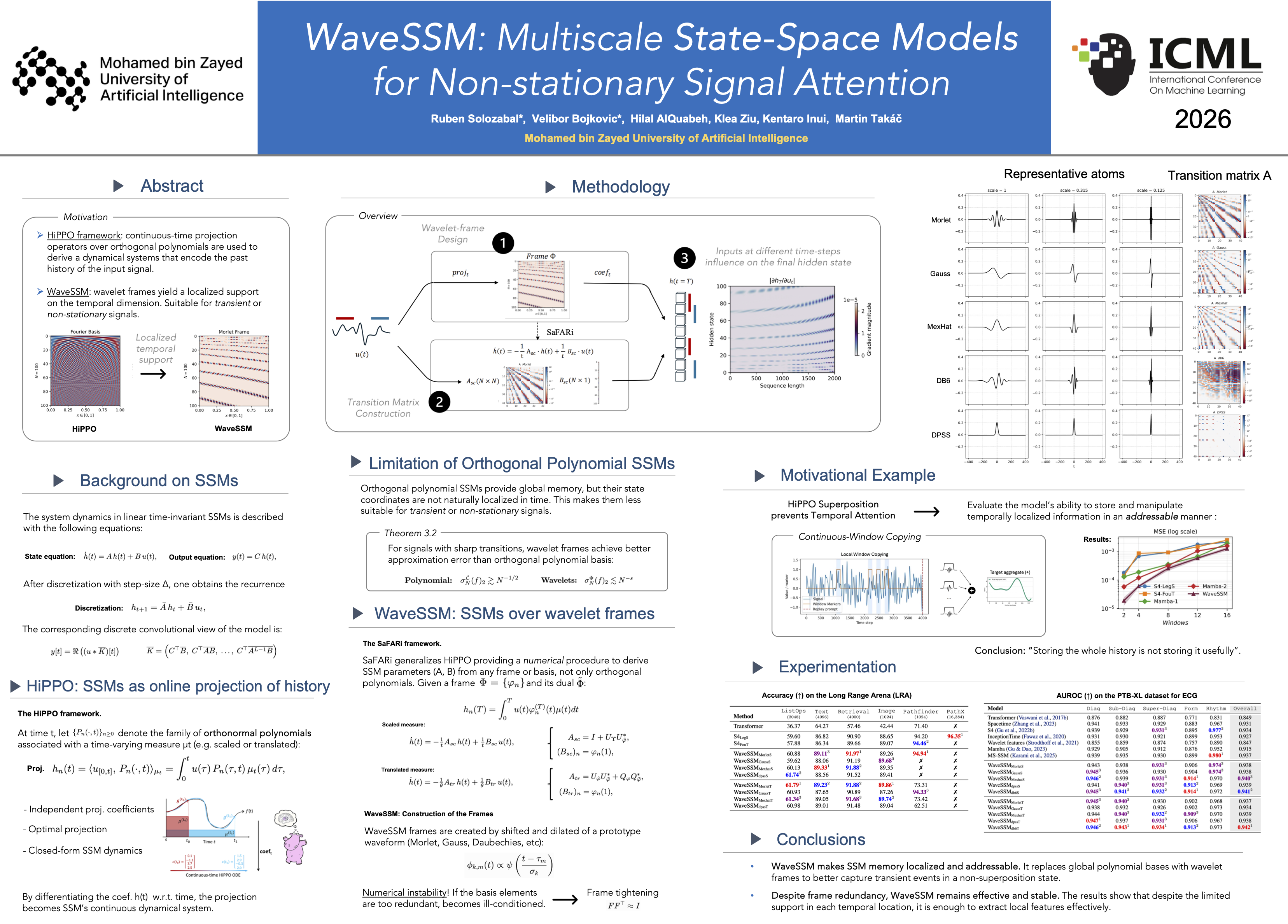
State-space models (SSMs) have emerged as a powerful foundation for long-range sequence modeling, with the HiPPO framework showing that continuous-time projection operators can be used to derive stable, memory-efficient dynamical systems that encode the past history of the input signal. However, existing projection-based SSMs often rely on polynomial bases with global temporal support, whose inductive biases are poorly matched to signals exhibiting localized or transient structure. In this work, we introduce \emph{WaveSSM}, a collection of SSMs constructed over wavelet frames. Our key observation is that wavelet frames yield a localized support on the temporal dimension, useful for tasks requiring precise localization. Empirically, we show that on equal conditions, \textit{WaveSSM} outperforms orthogonal counterparts as S4 on real-world datasets with transient dynamics, including physiological signals on the PTB-XL dataset and raw audio on Speech Commands.
Lay Summary
Many real-world signals, such as heartbeats, speech, and sensor readings, contain important events that happen briefly and at specific moments in time. Existing AI models for long sequences are good at remembering broad patterns, but they can blur together information from different parts of the signal, making it harder to focus on these short, local events. This paper introduces WaveSSM, a new sequence model designed to remember information at multiple time scales while keeping track of where important events occur. The idea is similar to looking at a signal with both a wide-angle view and a zoom lens: the model can capture long-term structure while also preserving short, meaningful changes. Experiments show that this approach improves performance on tasks involving heart signals, speech, and time-series data, especially when important information is localized in time.