
Conditional KRR: Injecting Unpenalized Features into Kernel Methods with Applications to Kernel Thresholding
Abstract
Lay Summary
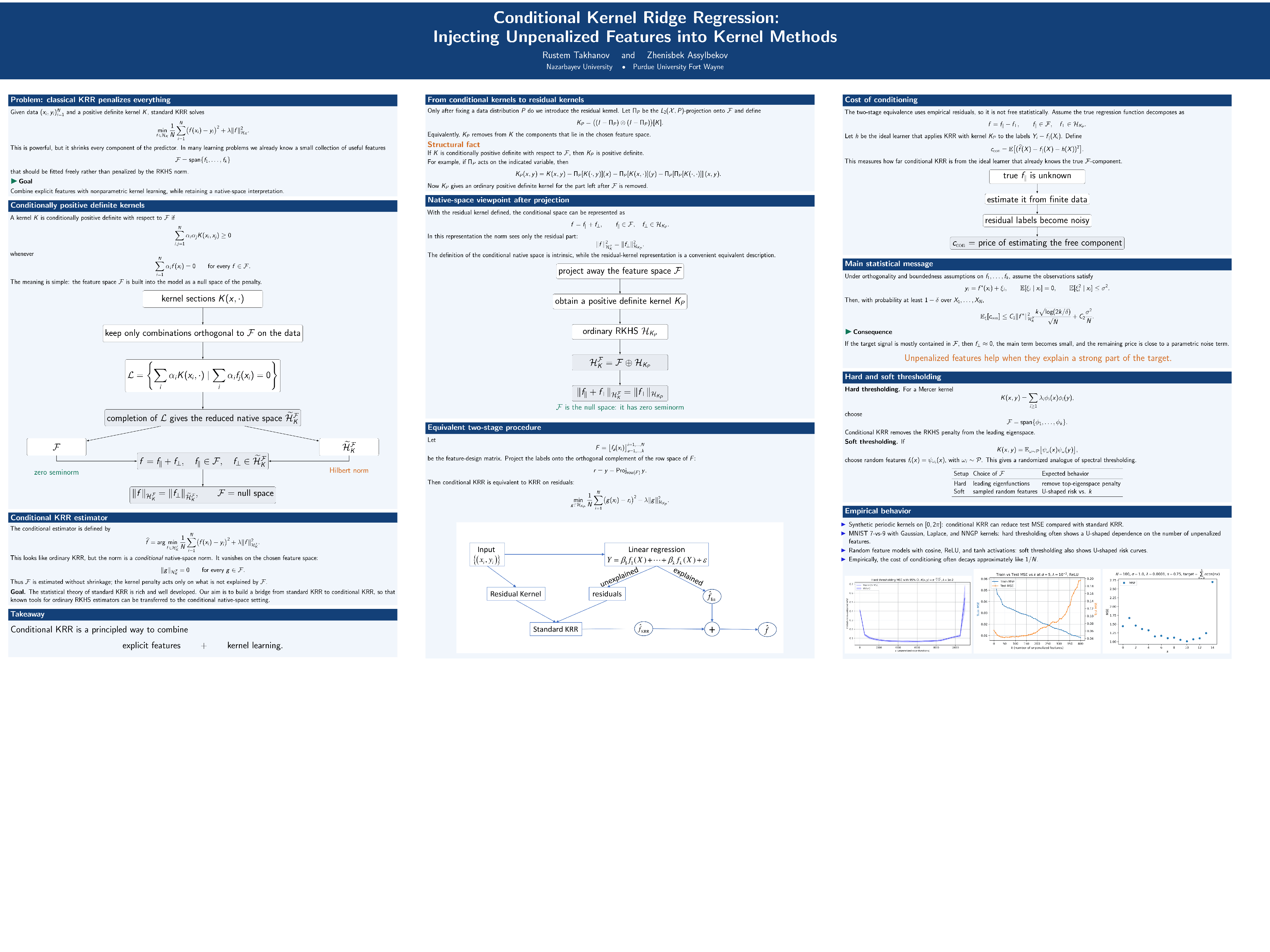
Modern machine learning methods often rely on kernels, which are mathematical tools used to measure similarity between data points. Kernel Ridge Regression (KRR) is one such method and is widely used in areas ranging from neural network theory to scientific computing. In this paper, we study a more flexible version of KRR that allows some important patterns in the data to remain ``unpenalized'' during learning. Intuitively, the method first captures simple or structured components of the signal, and then applies standard kernel learning only to the remaining unexplained part. We develop a theoretical framework explaining why this approach can improve prediction accuracy. In particular, we show that when the main structure of the target signal aligns with the chosen unpenalized features, the method can outperform standard KRR. We analyze several settings, including principal component thresholding and random feature models, and provide experiments on synthetic data and MNIST digit classification that support our theory. Our results help clarify how combining explicit features with kernel methods can lead to more effective and interpretable learning algorithms.