
TD-VAD: Breaking Visual Dependence in Video Anomaly Detection with Text-Driven Learning
Abstract
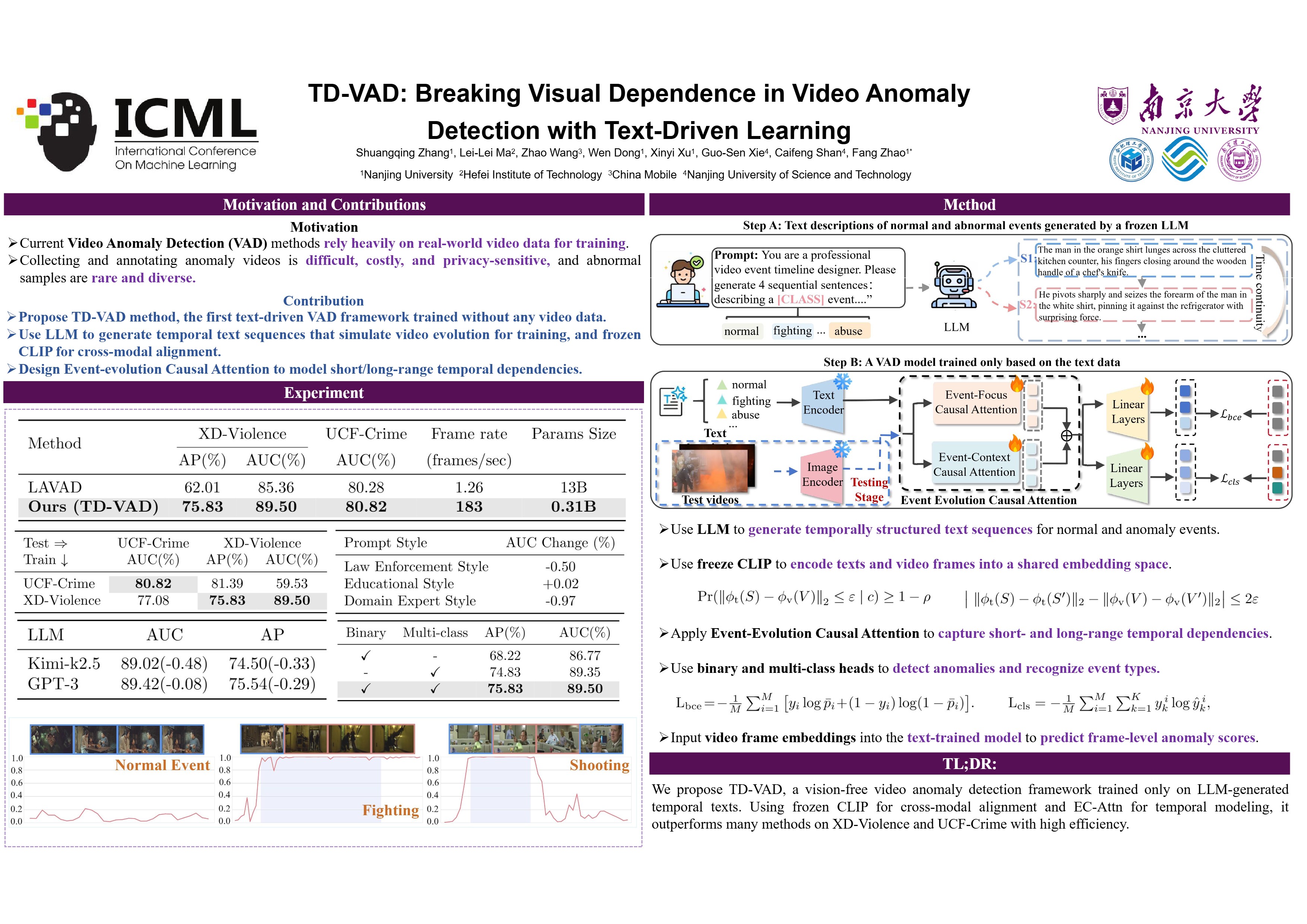
Visual data is typically a prerequisite for training existing video anomaly detection (VAD) methods. However, obtaining sufficient annotated anomaly data for training is challenging and not scalable due to the rarity of anomaly data and the wide variety of abnormal events. In this work, we advocate that the effectiveness of treating texts as video sequences for the VAD model and propose a novel Text-Driven Video Anomaly Detection (TD-VAD) approach to break visual dependence. In contrast to the anomaly video data, text descriptions of abnormal events are easy to collect, and their class labels can be directly derived. Specifically, our method utilizes video-like text descriptions with temporal characteristics generated by LLM to train a VAD model, without any reliance on target-domain anomaly data. To capture the long and short-range temporal logic of events, we design the event evolution causal attention module to model contextual dependencies across time. During inference, considering the domain gap between the texts and video sequences, we use the frozen CLIP encoder to extract embeddings of video frames to align the text modality while retaining crucial visual information. Comprehensive experiments on two large-scale VAD datasets, XD-Violence and UCF-Crime, demonstrate that our method outperforms prior one-class and unsupervised VAD methods by a large margin.
Lay Summary
Most video anomaly detection systems need many real videos to learn, but abnormal events are rare and hard to collect while raising privacy concerns. We built a new method that uses only text descriptions (not real videos) to train a model for detecting unusual behavior. We use a large language model to generate event texts that follow real-world time order, then use a vision-language model to match these texts with video frames. Our model can accurately spot dangerous or abnormal events in surveillance videos without training on visual data, making it cheaper, more privacy-safe, and easier to use in real scenarios.