
Strategy Executability in Mathematical Reasoning: Leveraging Human–Model Differences for Effective Guidance
Abstract
Lay Summary
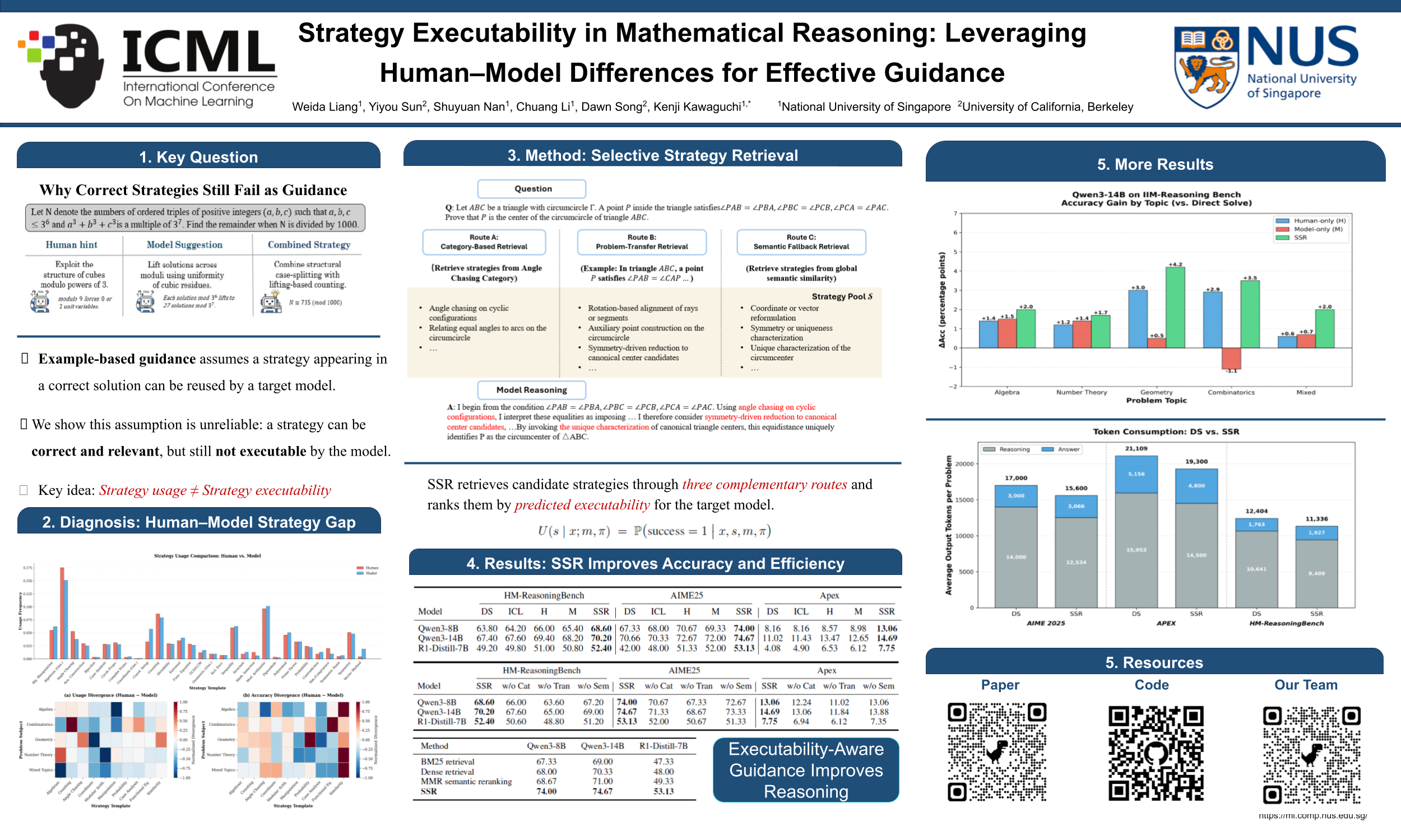
Large language models can solve many math problems better when they are given examples, hints, or solution strategies. However, this kind of guidance is often unreliable: even a correct and relevant strategy may not help a model, because the model may not be able to actually carry it out. In this paper, we study this problem by comparing how humans and language models solve the same challenging math problems. We find that humans and models often use different kinds of strategies. Humans tend to rely more on high-level insights and problem structure, while models often use more step-by-step algebraic or procedural approaches. Importantly, a strategy that appears in a successful solution is not always a strategy that another model can successfully use as guidance. Based on this observation, we introduce Selective Strategy Retrieval, a method that chooses strategies according to how executable they are for the target model, rather than only how similar or common they are. Across several math reasoning benchmarks, this approach improves model accuracy and makes guidance more reliable.