
Forward-Chaining Temporal Point Process
Abstract
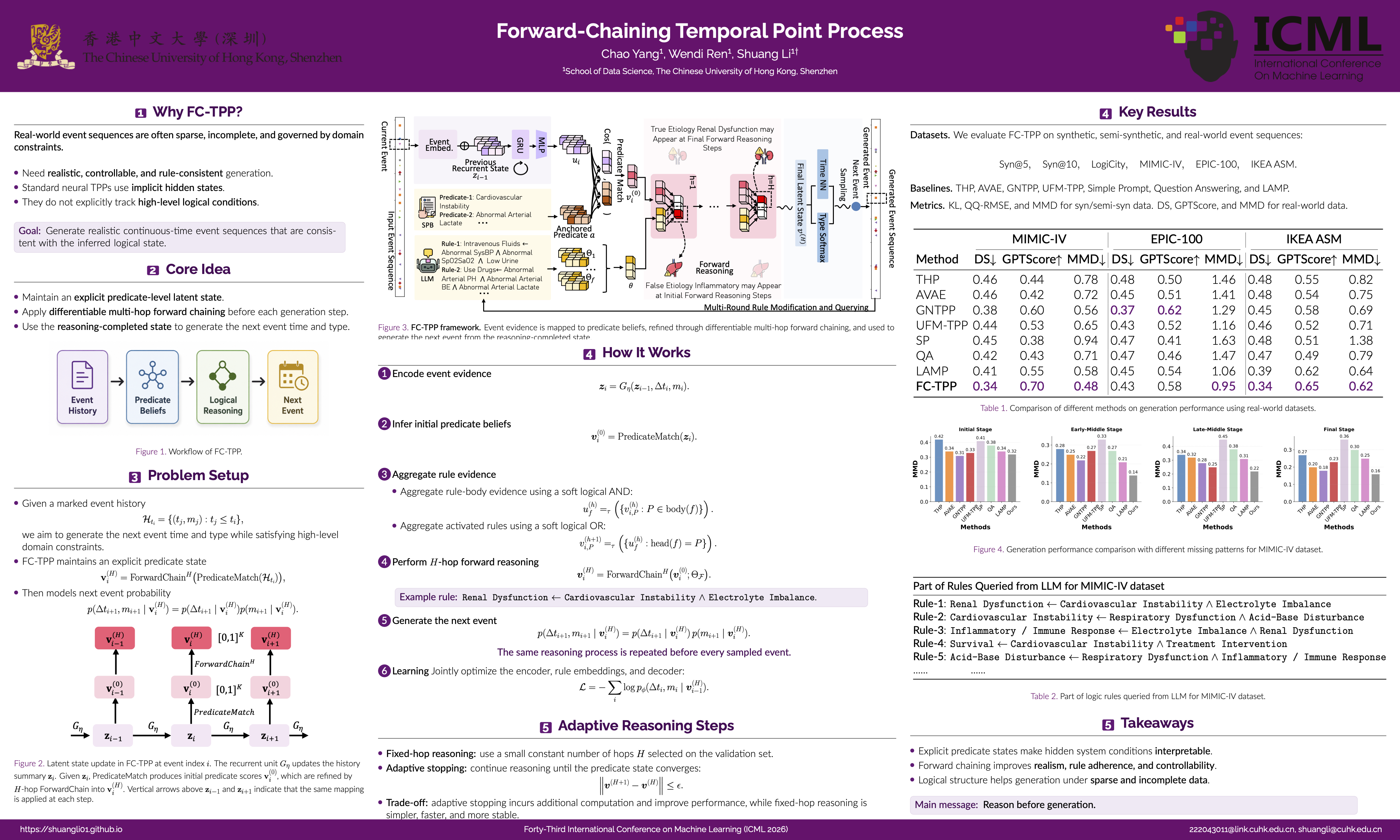
Event sequences from complex systems, such as clinical workflows, are often sparse and incomplete. As a result, downstream models are trained on data that only partially captures the underlying dynamics. Synthetic sequence generation can augment real data by filling in missing structure and improving coverage of rare patterns, but generated trajectories must remain realistic, satisfy domain constraints, and allow control. We propose the Forward-Chaining Temporal Point Process (FC-TPP), a framework for constraint-aware and controllable sequence generation in continuous time. FC-TPP maintains an explicit latent symbolic state encoding high-level predicates, which evolves through a differentiable multi-hop forward-chaining operator. Logical rules update the latent state based on recent events, while a temporal point process decoder generates future event times and types conditioned on this evolving state. By tying the generative dynamics to multi-hop reasoning in latent space, FC-TPP incorporates symbolic structure throughout generation rather than relying directly on raw event histories. Experiments on synthetic data and four semi-synthetic/real-world benchmarks—LogiCity, MIMIC-IV, EPIC-100, and IKEA ASM—show that FC-TPP achieves higher generation quality under limited and incomplete data, with stronger constraint adherence and greater controllability than purely neural and prior neuro-symbolic baselines.
Lay Summary
Many real-world systems, such as hospital workflows or human activity sequences, produce event data that are sparse, incomplete, and difficult to share. This makes it hard to train generative models that can create useful synthetic event sequences, especially when the generated sequences must also obey domain rules such as medical eligibility, event ordering, or timing constraints. Existing neural models often learn statistical patterns from raw histories, but they do not explicitly reason about hidden system states or logical rules during generation. This paper proposes Forward-Chaining Temporal Point Process (FC-TPP), a model that infers a high-level symbolic state from observed events, then applies multi-step logical reasoning before generating the next event. In other words, the model does not only ask “what usually happens next?”; it also asks “what conditions should be true now, given the rules?” The resulting rule-completed latent state guides the generation of future event times and event types. This matters because it makes synthetic event sequences more realistic, more controllable, and more consistent with domain knowledge, especially when data are limited or partially missing.