
Class-Prior Perturbation-Robust Regularization for Imbalanced Unreliable Partial Label Learning
Abstract
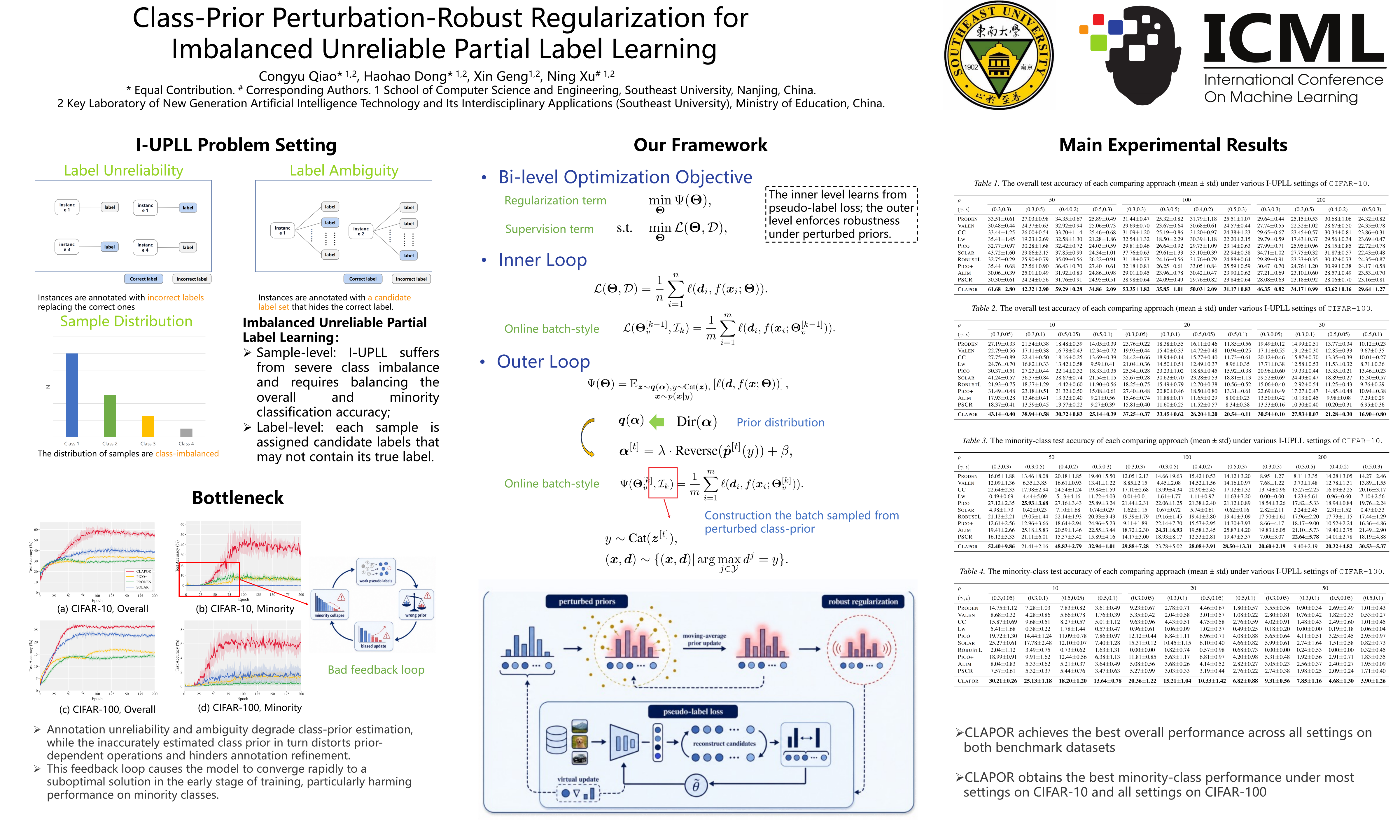
Imbalanced Unreliable Partial Label Learning (I-UPLL) is a challenging weakly supervised learning setting in which severe class imbalance and unreliable candidate labels jointly degrade model performance. By revisiting existing approaches for imbalanced learning, we observe that most of them fundamentally rely on estimating the class prior to guide balancing operations, such as re-sampling, pseudo-label generation, or logit adjustment. However, under I-UPLL, obtaining stable and accurate prior estimates at the early stage of training is often unrealistic due to the ambiguity and unreliability of partial labels, thereby leading the model to rapidly converge to a suboptimal solution. To address this issue, we propose CLAPOR, a novel CLAss-PriOr perturbation-Robust regularization framework that fundamentally avoids dependence on accurate prior estimation. Specifically, the proposed regularization trains the model under deliberately perturbed class priors, sampled from a Dirichlet distribution that deviates from the current estimated prior. This design encourages consistent performance under prior uncertainty and naturally preserves attention to minority classes. Extensive experiments on benchmark datasets demonstrate the effectiveness of CLAPOR across various settings of I-UPLL.
Lay Summary
When teaching computers to recognize images, we often face two real-world problems: some categories have very few examples (like rare diseases in medical imaging), and the provided labels can be unreliable or incomplete. Traditional methods try to first estimate how many examples exist for each category, then use this estimate to balance the learning. However, when labels are unreliable, these estimates become inaccurate, causing the model to quickly learn wrong patterns and perform poorly on rare but important categories. We developed a new approach called CLAPOR that avoids relying on accurate estimates altogether. Instead, we deliberately train the model under many different "what-if" scenarios where we pretend the category distribution is different from what we estimated. Think of it like training a student not just on the expected test questions, but also on many variations—they become robust to unexpected situations. This is achieved by randomly perturbing the category distribution during training using a mathematical tool called Dirichlet sampling. Our method significantly outperforms existing approaches on benchmark datasets, especially for rare categories where improvements can exceed 20 percentage points. This makes it particularly valuable for applications like medical diagnosis or wildlife monitoring, where missing rare but critical cases can have serious consequences.