
DuRP: Dual-Stage Physics-Embedded Learning for Joint Radiance and Polarization Restoration
Abstract
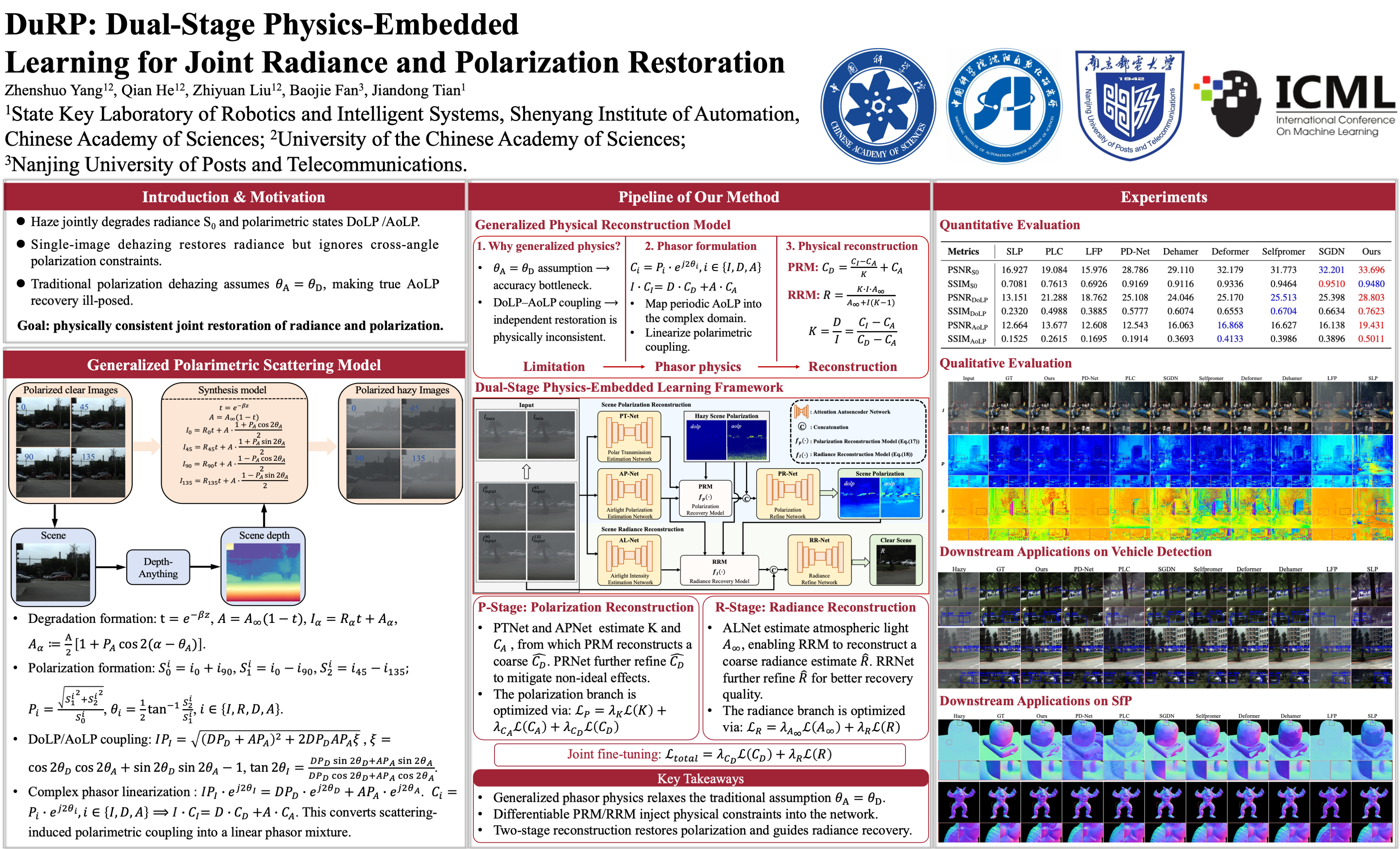
Polarization information is valuable for many computer vision applications. However, in hazy environments, polarization information is severely attenuated due to the degradation of captured polarized images. Existing dehazing methods struggle to effectively restore polarization information, as single-image methods are unaware of polarization, and polarization-based methods are constrained by the traditional polarization models. These deficiencies lead to inaccurate polarimetric signatures and physical inconsistencies in scattering environments. To overcome these limitations, we propose DuRP, a dual-stage physics-embedded learning framework for joint restoration of scene radiance and polarization information. Specifically, we derive generalized polarization physics models that relax the ideal assumptions of traditional theory to provide a more precise foundation for the joint restoration of polarimetric and amplitude information. We then design a dual-stage neural network to estimate latent physical parameters through differentiable operators, ensuring that both the polarimetric state and radiance are accurately recovered. Experimental results show that DuRP achieves state-of-the-art performance in joint restoration and significantly enhances polarization-based vision tasks. Project website: https://DuRP.github.io/
Lay Summary
Many cameras can record not only how bright a scene is, but also how light is oriented, which gives useful clues about materials, vehicles, and 3D shape. In haze or fog, however, scattered light washes out both the image and these polarization clues, making vision systems less reliable. Existing methods for removing haze usually restore only the ordinary image, while methods designed for polarized images often rely on overly simple assumptions that do not match real outdoor scenes. In this paper, we introduce DuRP, a machine-learning system built around formulas that describe how haze degrades a scene’s polarization signals. These formulas account for the fact that the scene’s polarization and the scattered atmospheric light may have different orientations, which earlier simplified models often ignored. DuRP uses this physical description to first recover the degraded polarization cues and then restore a clearer image, keeping both steps consistent with how light behaves in haze. Our experiments show that DuRP restores polarization and image appearance more accurately than prior methods. This improves downstream tasks such as detecting vehicles and estimating 3D surface shape in hazy conditions. By making cameras more reliable in challenging weather, this work can support safer autonomous driving, robotics, and outdoor sensing.