
Select to Think: Unlocking SLM Potential with Local Sufficiency
Abstract
Lay Summary
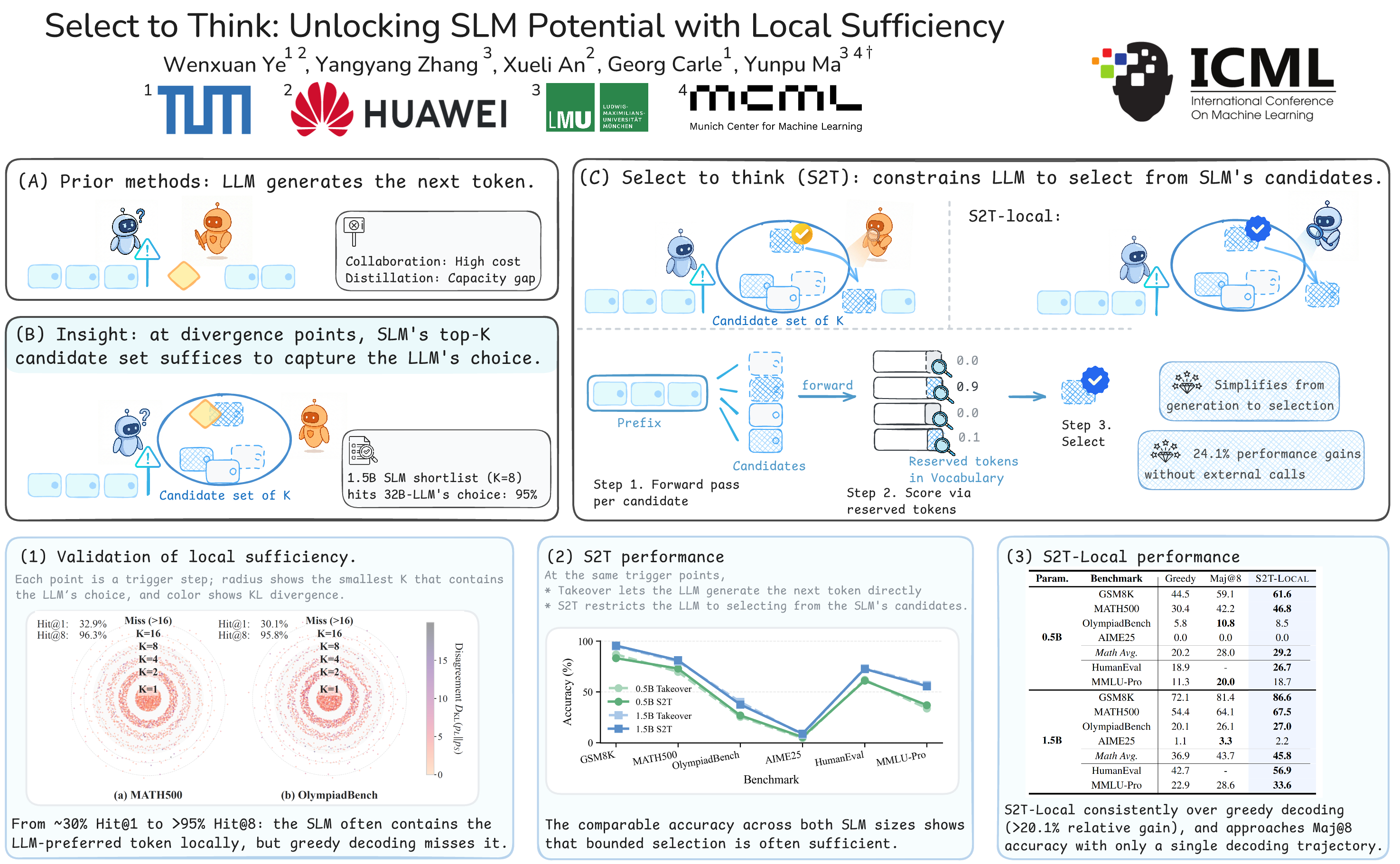
Small language models (SLMs) are attractive for their efficiency, yet they often fall short of the reasoning power of larger language models (LLMs). Existing solutions either ask an LLM for help during inference, making reasoning slower and more expensive, or distill the LLM into the SLM, which can be too demanding due to the capacity gap. Our key finding is local sufficiency: at difficult decision points, LLM’s preferred next step is often already present among the SLM’s top few candidate tokens, even when SLM does not rank it first. In our experiments, the 32B model’s preferred token appears in the 1.5B model’s top-8 candidates 95% of the time. This means that SLM may not need LLM to generate new reasoning tokens; instead, it mainly needs help choosing among options it already considered. Select to Think therefore changes the LLM’s role from generator to selector over the SLM’s own candidates. We then train this selection ability into the SLM, producing S2T-Local, which re-ranks its own candidates without LLM calls at test time. This substantially improves single-trajectory reasoning by an average of 24% relative gains on 1.5B SLM.