
EduMirror: Modeling Educational Social Dynamics with Value-driven Multi-agent Simulation
Abstract
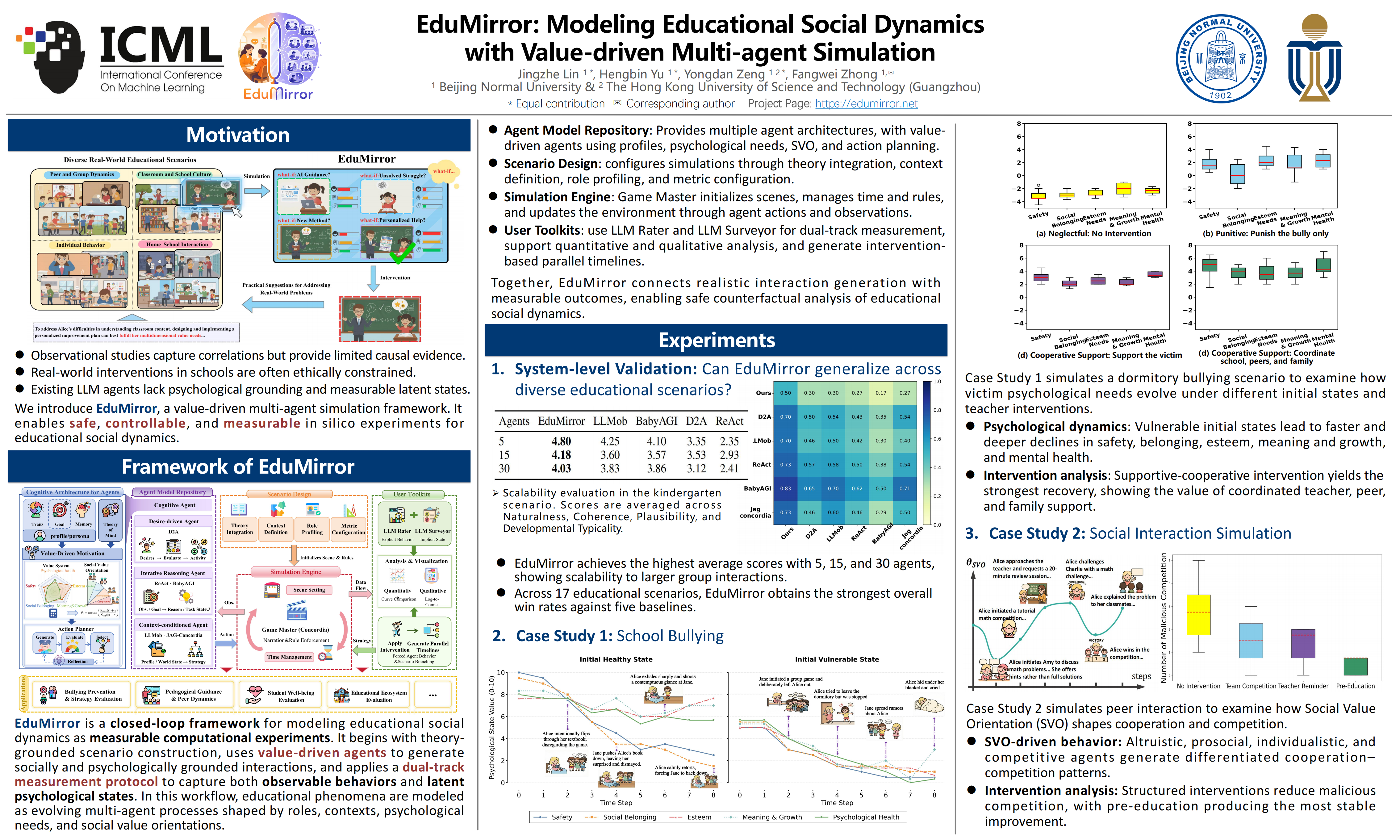
Understanding how educational social dynamics evolve is critical for informing effective educational policies and counterfactual interventions. However, traditional methods face a fundamental dilemma: observational studies often lack causal power, while controlled experiments are frequently constrained by ethical concerns. Although LLM-based multi-agent simulations offer a scalable in silico alternative, existing approaches remain limited by weak psychological grounding and insufficient measurement of latent psychological states. To address this, we introduce EduMirror, a multi-agent simulator for the scientific study of educational social dynamics. We provide configurable education-oriented agent forms, including value-driven agents grounded in psychological needs and social value orientation, together with a dual-track measurement protocol for quantifying observable behaviors and latent psychological states. We validate the realism and usability of EduMirror through case studies on school bullying and group cooperation, as well as broader evaluations across diverse educational scenarios. The results show that EduMirror generates educational social dynamics that are realistic, theory-consistent, and measurable by empirical criteria. These properties enable structured in silico educational research, providing a computational tool for hypothesis testing and counterfactual intervention analysis in educational science. Project page: https://edumirror.net.
Lay Summary
Educational social dynamics shape students’ development through continuous interactions among peers, teachers, and families. However, these dynamics are difficult to study because surveys and observations often capture only correlations, while controlled interventions in real schools can be ethically constrained or practically difficult to conduct. In this paper, we introduce EduMirror, a multi-agent simulator designed to model and analyze educational social dynamics in a safe in silico environment. EduMirror supports theory-grounded educational scenarios and value-driven agents, which generate realistic behaviors while being guided by psychological needs and social value orientation, such as safety, belonging, and self-esteem. EduMirror can also measure both observable behaviors and latent psychological states, allowing researchers to compare different "what if" interventions in the same situation. Through two case studies on school bullying and peer interaction, we evaluate the realism of the simulated social dynamics and demonstrate how EduMirror supports the comparison of different intervention strategies. This work provides a safer way to explore sensitive educational problems before testing ideas in real educational settings. Project page: https://edumirror.net.