
Marrying Generative Model of Healthcare Events with Digital Twin of Social Determinants of Health for Disease Reasoning
Abstract
Lay Summary
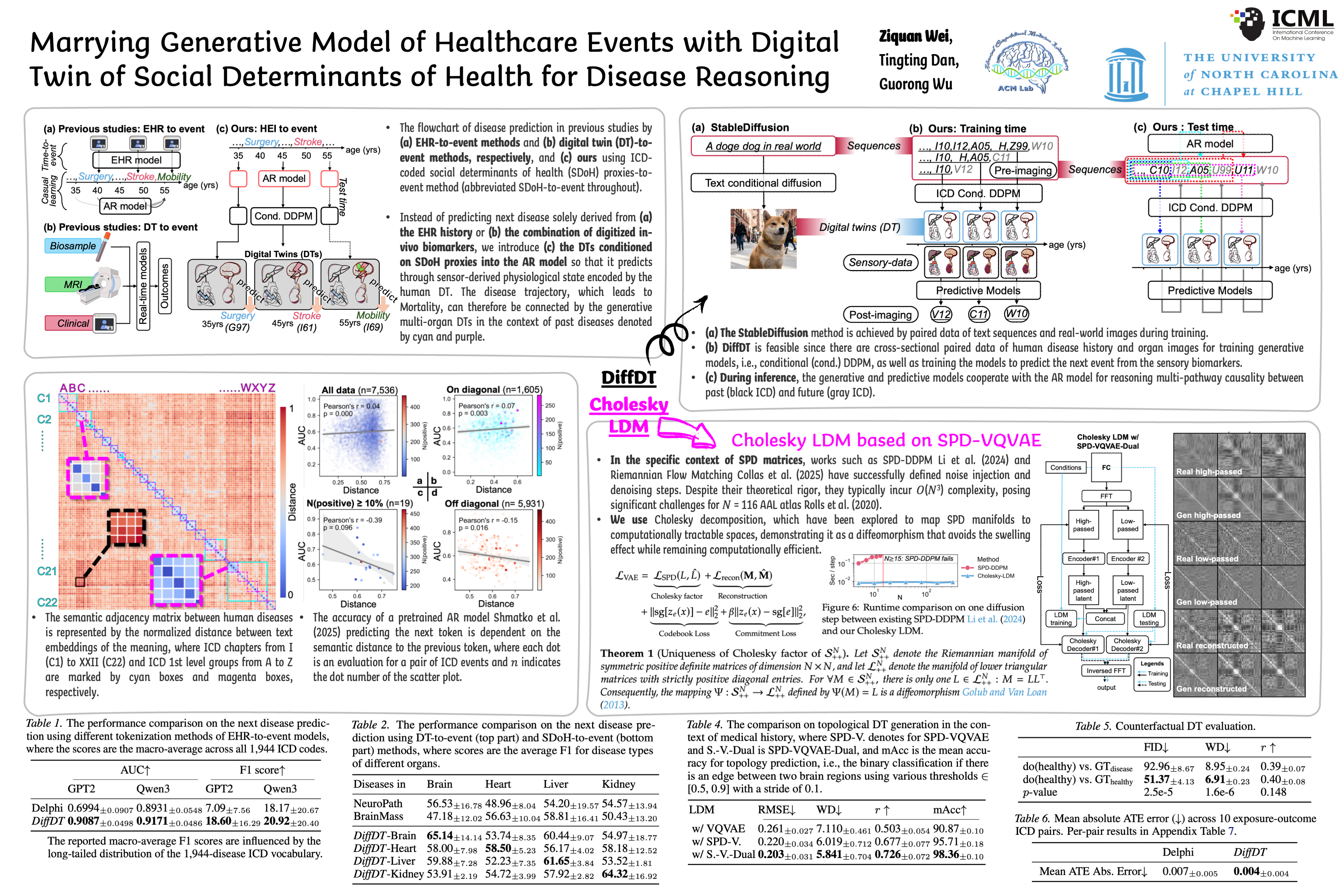
Predicting Future Health Risks by Combining Organ Scans and Social Factors The Problem: Current AI models for predicting disease trajectories mostly rely on basic hospital records. They often ignore crucial organ-specific data (like brain or heart scans) and vital social determinants of health, such as a patient's living environment and economic background. The Solution: We developed DiffDT, a new generative AI framework that combines multi-organ scans (brain, heart, liver, and kidney) with social health factors and medical histories from half a million participants. It uses advanced digital modeling to simulate how complex body networks, like brain connectivity, change over time. The Impact: By successfully mapping these diverse data points together, DiffDT allows doctors to run virtual interventions and accurately forecast a patient's future health. This paves the way for highly personalized medicine and better clinical decision support before diseases progress.