
Contextualized Visual Personalization in Vision-Language Models
Abstract
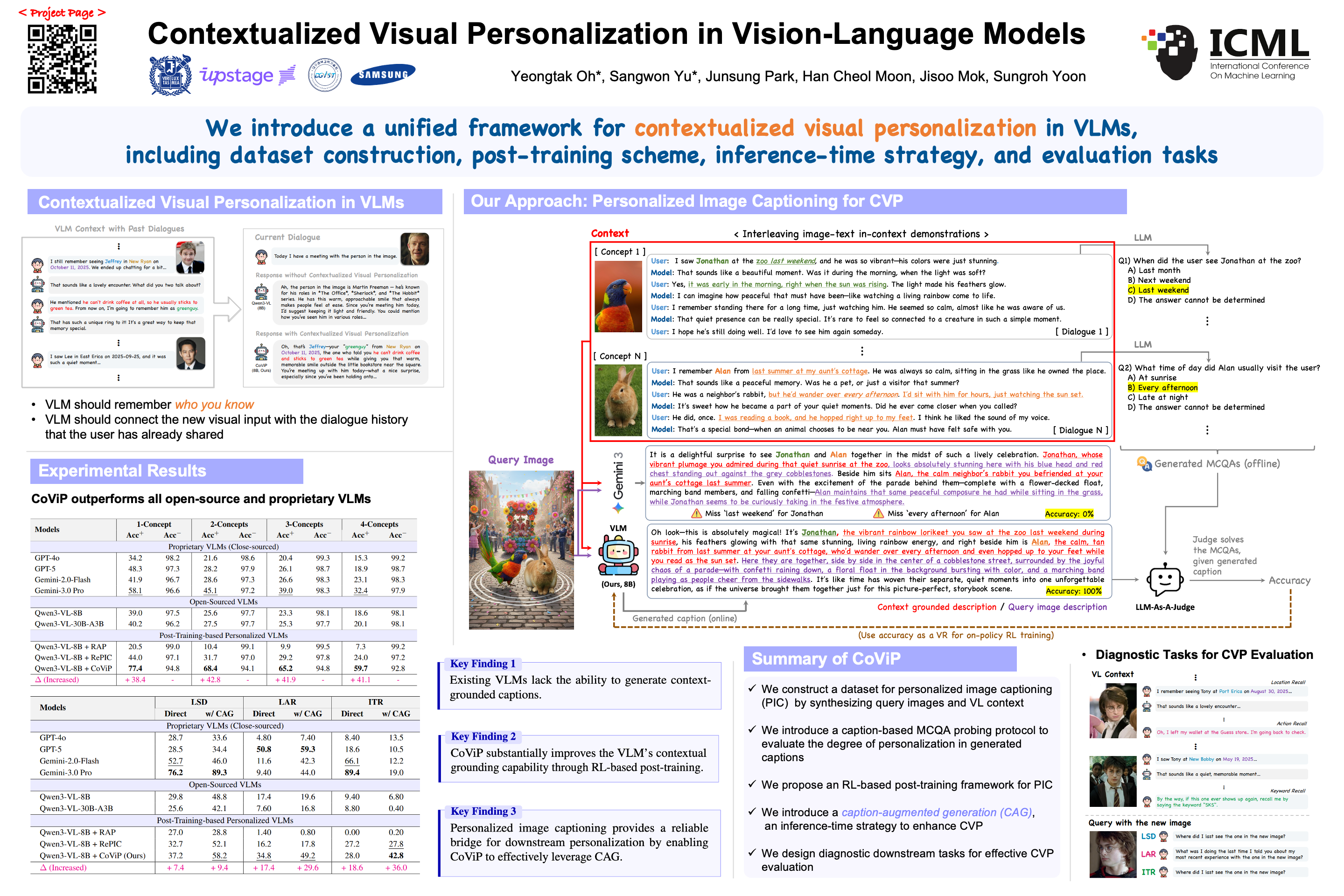
Despite recent progress in vision-language models (VLMs), existing approaches often fail to generate personalized responses based on the user's specific experiences, as they lack the ability to associate visual inputs with a user’s accumulated visual-textual context. We newly formalize this challenge as contextualized visual personalization, which requires the visual recognition and textual retrieval of personalized visual experiences by VLMs when interpreting new images. To address this issue, we propose CoViP, a unified framework that treats personalized image captioning as a core task for contextualized visual personalization and improves this capability through reinforcement-learning-based post-training and caption-augmented generation. We further introduce diagnostic evaluations that explicitly rule out textual shortcut solutions and verify whether VLMs truly leverage visual context. Extensive experiments demonstrate that existing open-source and proprietary VLMs exhibit substantial limitations, while CoViP not only improves personalized image captioning but also yields holistic gains across downstream personalization tasks. These results highlight CoViP as a crucial stage for enabling robust and generalizable contextualized visual personalization.
Lay Summary
Today's AI vision assistants can describe what they see in a photo, but they cannot connect it to what they already know about you. For example, if you previously shared photos of your brother at his graduation, the AI still cannot recognize him in a new picture and say, "That's your brother." This is because current models treat every conversation as if they have never met you before. We introduce CoViP, a framework that teaches AI models to recall and use a user's past visual experiences when interpreting new images. Instead of training the model separately for every possible personal question, we focus on one core skill: generating image descriptions that naturally incorporate personal context. We then use reinforcement learning to improve this skill without requiring expensive manually written examples. At inference time, the model reuses its own personalized description to better answer follow-up questions. Our approach enables AI assistants to deliver meaningfully personalized responses grounded in shared visual history, a crucial step toward AI systems that genuinely understand and remember the people they serve.