
Bounded Hyperbolic Tangent: A Stable and Efficient Alternative to Pre-Layer Normalization in Large Language Models
Abstract
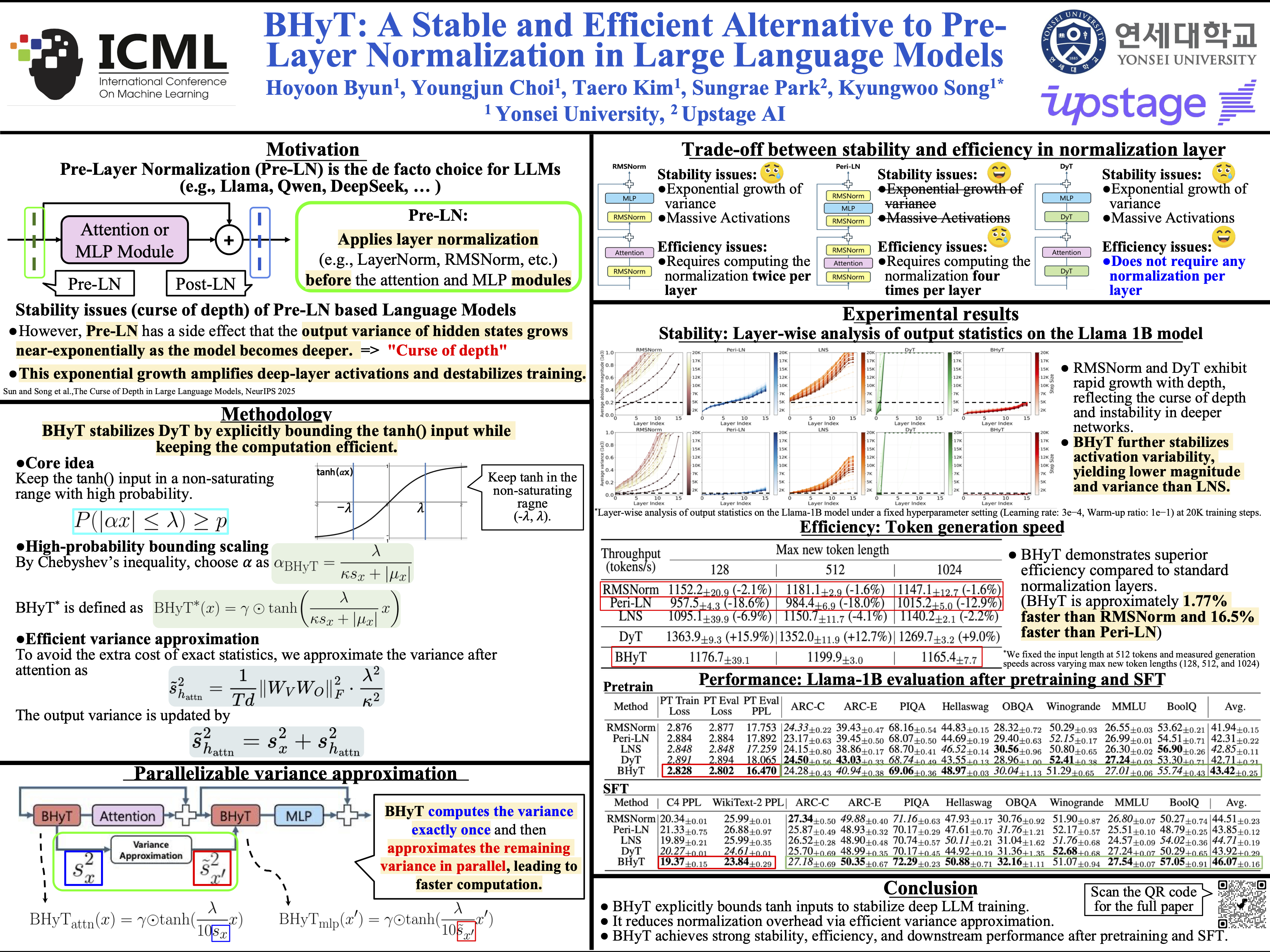
Pre-Layer Normalization (Pre-LN) is the de facto choice for large language models (LLMs) and is crucial for stable pretraining and effective transfer learning. However, Pre-LN incurs repeated statistical-computation overhead and remains vulnerable to the curse of depth, where hidden-state magnitudes and variances grow as the number of layers increases, destabilizing training. Efficiency-oriented normalization-free methods such as Dynamic Tanh (DyT) improve throughput but remain fragile at depth. To jointly address stability and efficiency, we propose Bounded Hyperbolic Tanh (BHyT), a drop-in replacement for Pre-LN. BHyT combines a tanh nonlinearity with explicit, data-driven input bounding to keep activations within a non-saturating range. It prevents depth-wise growth in activation magnitude and variance and provides a theoretical stability guarantee. For efficiency, BHyT computes exact statistics once per block and replaces a second normalization with a lightweight variance approximation. Empirically, BHyT demonstrates improved stability and efficiency during pretraining, achieving an average of 1.6\% faster training and an average of 1.77\% higher token generation throughput compared to RMSNorm, while maintaining strong pretraining-only and post-SFT performance across language understanding and reasoning benchmarks\footnote{Code is available at: \url{https://github.com/MLAI-Yonsei/BHyT}}.
Lay Summary
Large language models are powerful, but they are costly and difficult to train because their internal signals can grow unstable as models become deeper. We introduces BHyT, a simple replacement for a common stabilization step used in these models. BHyT works like a guardrail: it keeps internal signals within a safe range while avoiding some repeated calculations. Across several model sizes, BHyT makes training and text generation faster than standard methods while maintaining strong language understanding performance. This suggests a practical path toward building large language models that are both more stable and more efficient.