
LittleBit-2: Maximizing the Spectral Energy Gain in Sub-1-Bit LLMs via Latent Geometry Alignment
Abstract
Lay Summary
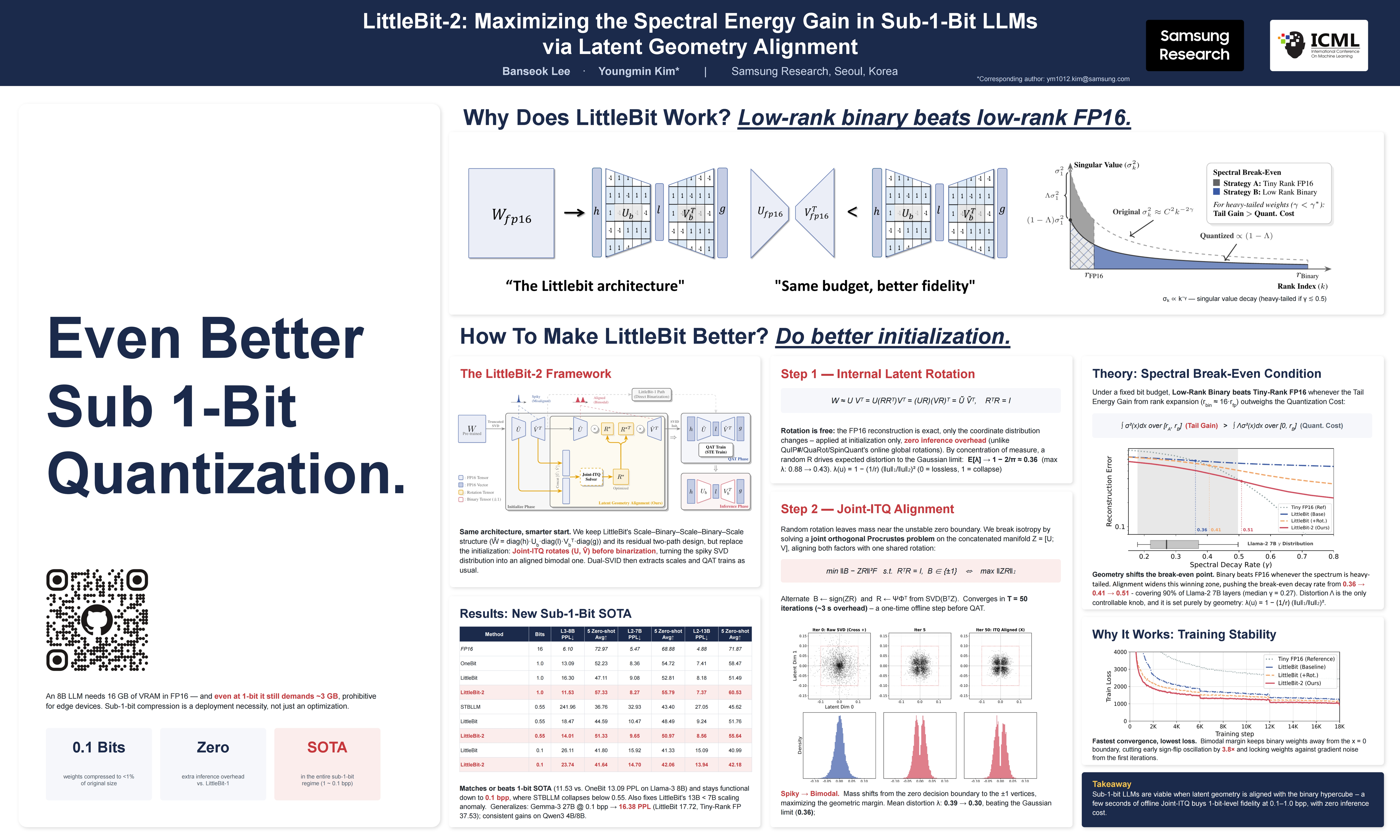
Modern AI language models are extraordinarily capable, but they are also enormous, often too large to fit on a phone or laptop. Making them smaller usually means storing each internal number using fewer "bits" of information, and the most aggressive methods shrink each number down to a single bit. Our work pushes even further, into the "less-than-one-bit" range, so that large models can run on memory-limited devices. The difficulty is that squeezing this hard normally ruins the model's accuracy. We found that the problem is largely geometric: when the internal information is rounded to single bits, it sits in an awkward orientation that causes large errors. Our method, LittleBit-2, rotates this information into a friendlier arrangement before compressing it, like turning a key so it fits the lock. This rotation is computed once in advance and adds no cost while the model is running. The result is a new state of the art for extreme compression: our tiny models match the accuracy of much larger one-bit models, helping bring powerful AI to devices where it previously could not run.