
A Cartesian-3j Framework for Machine Learning Interatomic Potentials
Abstract
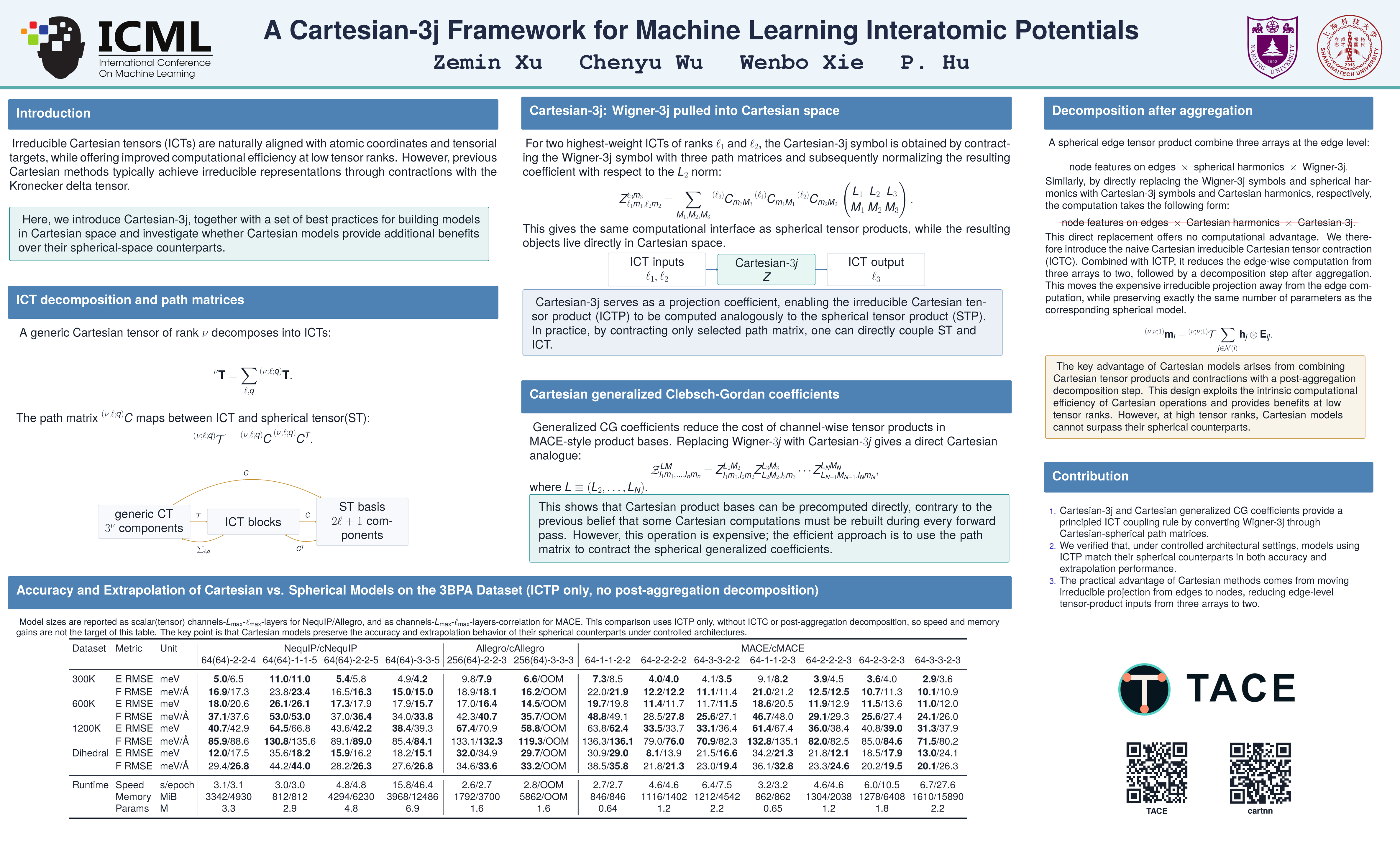
Machine learning interatomic potentials (MLIPs) have brought substantial gains in the extrapolation capability in computational chemistry. However, most equivariant models are typically built with spherical tensors (STs), while Cartesian tensor formulations remain less developed despite their natural alignment with atomic coordinates and tensorial targets. In this work, we develop a Cartesian framework for irreducible Cartesian tensors (ICTs) by introduce the Cartesian-3j symbol and Cartesian Generalized Clebsch-Gordan Coefficients, which serve as direct analogues of the Wigner-3j symbol and Generalized Clebsch-Gordan coefficients defined for ST coupling. We extend the e3nn library to support ICT product, and use this framework to build Cartesian counterparts of MACE, NequIP, and Allegro, allowing the first controlled comparison where architectures are held fixed and only the tensor basis is changed. Our experiments show that irreducible Cartesian models can achieve accuracy comparable to spherical counterparts, but direct Cartesianization incurs unfavorable compute and memory scaling, motivating dedicated Cartesian architectural choices. Leveraging ICTs and our framework, we introduce TACE-v1-OAM-M and demonstrate that it achieves competitive performance on Matbench Discovery compared to state-of-the-art ST models.
Lay Summary
Theoretical simulations are essential for understanding molecules and materials, but highly accurate first-principles calculations are often too slow for large systems. Machine-learning models can speed up these simulations by learning how atoms interact and predicting quantities such as energies and forces. Many current models use sphere-based mathematical descriptions, because they make it easier to handle rotations in three-dimensional space: energies should not depend on how a molecule or material is oriented, and forces should rotate consistently with it. At the same time, atomic positions and many physical quantities are naturally written in ordinary Cartesian coordinates, the familiar x, y, and z directions. Some recent atomistic machine-learning models have begun to use Cartesian-based representations, but it has remained unclear how well these representations perform in a fair comparison with the standard sphere-based approach, and what practical trade-offs they introduce. This paper develops new tools for building atomistic machine-learning models with Cartesian representations and compares them under matched model and training settings. We find that Cartesian models can reach similar accuracy, but they are not automatically more efficient and require designs tailored to their strengths and limitations. Overall, this work provides practical tools and guidance for when Cartesian representations are useful in molecular and materials simulations.