
Rethinking Feature Alignment in Generalist Graph Anomaly Detection: A Relational Fingerprint-based Approach
Abstract
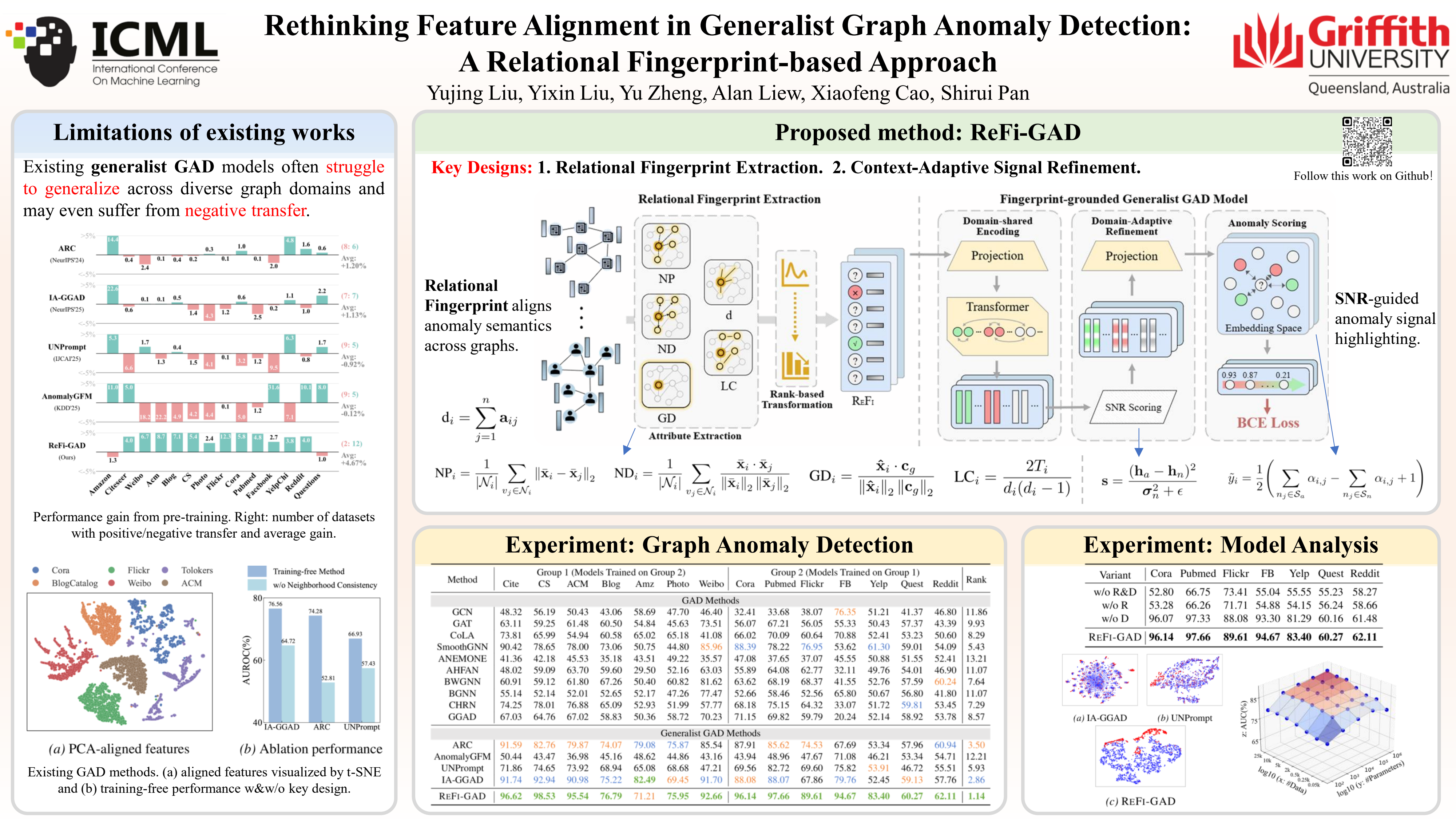
Extending traditional graph anomaly detection (GAD) from one-for-one to one-for-all paradigms, generalist GAD aims to learn a universal detector for identifying anomalies on unseen graphs without graph-specific retraining. Nevertheless, existing approaches primarily focus on aligning heterogeneous features across different data domains via PCA-based projection, which harmonizes feature dimensions but neglects semantic alignment. As a result, GAD models fail to acquire semantically transferable knowledge from source-domain pre-training, and even exhibit negative transfer on unseen graphs. To address this issue, we propose a Relational Fingerprint-based generalist GAD approach (REFI-GAD for short), aligning heterogeneous raw features with a universal and semantics-aware relational fingerprint (REFI) that encodes anomaly-indicative cues from both contextual and structural perspectives. Building on REFI, we design a fingerprint-grounded generalist GAD model, which combines a transformer-based encoder to capture domain-invariant knowledge with an SNR-guided refinement module for domain-specific adaptation. Extensive experiments on 14 datasets demonstrate that REFI-GAD significantly outperforms state-of-the-art methods.
Lay Summary
Generalist graph anomaly detection aims to identify unusual or suspicious nodes in unseen graph datasets without retraining a model. However, existing methods often struggle because graph datasets can have very different types of features and structures. In this work, we propose REFI-GAD, a new framework that converts diverse graph data into a unified relational representation that captures common anomaly patterns. This enables the model to generalize more effectively across different graph domains while adapting to dataset-specific characteristics. Experiments on 14 datasets show that REFI-GAD consistently achieves better cross-domain anomaly detection performance than existing methods.