
View Space: Learning Representation across Arbitrary Graphs
Abstract
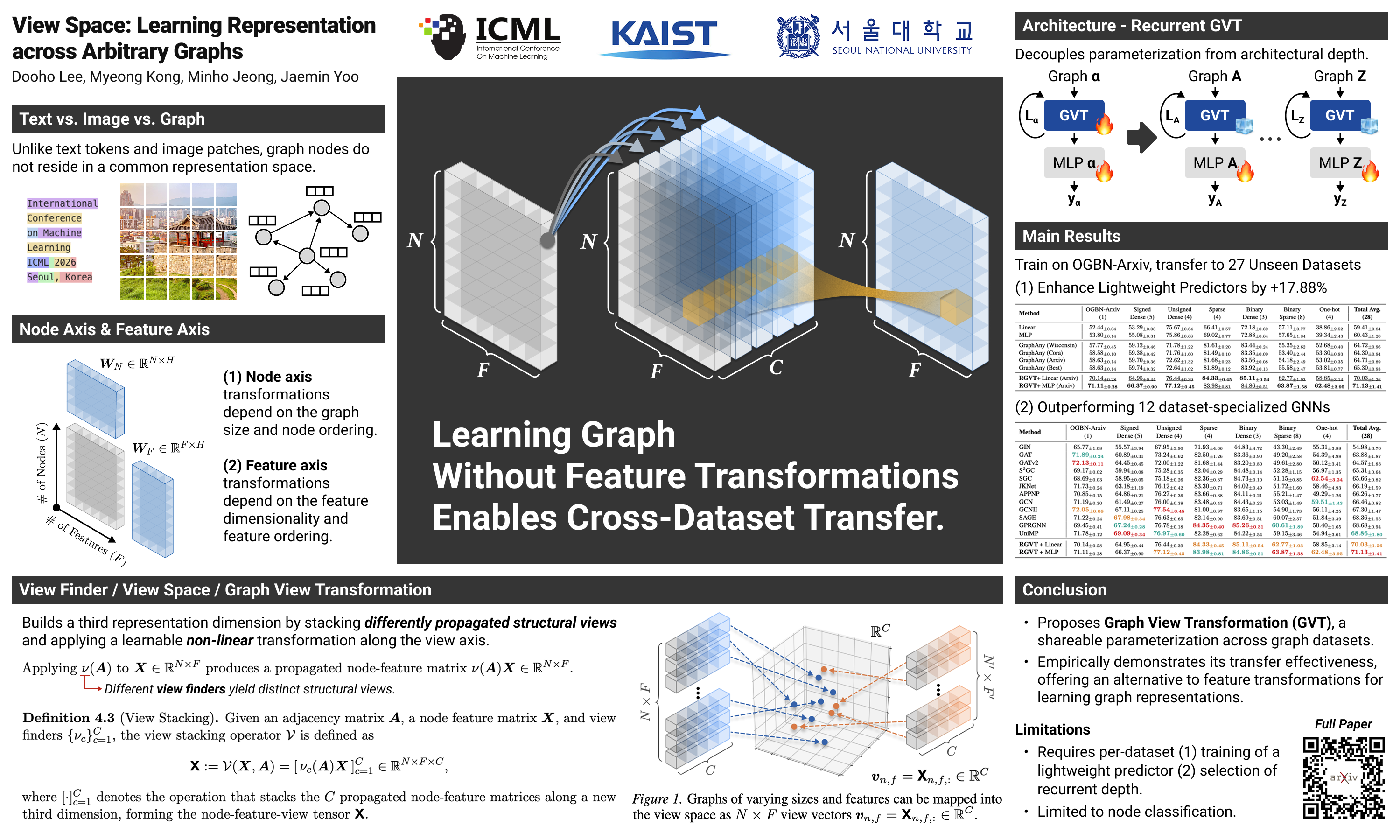
Generalizing pretrained models to unseen datasets without retraining is a central challenge toward foundation models. Achieving fully inductive inference on numerical data is particularly difficult due to large variations in feature dimensionality and semantics across datasets. We observe that, in the presence of graph structure, numerical data admits a distinct structure-induced representational axis beyond the feature space, which we formalize as the view space. This view space enables a unified representation of graphs with heterogeneous features and motivates Graph View Transformation (GVT), a class of parametric mappings that can be shared across arbitrary graphs. We instantiate this framework with Recurrent GVT, an architecture for fully inductive node representation learning in node classification. Pretrained on OGBN-Arxiv and evaluated on 27 benchmarks, Recurrent GVT outperforms GraphAny, the prior fully inductive graph model, by +8.93%, and surpasses 12 individually tuned GNNs by at least +3.30%. These results establish the view space as a principled and practical foundation for learning across graphs with heterogeneous feature spaces. Code and checkpoints are available in https://github.com/dooho00/graph-view-space.
Lay Summary
AI models often require retraining for each new dataset, particularly when feature dimensions and semantic meanings vary substantially across domains. In this work, we show that graph-structured datasets share a common structural representation space beyond node features, which we term the view space. This shared view space enables the learning of a transferable Graph View Transformation (GVT) across heterogeneous graph datasets. Building on this insight, we develop Recurrent GVT (RGVT), a model that can be pretrained once and subsequently applied to arbitrary unseen graph datasets without retraining the representation model itself. Across 27 unseen graph datasets, RGVT substantially outperforms existing cross-dataset graph learning methods and even surpasses many graph neural networks that are individually trained and tuned for each dataset. These results suggest that view-space learning provides a practical foundation for developing generalizable and reusable AI systems for graph-structured data.