
Glimpse: Geometry Learning of Multi-scale Structural Priors for 3D Pose Estimation
Abstract
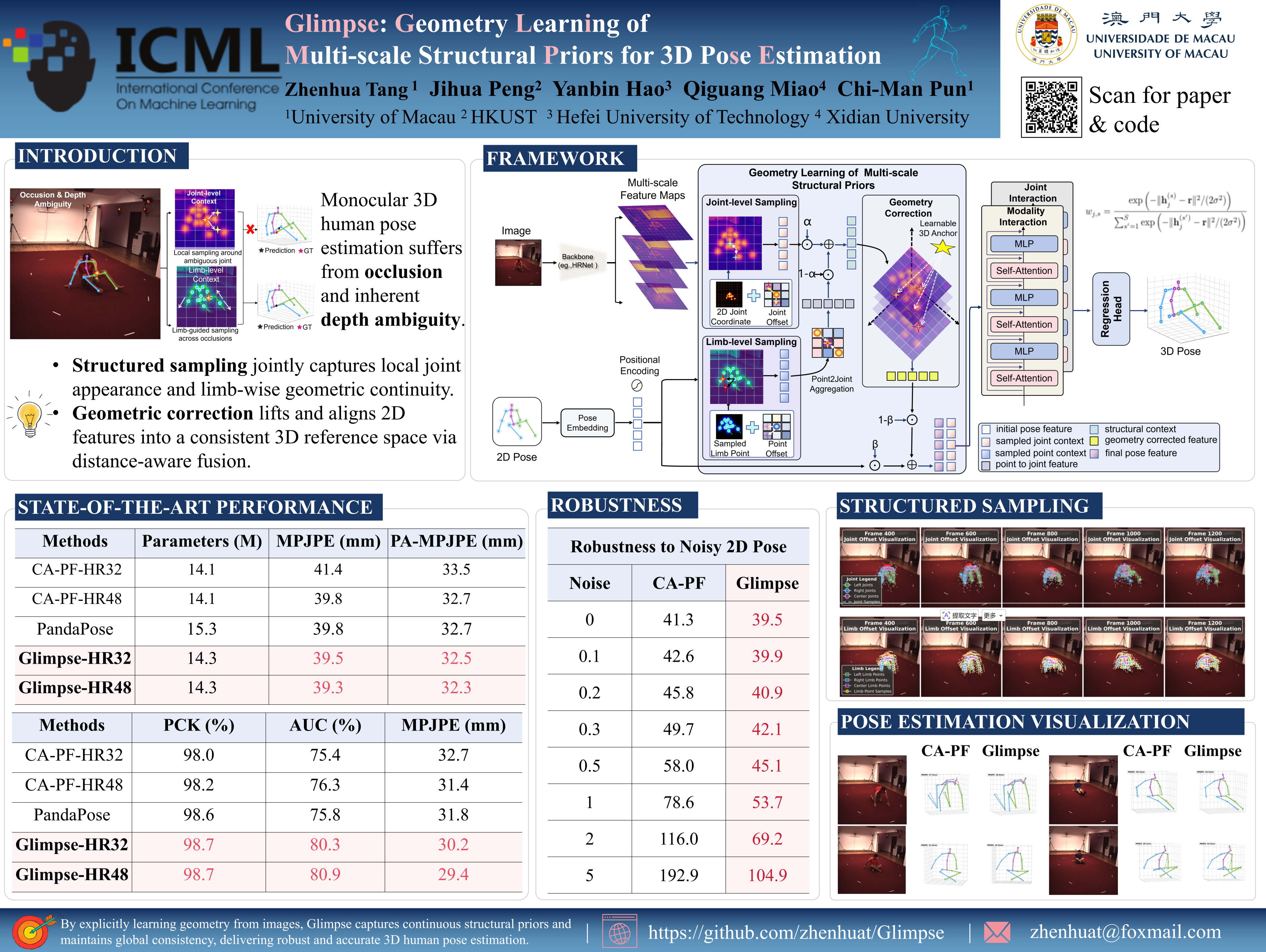
Monocular 3D human pose estimation is fundamentally challenged by severe occlusion and inherent depth ambiguity. To address this, we propose Glimpse, a framework that learns robust 3D poses by explicitly modeling anatomical geometry from a single image. We recast the problem as geometry learning of multi-scale structural priors, realized through two synergistic components. First, structured sampling captures the body's geometric continuity through dual-level feature extraction, acquiring both local joint appearance and continuous features along skeletal limbs via deformable sampling. By propagating limb-level geometric cues to their connected joints, this design bridges information gaps caused by occlusion. Second, geometric correction ensures global 3D consistency by lifting coherent 2D features into a canonical 3D reference space, where a shared 3D anchor guides a distance-aware fusion mechanism. Extensive experiments conducted on Human3.6M and MPI-INF-3DHP demonstrate that Glimpse achieves state-of-the-art performance, with superior robustness under severe occlusion and complex articulation.
Lay Summary
Estimating a person's 3D pose from a single photo is challenging because flat images lack depth information, and body parts often block each other from view. We introduce Glimpse, a method that learns to reconstruct 3D human poses by understanding the body's natural structure. Rather than looking at body joints in isolation, Glimpse traces along the limbs to capture how body parts connect and move together. It also uses a shared 3D reference to ensure the predicted pose is globally consistent, not just locally plausible. Together, these ideas allow Glimpse to accurately predict 3D poses even when some joints are hidden or when the 2D joint locations are imprecise. Experiments show that Glimpse outperforms existing single-image methods and is more robust to occlusion and noisy inputs. The code is publicly available.