
PhysHanDI: Physics-Based Reconstruction of Hand-Deformable Object Interactions
Abstract
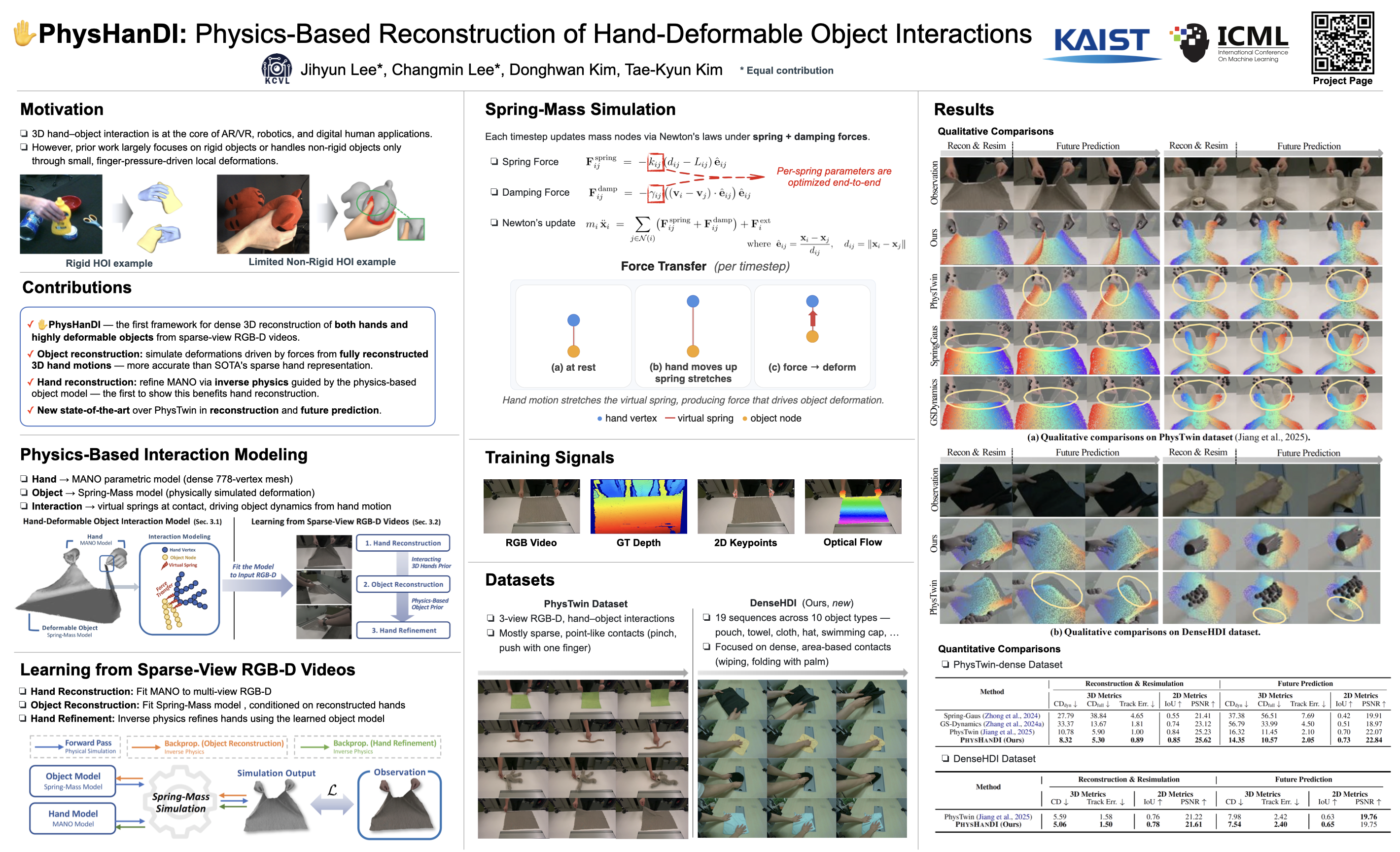
While existing methods for reconstructing hand–object interactions have made impressive progress, they either focus on rigid or part-wise rigid objects—limiting their ability to model real-world objects (e.g., cloth, stuffed animals) that exhibit highly non-rigid deformations—or model deformable objects without full 3D hand reconstruction. To bridge this gap, we present PhysHanDI (Physics-based Reconstruction of Hand and Deformable Object Interactions), a framework that enables full 3D reconstruction of both interacting hands and non-rigid objects. Our key idea is to physically simulate object deformations driven by forces induced from densely reconstructed 3D hand motions, ensuring that the reconstructed object dynamics are both physically plausible and coherent with the interacting hand movements. Furthermore, we demonstrate that such simulation of object deformations can, in turn, refine and improve hand reconstruction via inverse physics. In experiments, PhysHanDI outperforms the state-of-the-art baseline across reconstruction and future prediction.
Lay Summary
We use our hands every day to handle not only rigid objects like phones, but also soft items that bend or squish—clothes, towels, stuffed animals. For computers to understand human actions in 3D, they must capture these interactions, yet most existing methods only handle rigid objects. We developed PhysHanDI, which reconstructs both the moving hand and the deforming object in 3D from just a few camera views. Once we recover a detailed 3D hand model, we apply physical forces from the hand's motion onto the object so it bends and stretches according to the laws of physics. We further show that this simulation can run in reverse—using the deforming object to refine the hand pose itself. Our system reconstructs these interactions more accurately than prior work and can even predict how an object will deform under future hand movements, opening new possibilities for immersive VR, robot learning from human demonstrations, and remote robotic manipulation.