
Small Agent Group is the Future of Digital Health
Abstract
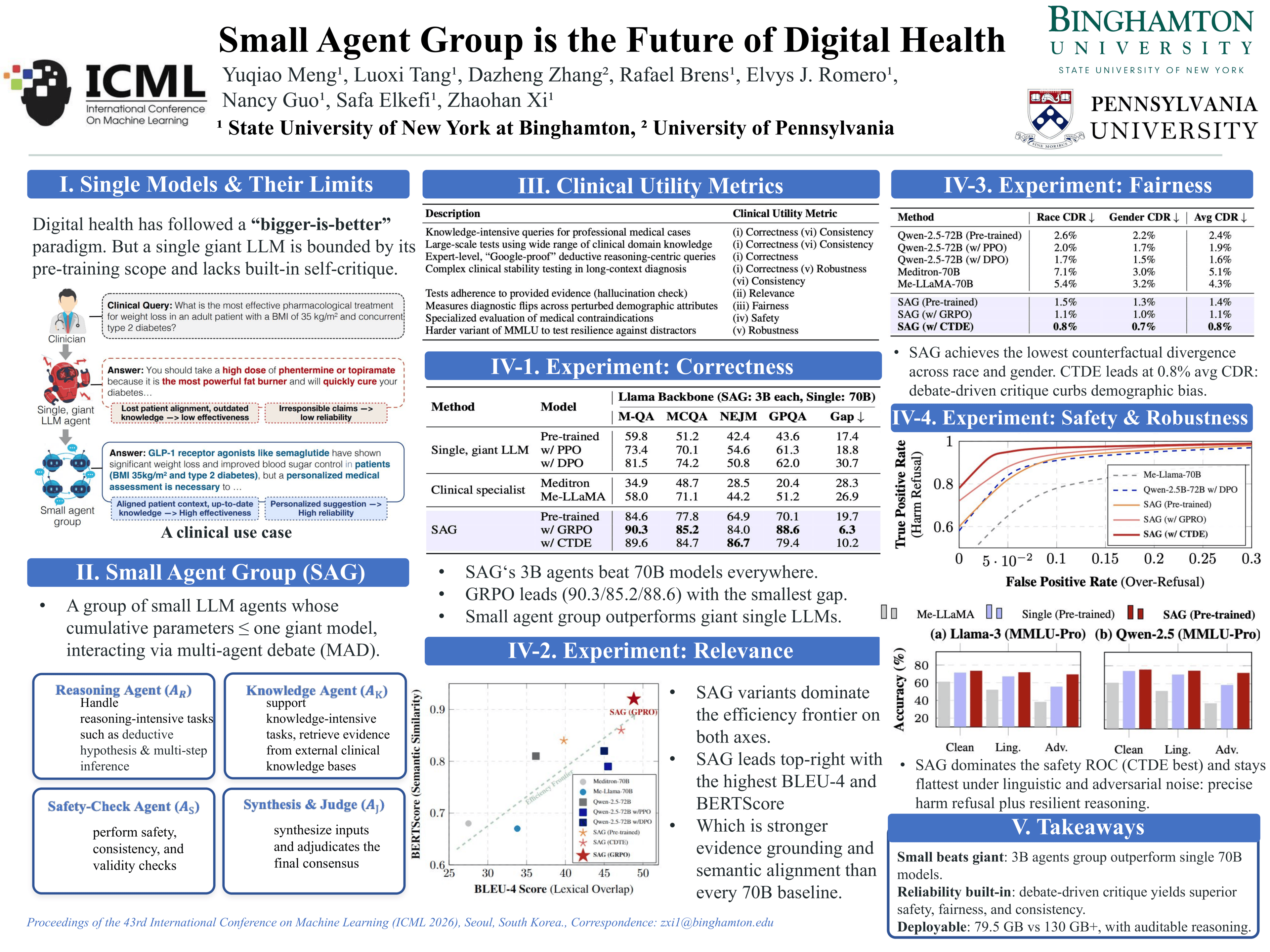
The rapid adoption of large language models (LLMs) in digital health has been driven by a "scaling-first" philosophy, i.e., the assumption that clinical intelligence increases with model size and data. However, real-world clinical needs include not only effectiveness, but also reliability and reasonable deployment cost. Since clinical decision-making is inherently collaborative, we challenge the monolithic scaling paradigm and ask whether a Small Agent Group (SAG) can support better clinical reasoning. SAG shifts from single-model intelligence to collective expertise by distributing reasoning, evidence-based analysis, and critical audit through a collaborative deliberation process. To assess the clinical utility of SAG, we conduct extensive evaluations using diverse clinical metrics spanning effectiveness, reliability, and deployment cost. Our results show that SAG achieves superior performance compared to a single giant model, both with and without additional optimization or retrieval-augmented generation. These findings suggest that the synergistic reasoning represented by SAG can substitute for model parameter growth in clinical settings. Overall, SAG offers a scalable solution to digital health that better balances effectiveness, reliability, and deployment efficiency.
Lay Summary
When AI is used to help with medical decisions, the common approach today is to build one enormous model, trained on huge amounts of data, and hope that bigger means smarter. But real hospitals need more than just smart answers. They need answers they can trust, answers that don't change unpredictably, and systems they can actually afford to run on their own computers without sending sensitive patient data to the cloud. In real medicine, doctors don't work alone. A complex case usually involves a team: someone reasons through the symptoms, someone looks up the latest guidelines, someone double-checks for safety risks, and someone makes the final call. We asked a simple question: what if AI worked the same way? This paper introduces a "Small Agent Group" (SAG), where several small AI models, each with a specific job, talk to each other, challenge each other's thinking, and reach a decision together. The total size of the group is no larger than a single giant model, but the way they collaborate changes everything. Across many medical tests, this small team approach beat much larger single models. It gave more accurate answers, made fewer unsafe recommendations, treated patients of different backgrounds more equally, and produced more stable results when the same question was asked twice. It also runs on more modest hardware, making it more practical for everyday hospitals and smaller clinics. Our findings suggest that the future of medical AI may not depend on building ever-larger models, but on building smarter teams of smaller ones, much like the human care teams they are meant to support.