
IACW: Intent-Aware Controllable Watermarking for Scalable Authorial Intent Attribution
Abstract
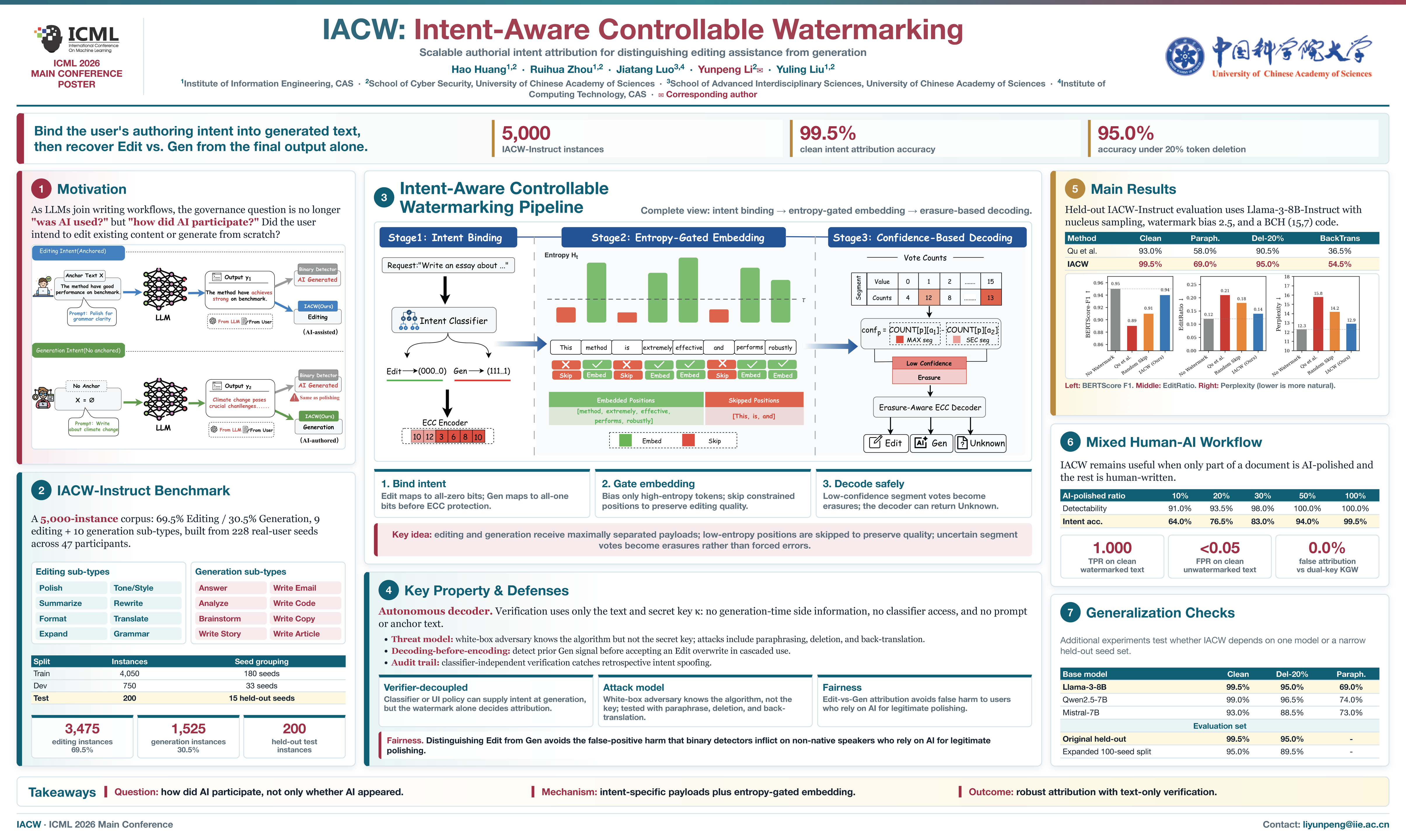
As Large Language Models (LLMs) integrate into writing workflows, precise governance requires distinguishing ''how AI participated'' rather than merely ''whether AI was used.'' Traditional binary detection often misclassifies ``AI-polished'' content as generated, creating fairness risks. We propose shifting from passive post-hoc detection to active intent attribution, focusing on the distinction between Editing (source-anchored) and Generation (unanchored). We introduce \textbf{IACW-Instruct}, a corpus of diverse editing operations constructed via a Director--Actor--Judge pipeline to enable systematic evaluation. Building on this benchmark, we propose \textbf{Intent-Aware Controllable Watermarking (IACW)}, featuring intent-adaptive entropy gating for semantically lossless embedding. Experiments show that IACW achieves 95\% attribution accuracy under 20\% token deletion while preserving near-unwatermarked semantic fidelity, establishing a practical paradigm for fine-grained provenance.
Lay Summary
As AI writing tools become common, the simple question “was AI used?” is often not enough. A person may ask AI to polish an existing draft, which preserves the person’s ideas and structure, or ask AI to write new text from scratch. Treating both cases as the same can be unfair, especially for people who use AI mainly to improve clarity or language. This paper studies how to record this difference directly when an AI system produces text. We build a dataset of writing requests that separates editing from generation, and we introduce IACW, a method that adds a hidden but recoverable signal to the AI output indicating which kind of help was used. The signal is added carefully so that edited text keeps its original meaning and quality. Our experiments show that this signal can usually be recovered even after some parts of the text are changed or deleted. This can support more transparent and nuanced tools for understanding how text was created, while such tools should be used as supporting evidence rather than absolute proof of authorship.