
Bridging Dynamics and Data: A Unified Diffusion Framework for Mechanistically-Informed Epidemic Forecasting
Abstract
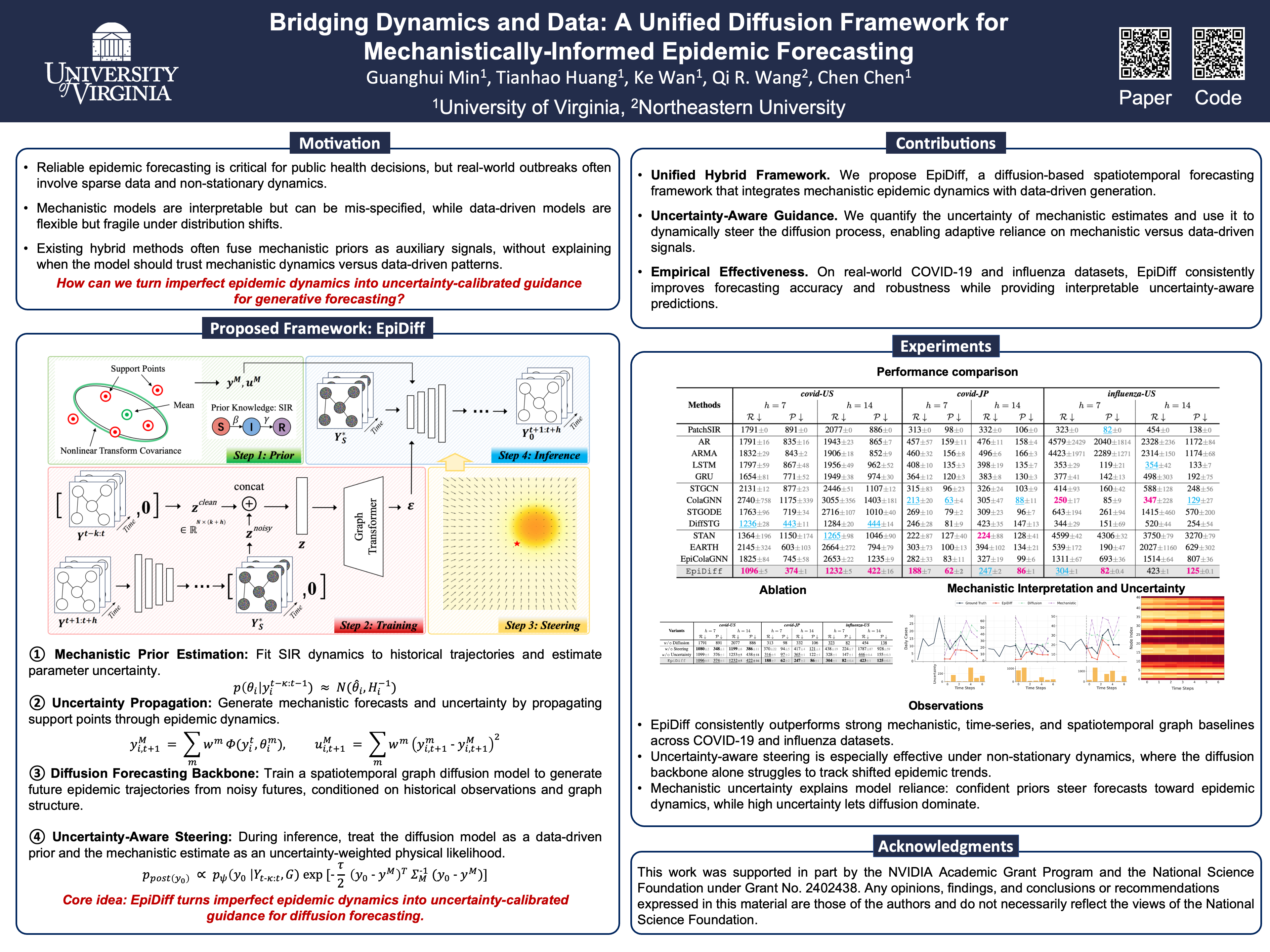
Reliable epidemic forecasting is critical for public health decision-making yet remains challenging due to data sparsity and the non-stationary nature of disease dynamics. While recent hybrid models attempt to integrate mechanistic principles with data-driven approaches, they often relegate mechanistic priors to merely auxiliary features or regularization terms. This design not only obscures the interpretability of the mechanistic contribution but also fails to inherit the capability of physical models to generalize under non-stationary dynamics, as the core architecture remains predominantly data-driven. To address these limitations, we propose EpiDiff, a unified framework that synergizes epidemiological domain knowledge with the generative power of diffusion models. Unlike methods that rigidly fuse features, EpiDiff employs a novel uncertainty-aware steering mechanism during inference. Specifically, we quantify the posterior uncertainty of mechanistic estimations and use it to dynamically modulate the diffusion process. Extensive experiments on real-world datasets demonstrate that EpiDiff consistently outperforms state-of-the-art baselines in accuracy and robustness, particularly under non-stationary distributions, while offering transparent insights into model reliance by explicitly visualizing when the forecast is governed by mechanistic laws versus data-driven patterns.
Lay Summary
Epidemic forecasting is difficult because disease patterns can change quickly and reported data are often noisy or incomplete. Purely data-driven models may fail when future outbreaks look different from the past, while traditional epidemic models are easier to interpret but often too simple to match real-world patterns. We propose EpiDiff, a forecasting method that combines both strengths. It uses an epidemic model to provide a rough, interpretable forecast and estimates how uncertain that forecast is. A modern generative model then uses this information as soft guidance: it follows the epidemic model more when it is confident, and relies more on data-driven patterns when the epidemic model is uncertain. Across COVID-19 and influenza datasets, EpiDiff produces more accurate and robust forecasts than strong existing methods. It also helps show when predictions are driven more by epidemic knowledge or by learned data patterns, which can make forecasts more useful for public health planning.