
CHESS: Chebyshev Spectral Synthesis for Trajectory Condensation
Ruituo Wu ⋅ Hongyu Zhang ⋅ Qiang Wang ⋅ Jiawei Du ⋅ Wei Cui ⋅ Ce Zhu ⋅ Bing Li
Abstract
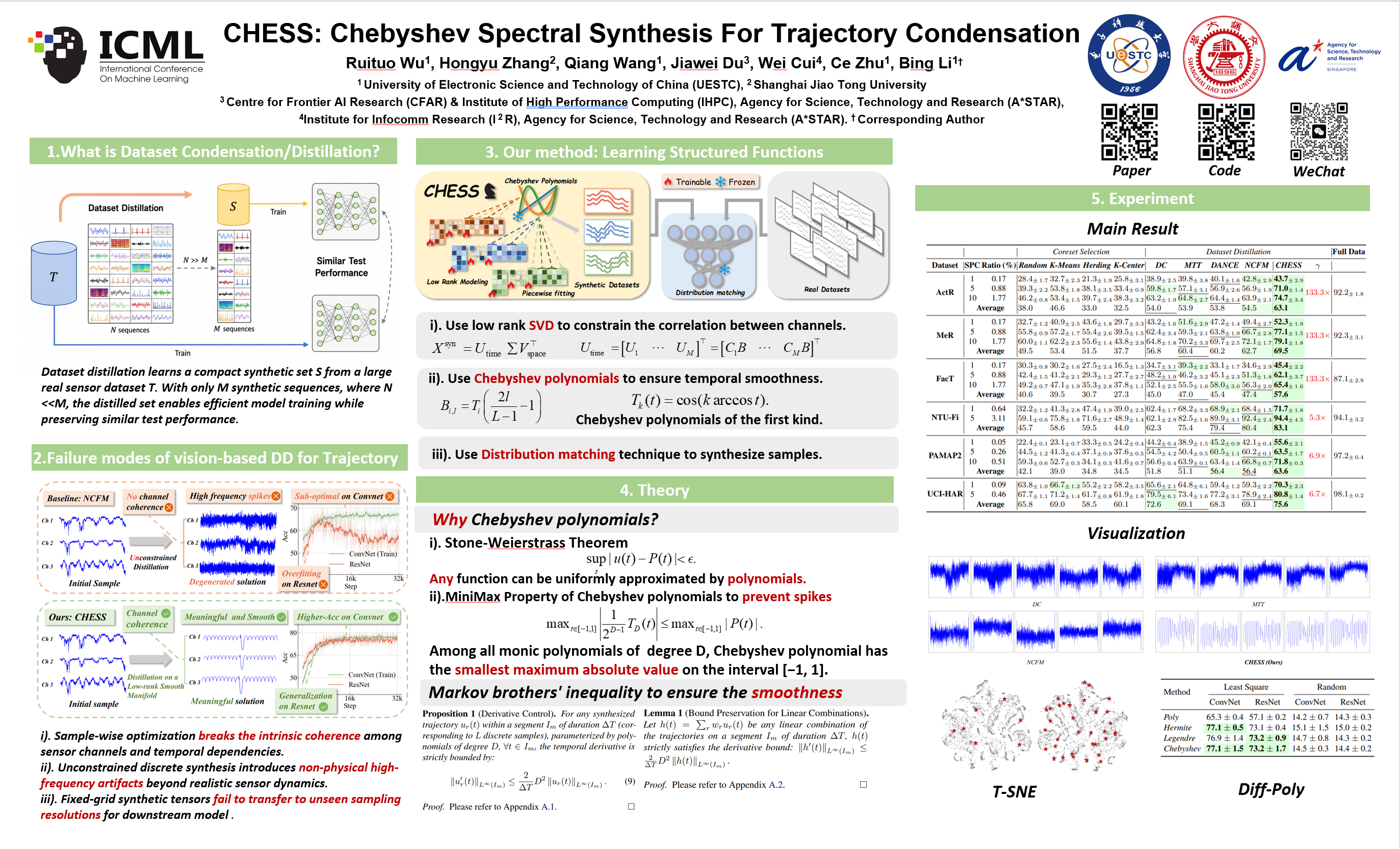
Learning from continuous-time trajectories requires modeling multivariate sensor measurements generated by underlying physical or dynamical processes. Under extreme data compression and heterogeneous sampling, directly optimizing synthetic signals as discrete sample values becomes fundamentally misaligned with the underlining \emph{continuous-time physical processes}, often producing high-frequency, non-physical artifacts that overfit specific models and break reuse across architectures and sampling rates. We propose CHESS, a \emph{function-first} synthesis framework shifts optimization from discrete samples to underlying continuous-time signal trajectories. CHESS injects physics-induced structure by jointly enforcing low-rank spatial coherence and piecewise Chebyshev polynomial temporal parameterization, constraining synthesis to a physically meaningful function manifold. We provide theoretical analysis establishing explicit smoothness and stability guaranties. Experiments on diverse sensor testbeds under the dataset distillation protocol demonstrate CHESS consistently outperform state-of-the-art methods with a compression ratios up to $133\times$ for each synthetic sample. Furthermore, CHESS exhibits strong cross-architecture generalization and enables zero-shot adaptation across different sampling resolutions.
Lay Summary
Modern AI models that analyze sensor data, such as WiFi signals tracking human activity or wearables monitoring movement, typically require large training datasets that are costly to collect, store, and transmit, especially on small devices. Dataset distillation aims to shrink such datasets into a handful of synthetic samples, but existing methods were designed for images and treat each time step of a sensor signal as an independent pixel to be tuned. This clashes with the nature of sensor data, which arises from smooth, continuous physical processes: optimizing point by point yields jagged, spiky fake signals that bear little resemblance to real measurements and fail to transfer across AI models. We propose CHESS, which shifts the goal from fitting discrete points to recovering the smooth curve behind them. CHESS represents signals with Chebyshev polynomials, a mathematical tool known for producing flat, stable curves, and captures the natural correlations between sensor channels, keeping the synthesized data within a physically realistic space. CHESS compresses each sample by up to $133\times$, transfers reliably across network architectures, and can be resampled at any sampling rate without redistillation, offering a distill once, deploy anywhere capability for resource-constrained sensing applications.
Video
Chat is not available.
Successful Page Load