
See the Emotion: A Facial Emoji Proxy Modeling for EEG Emotion Recognition
Abstract
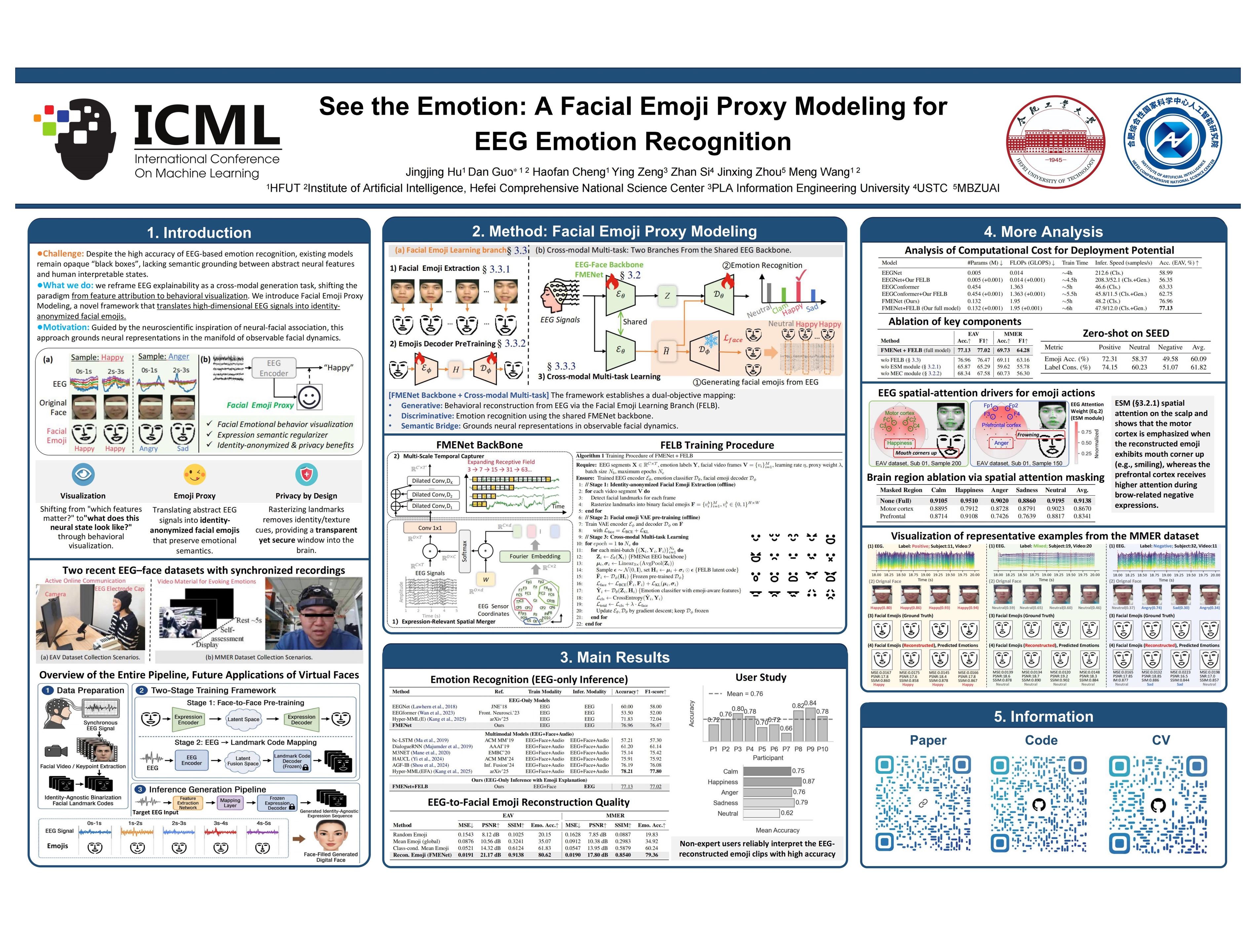
Despite the high accuracy of EEG-based emotion recognition, existing models remain opaque "black boxes", lacking semantic grounding between abstract neural features and human-interpretable states. In this paper, we reframe EEG explainability as a cross-modal generation task, shifting the paradigm from feature attribution to behavioral visualization. We introduce Facial Emoji Proxy Modeling, a novel framework that translates high-dimensional EEG signals into identity-anonymized facial emojis. Guided by the neuroscientific inspiration of neural-facial association, this approach grounds neural representations in the manifold of observable facial dynamics. Technically, our framework integrates FMENet, a specialized backbone modeling expression-relevant spatial synergies, and the Facial Emoji Learning Branch (FELB), which treats emoji reconstruction as a structured semantic regularizer. Extensive experiments on EAV and MMER benchmarks demonstrate that our method achieves state-of-the-art accuracy among EEG-only models. Crucially, it generates semantically faithful facial animations that provide a transparent, privacy-preserving window into the brain's emotional evolution, effectively allowing users to ``see the emotion'' directly from neural signals. Code is available at https://github.com/xian-sh/SeeEmotion
Lay Summary
EEG signals can reveal a person’s emotional state, but most existing models work like “black boxes” — they make accurate predictions without telling us why. This makes it hard to trust or understand them, especially in important areas like healthcare or human-computer interaction. In this work, we propose a new approach that translates EEG signals directly into simple, anonymous facial emojis. Instead of just outputting an emotion label, our model shows how the emotion unfolds over time by generating a short animation of facial expressions. These emojis preserve the emotional meaning but hide real identity, protecting privacy. Experiments on multiple datasets show that our model achieves high emotion recognition accuracy, and the generated emojis are realistic and easy for non-experts to understand. In a user study, ordinary people could correctly recognize the intended emotion from the EEG-reconstructed emojis most of the time. This work makes EEG-based emotion recognition more transparent, private, and human-understandable, with potential applications in mental health support, assistive technology, and more empathetic AI systems.