
Error-Driven Graph Augmentation for Mesh-Based PDE Surrogates
Abstract
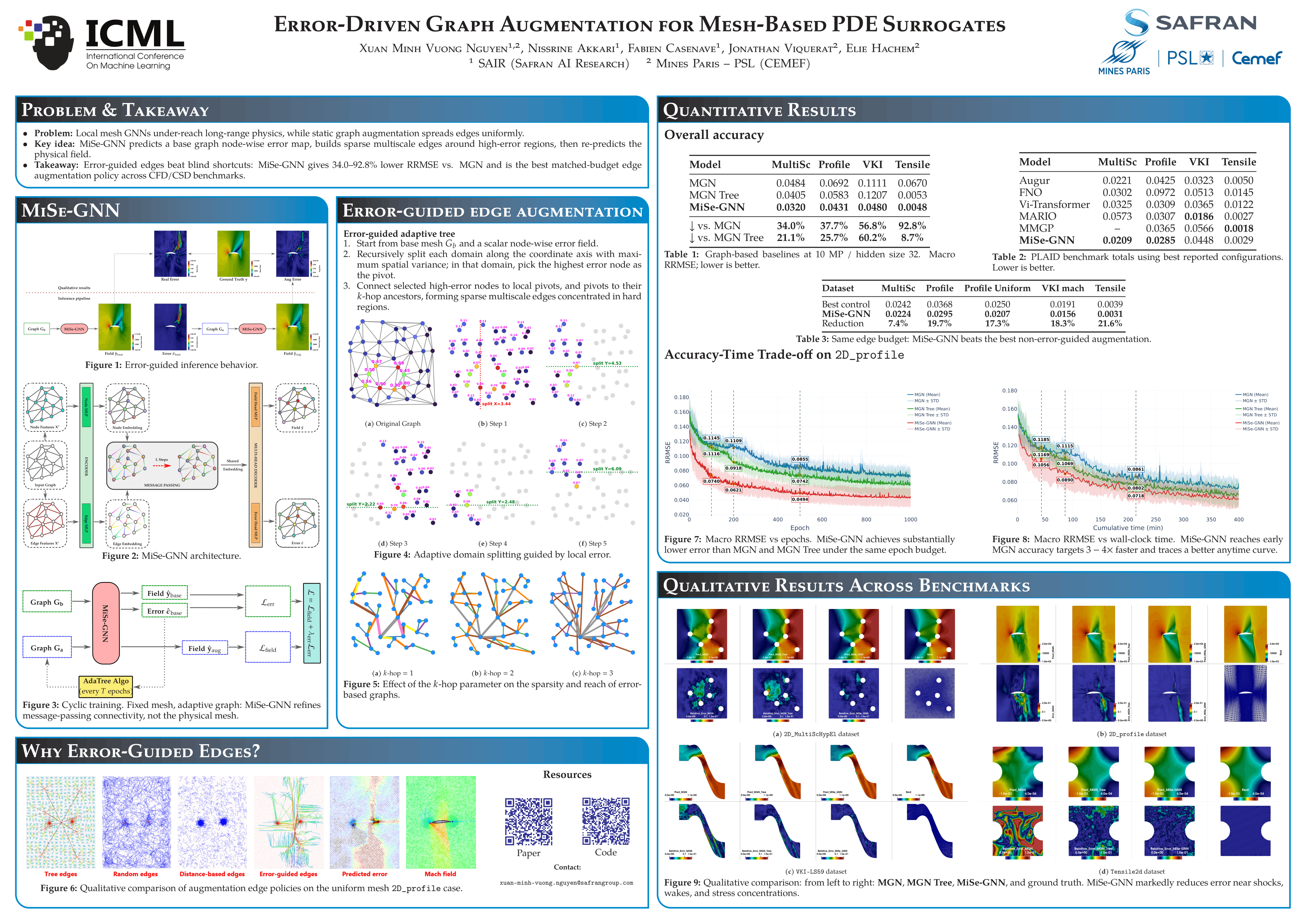
Graph Neural Networks (GNNs) on meshes have emerged as promising surrogates for computational mechanics, but standard local message passing struggles to propagate information across unstructured meshes, leading to large errors in regions with complex physics (e.g., shocks, wakes, boundary layers). Existing approaches enlarge connectivity with long-range edges chosen a priori via geometric heuristics or random sampling, which lack a mechanism to prioritize high-error regions and often introduce redundant communication. We propose MiSe-GNN, a dual-head architecture that adaptively augments graph connectivity using model-predicted a posteriori errors. MiSe-GNN jointly predicts physical fields and a node-wise error indicator; the predicted error is periodically converted into a hierarchy of additional edges via an adaptive tree that links high-error nodes to spatial pivots at multiple scales. This error-guided connectivity concentrates message passing where the surrogate is uncertain while keeping the graph sparse elsewhere, yielding a transparent and physically interpretable graph-space analogue of adaptive mesh refinement. Across industrial CFD and CSD benchmarks, MiSe-GNN consistently improves accuracy and accuracy–compute trade-offs over strong baselines, and qualitative analyses show that it routes communication toward physically challenging regions. These results establish error-guided edge augmentation as a robust and general design principle for long-range message passing in physics-aware GNNs.
Lay Summary
Graph Neural Networks can speed up simulations of physical systems on meshes, but they often struggle in difficult regions such as shocks, wakes, and boundary layers. MiSe-GNN learns to predict where its own errors are likely to be high and then adds extra graph connections around those regions, allowing information to travel more effectively across the mesh. This makes the model more accurate while keeping the graph sparse and computationally efficient. Our experiments on fluid and solid mechanics benchmarks show that error-guided graph augmentation is a useful design principle for building faster and more reliable surrogate models for PDE simulations.