
A Very Big Video Reasoning Suite
Abstract
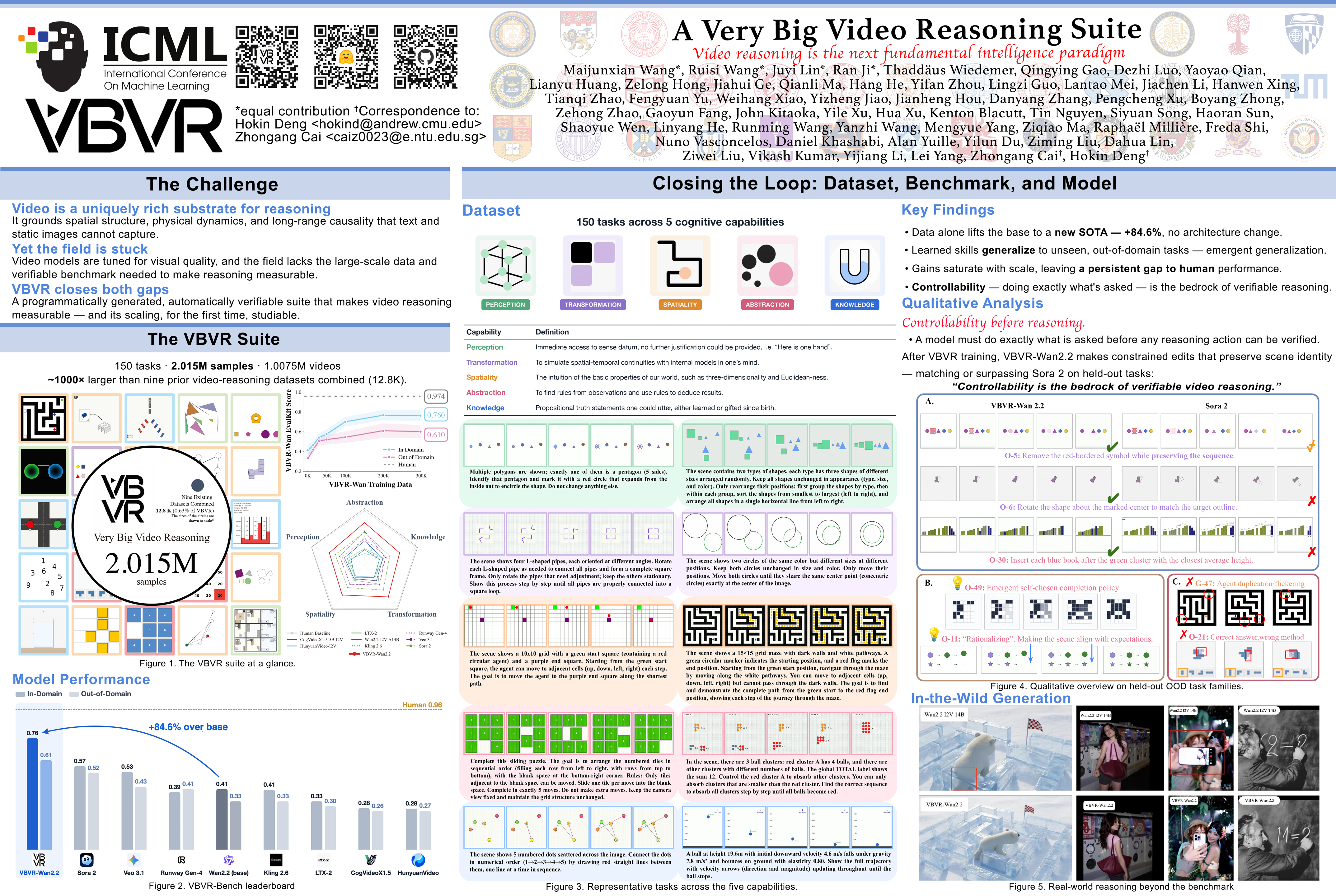
Rapid progress in video models has largely focused on visual quality, leaving their reasoning capabilities underexplored. Video reasoning grounds intelligence in spatiotemporally consistent visual environments that go beyond what text can naturally capture, enabling intuitive reasoning over spatiotemporal structure, such as continuity, interaction, and causality. However, systematically studying video reasoning and its scaling behavior is hindered by the lack of large-scale video reasoning training data. To address this gap, we introduce the Very Big Video Reasoning (VBVR) Dataset, an unprecedentedly large-scale resource spanning 200 curated reasoning tasks following a principled taxonomy, and over one million video clips, making it approximately three orders of magnitude larger than existing datasets. We further present VBVR-Bench, a verifiable evaluation framework that moves beyond model-based judging by incorporating rule-based, human-aligned scorers, enabling reproducible and interpretable diagnosis of video reasoning capabilities. Leveraging the VBVR suite, we conduct one of the first video reasoning scaling studies and observe early signs of emergent generalization to unseen reasoning tasks. Together, VBVR lays a foundation for the next stage of research in generalizable video reasoning. The data, benchmark tool kit, and models are released publicly at video-reason.com.
Lay Summary
Today's AI can generate impressively realistic videos. But can it generate a video that actually solves a problem? Producing pixels that look real and producing pixels that follow the rules of physics, geometry, and logic are very different abilities, and AI has mostly mastered the first while still struggling with the second. We study what we call video reasoning: using video itself as the medium for thinking. Just as a mathematician sketches a diagram to work through a problem, a video AI should be able to generate a video demonstrating a solution: the agent successfully navigating the maze, the objects correctly sorted, the ball obeying the laws of physics. Progress has been slow because researchers lack a large, organized collection of tasks whose answers a computer can verify objectively. We built VBVR (Very Big Video Reasoning): about one million short videos covering 200 reasoning tasks such as navigating mazes, sorting shapes, tracking objects through occlusion, predicting bounces, and fluid flows. Every task has a mathematically checkable correct outcome, so we can grade a model's generated video automatically, without relying on subjective human or AI judgments. Using this dataset, we trained one of the strongest video reasoning modelsbuilt so far. As we scaled up the training data, the model began correctly handling reasoning tasks it had never seen during training. This is early evidence that, as data scale grows, video AI may gradually narrow the gap to the visual common sense humans take for granted. We release the dataset, the evaluation tools, and the trained models publicly.