
Agentic Confidence Calibration
Abstract
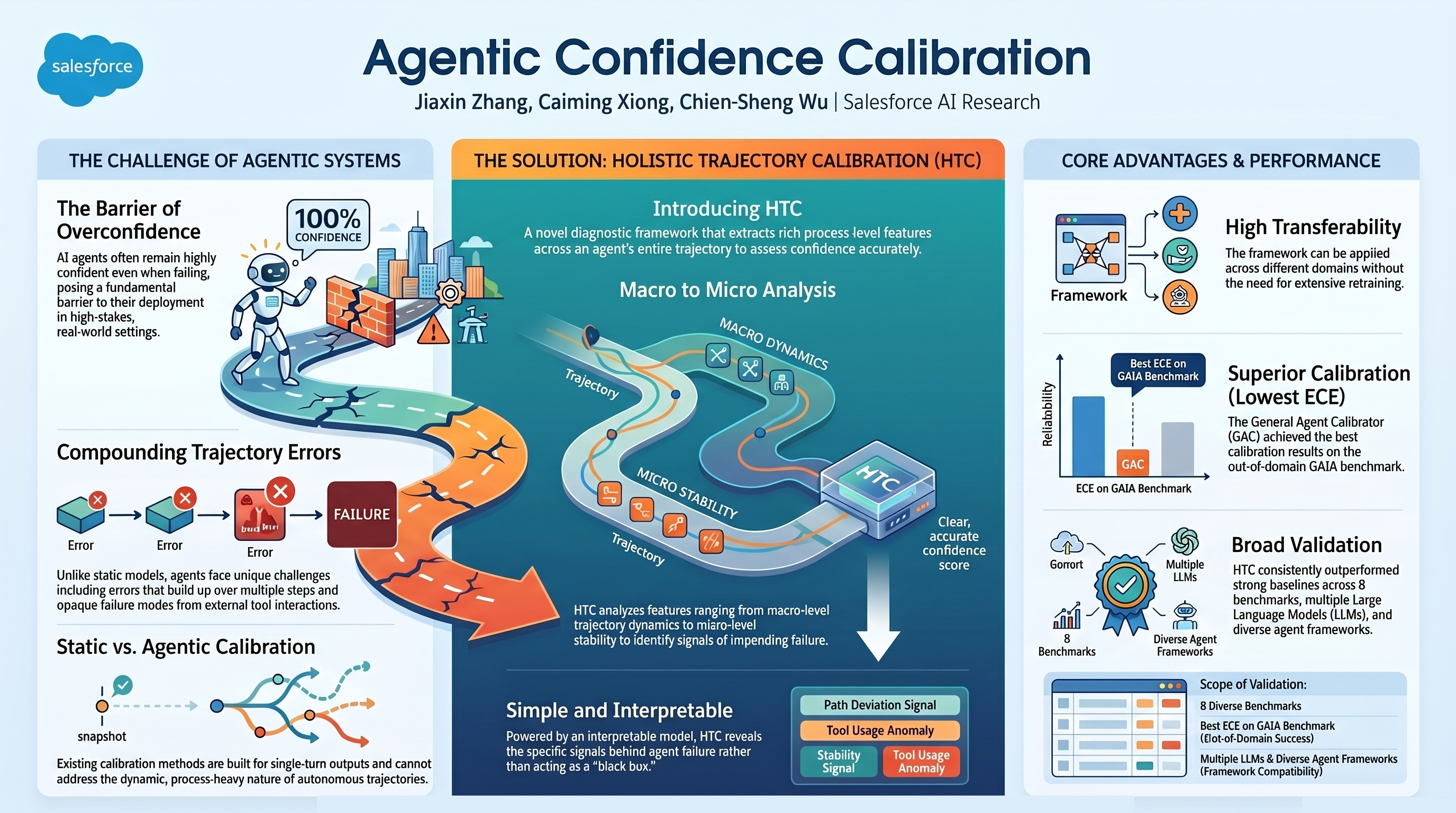
AI agents are rapidly advancing from passive language models to autonomous systems executing complex, multi-step tasks. Yet their overconfidence in failure remains a fundamental barrier to deployment in high-stakes settings. Existing calibration methods, built for static single-turn outputs, cannot address the unique challenges of agentic systems, such as compounding errors along trajectories, uncertainty from external tools, and opaque failure modes. To address these challenges, we introduce, for the first time, the problem of Agentic Confidence Calibration and propose Holistic Trajectory Calibration (HTC), a novel diagnostic framework that extracts rich process-level features ranging from macro dynamics to micro stability across an agent's entire trajectory. Powered by a simple, interpretable model, HTC consistently surpasses strong baselines in both calibration and discrimination, across eight benchmarks, multiple LLMs, and diverse agent frameworks. Beyond performance, HTC delivers three essential advances: it provides interpretability by revealing the signals behind failure, enables transferability by applying across domains without retraining, and achieves generalization through a General Agent Calibrator (GAC) that achieves the best calibration (lowest ECE) on the out-of-domain GAIA benchmark. Together, these contributions establish a new process-centric paradigm for confidence calibration, providing a framework for diagnosing and enhancing the reliability of AI agents.
Lay Summary
AI systems are increasingly able to act like assistants: they can plan, use tools, and work through complex tasks step by step. But these systems can still make mistakes while sounding very confident, which is especially risky in settings where people rely on them for important decisions. We study how to tell when an AI assistant’s final answer should be trusted. Our key idea is to look beyond the final answer and examine the whole process the system followed to reach it. Similar to checking a student’s work rather than only grading the final result, our method looks for warning signs across the steps of an AI assistant’s reasoning, such as unstable decisions or sudden changes in confidence. Using these signals, we build a lightweight tool that gives a more reliable estimate of whether the assistant is likely to be correct. This can help people better understand when an AI system may need extra checking. Our results suggest a practical way to make AI assistants safer, more transparent, and better able to recognize when they might be wrong.