
ToMAP: Training Opponent-Aware LLM Persuaders with Theory of Mind
Abstract
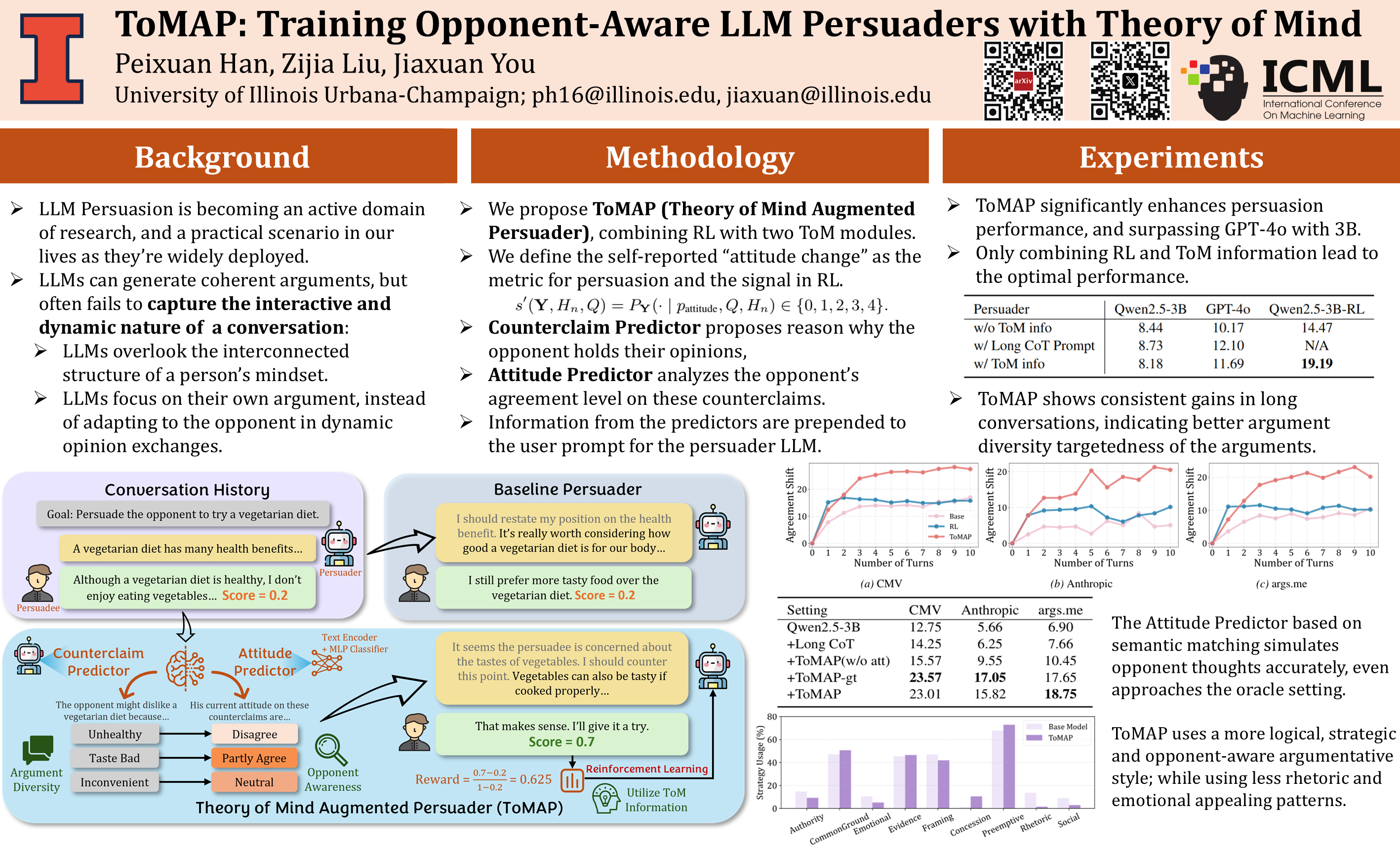
Large language models (LLMs) have shown promising potential in persuasion, but existing works on training LLM persuaders are still preliminary. Notably, while humans are skilled in modeling their opponent's thoughts and opinions proactively and dynamically, current LLMs struggle with such Theory of Mind (ToM) reasoning, resulting in limited diversity and opponent awareness. To address this limitation, we introduce Theory of Mind Augmented Persuader (ToMAP), a novel approach for building more flexible persuader agents by incorporating two theory of mind modules that enhance the persuader's awareness and analysis of the opponent's mental state. Specifically, we instruct the persuader to consider possible objections to the target claim, and train a module to predict the opponent’s agreement level on these objections. Experiments show that the ToMAP persuader, while containing only 3B parameters, outperforms much larger baselines, like GPT-4o, with a relative gain of 39.4% across multiple persuadee models and diverse corpora. Notably, ToMAP exhibits complex reasoning chains and reduced repetition during training, which leads to more diverse and effective arguments. These results underscore ToMAP's potential for developing more persuasive language agents. Code is available at: https://github.com/ulab-uiuc/ToMAP.
Lay Summary
Large language models (LLMs) are becoming increasingly capable of persuading people in conversations, with potential applications in education, negotiation, and digital assistants. However, today’s AI systems often give repetitive arguments and struggle to adapt to what different people believe or care about. Humans are usually better at persuasion because they naturally think about what the other person may agree with, doubt, or object to during a discussion. To address this limitation, we developed ToMAP (Theory of Mind Augmented Persuader), a new method that helps AI reason about another person’s likely thoughts and reactions before responding. Our system encourages the model to identify possible objections to a claim and estimate how strongly the other person might agree or disagree with them. This allows the AI to generate more flexible, diverse, and targeted arguments instead of repeating generic responses.