
Local Intrinsic Dimension of Representations Predicts Alignment and Generalization in AI Models and Human Brain
Abstract
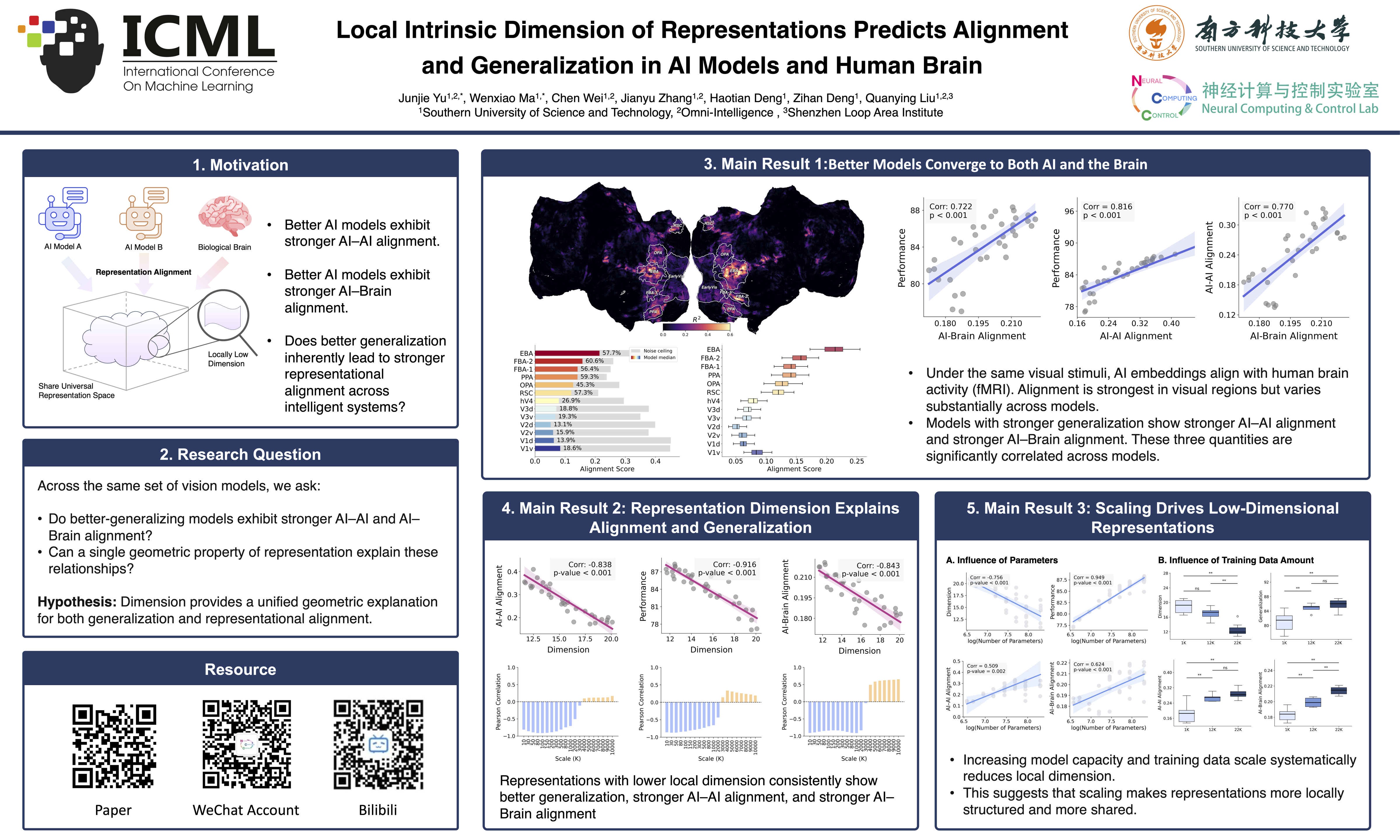
Recent work has found that neural networks with stronger generalization tend to exhibit higher representational alignment with one another across architectures and training paradigms. In this work, we show that models with stronger generalization also align more strongly with human neural activity. Moreover, generalization performance, model--model alignment, and model--brain alignment are all significantly correlated with each other. We further show that these relationships can be explained by a single geometric property of learned representations: the local intrinsic dimension of embeddings. Lower local dimension is consistently associated with stronger model--model alignment, stronger model--brain alignment, and better generalization, whereas global dimension measures fail to capture these effects. Finally, we find that increasing model capacity and training data scale systematically reduces local intrinsic dimension, providing a geometric account of the benefits of scaling. Together, our results identify local intrinsic dimension as a unifying descriptor of representational convergence in artificial and biological systems.
Lay Summary
The Platonic Representation Hypothesis suggests that different intelligent systems, including AI models and the human brain, may learn similar ways of representing the world. However, this idea has lacked a large-scale test across systems. We provide such a test by comparing many vision AI models with each other and with human brain activity. We find that stronger models not only generalize better but also have more similar internal representations to other AI models and to the brain. We further show that this convergence is linked to a simple geometric property: better models organize nearby information in a more compact, lower-dimensional way. This suggests that both AI systems and the brain may prefer to encode the external world as simply and efficiently as possible.