
Enhancing Neural Theorem Proving via High-Quality Proof Selection and Verifier Feedback
Abstract
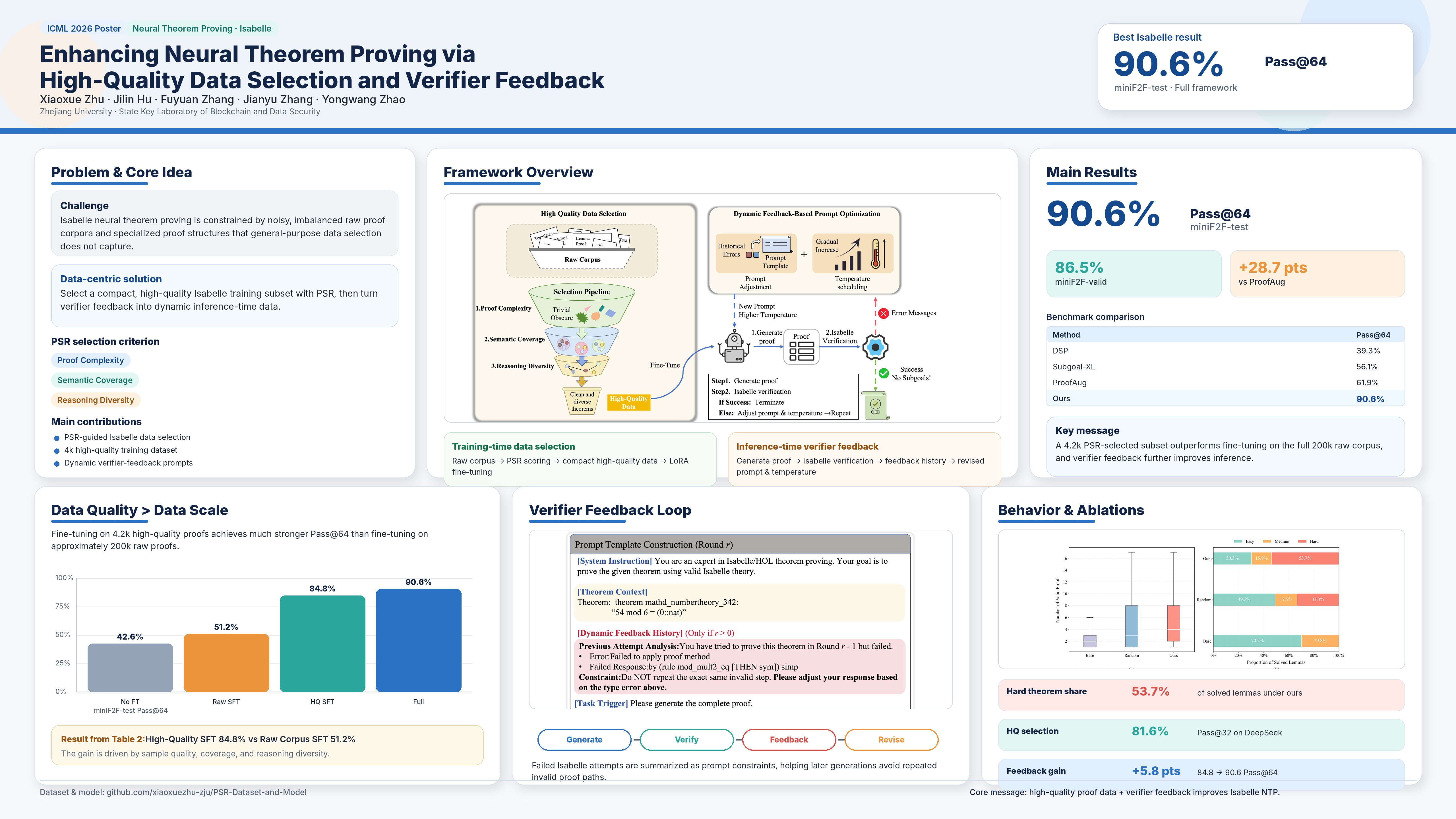
Recent advances in large language models have accelerated neural theorem proving (NTP). Isabelle is a mature and important formal theorem prover that has been widely used in software and hardware verification. However, progress in the Isabelle setting remains limited. Existing approaches either optimize search strategies or train on highly imbalanced raw proof corpora. At the same time, the specialized structure of Isabelle proofs limits the effectiveness of general-purpose data selection methods. To address these challenges, we adopt a data-centric framework for neural theorem proving in Isabelle. We characterize high-quality formal proof data along three complementary dimensions—proof complexity, semantic coverage, and reasoning diversity (PSR)—and propose a PSR-guided data selection pipeline to construct a compact, high-quality training subset. In addition, we leverage verifier feedback as a dynamic data signal during inference, introducing a dynamic feedback-based prompt optimization that iteratively incorporates Isabelle verifier feedback to guide proof generation. We construct and release a 4k high-quality Isabelle dataset based on the PSR criterion. On the miniF2F-test, fine-tuning solely on PSR-selected data achieves 84.8% Pass@64. When further combined with dynamic feedback–based prompt optimization, the full framework improves performance to 90.6% Pass@64, establishing a new state of the art for neural theorem proving in Isabelle.
Lay Summary
Formal theorem proving enables computers to reliably check mathematical proofs, which is critical in mathematics and verification. Despite this, writing proofs remains difficult, and current AI systems, especially in the Isabelle framework, have notable limitations. In this work, we study how to improve AI's ability to generate Isabelle proofs. Instead of simply training on more proof data, we focus on selecting better data. We identify useful proof examples by considering whether they have an appropriate level of difficulty, cover diverse mathematical topics, and contain varied reasoning strategies. We use these selected examples to fine-tune a language model. During proof generation, we also let the model learn from Isabelle’s feedback: when a proof attempt fails, the error message guides the next attempt. Our results demonstrate that a small, carefully selected dataset can outperform much larger raw datasets. These findings show that improving data quality and using verifier feedback can make AI-assisted theorem proving more effective and practical.