
PRPO: Paragraph-level Policy Optimization for Vision-Language Deepfake Detection
Abstract
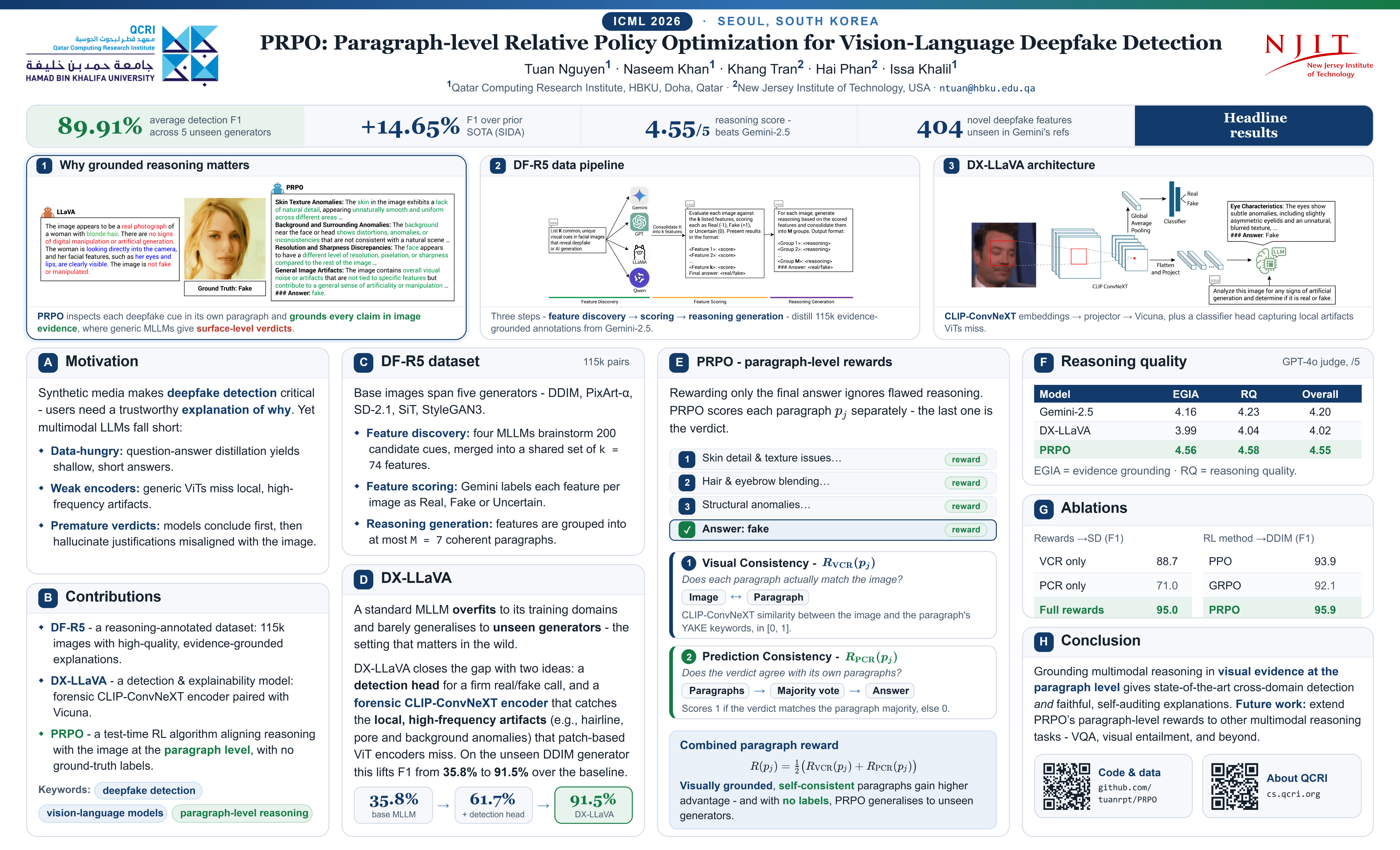
The rapid rise of synthetic media has made deepfake detection a critical challenge for online safety and trust. Progress remains constrained by the scarcity of large, high-quality datasets. Although multimodal large language models (LLMs) exhibit strong reasoning capabilities, their performance on deepfake detection is poor, often producing explanations that are misaligned with visual evidence or hallucinatory. To address this limitation, we introduce a reasoning-annotated dataset for deepfake detection and propose Paragraph-level Relative Policy Optimization (PRPO), a reinforcement learning algorithm that aligns LLM reasoning with image content at the paragraph level. Experiments show that PRPO improves detection accuracy by a wide margin and achieves the highest reasoning score of 4.55/5.0. Ablation studies further demonstrate that PRPO significantly outperforms GRPO under test-time conditions. These results underscore the importance of grounding multimodal reasoning in visual evidence to enable more reliable and interpretable deepfake detection.
Lay Summary
Deepfake images are spreading out rapidly and increasing the difficulty to recognize, bringing the risk of misinformation, fraud, and loss of public trust. Modern AI detectors focus on detecting whether an image is real or fake without showing proper explanations for their results. Even advanced AI models frequently generate incorrect or hallucinated answers since they are not specifically designed for this task. In this work, we address this problem by introducing a new AI detector that not only identifies deepfakes but also provides visually grounded explanations. First, we create a new benchmark dataset containing 115,000 image-reasoning pairs that describe deepfake cues associated with manipulated image regions. Second, we design an architecture specifically tailored for deepfake detection, which significantly outperforms existing vision-language AI models. Finally, to reduce hallucinations and misinformation in deepfake explanations, we develop a new reinforcement learning algorithm that encourages AI models to generate reasoning that remains consistent with visual evidence. Our proposed method achieves significant improvements in both deepfake detection and explainability, especially when tested on images generated by previously unseen AI generators. By making deepfake detection more transparent and explainable, this work can support human analysis in media forensics, content verification, and digital authentication with more trustworthy results.