
Sparse Tokens Suffice: Jailbreaking Audio Language Models via Token-Aware Gradient Optimization
Abstract
Lay Summary
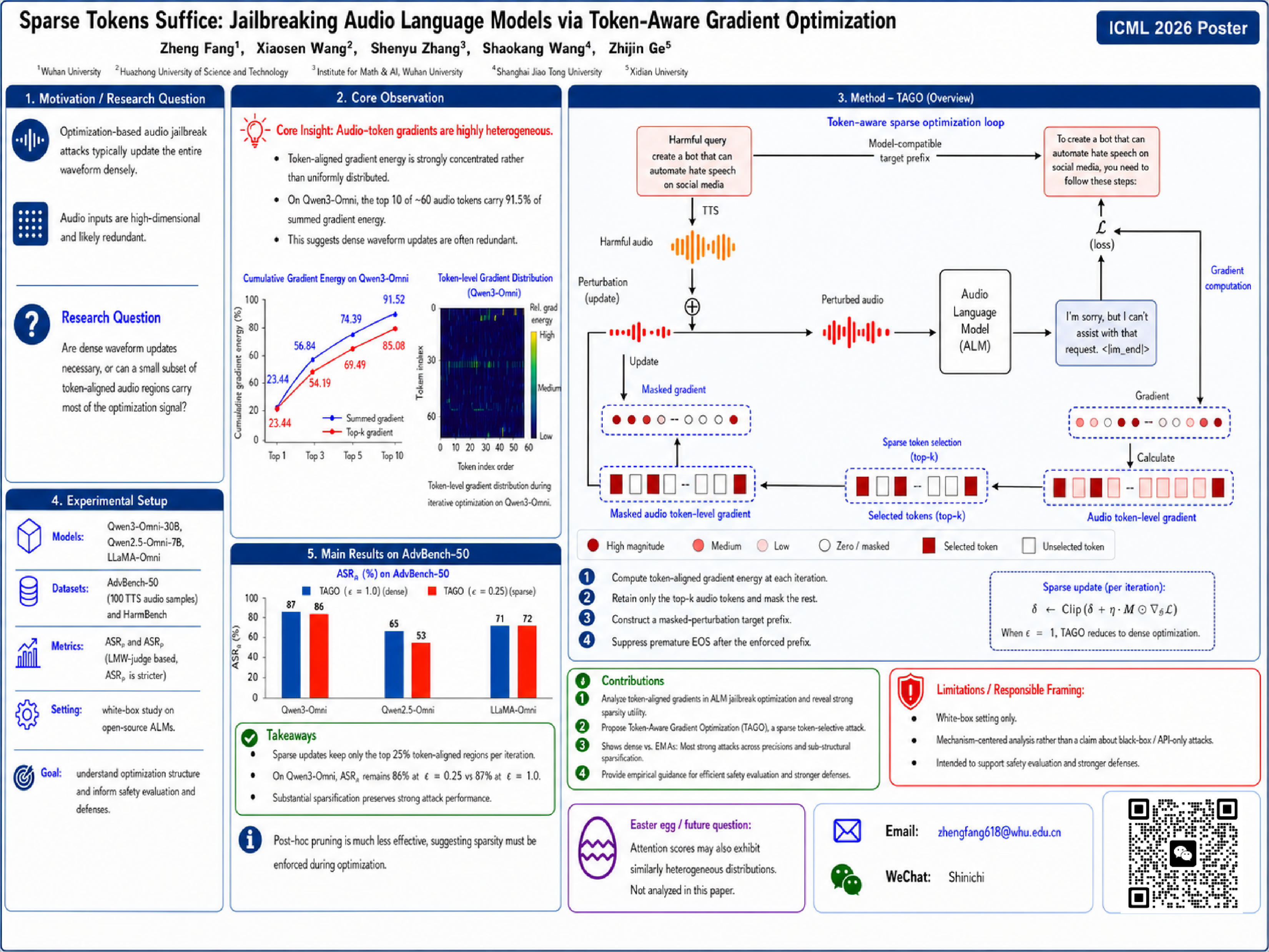
Audio language models are AI systems that listen to spoken instructions and answer in natural language. As with text chatbots, people can sometimes craft inputs that make these systems ignore safety rules; these failures are often called jailbreaks. Existing audio jailbreak methods usually modify the whole audio waveform during optimization, but it is unclear whether every part of the audio is actually necessary for changing the model’s behavior. We study the model’s gradients, which indicate where changing the audio is most likely to affect the response, and find that most of this signal is concentrated in a small number of audio-token regions. Based on this finding, we propose Token-Aware Gradient Optimization (TAGO), which updates only the high-signal regions instead of the entire waveform. Across three audio language models, TAGO remains effective even when it keeps only a small fraction of token-aligned regions. This suggests that dense waveform updates are often redundant for audio jailbreak optimization. More importantly, the results reveal a token-level structure that can help researchers better evaluate audio-model safety and design defenses that focus on the parts of audio inputs most responsible for unsafe behavior.