
Tabero: Learning Gentle Manipulation with Closed-Loop Force Feedback from Vision, Touch, and Language
Abstract
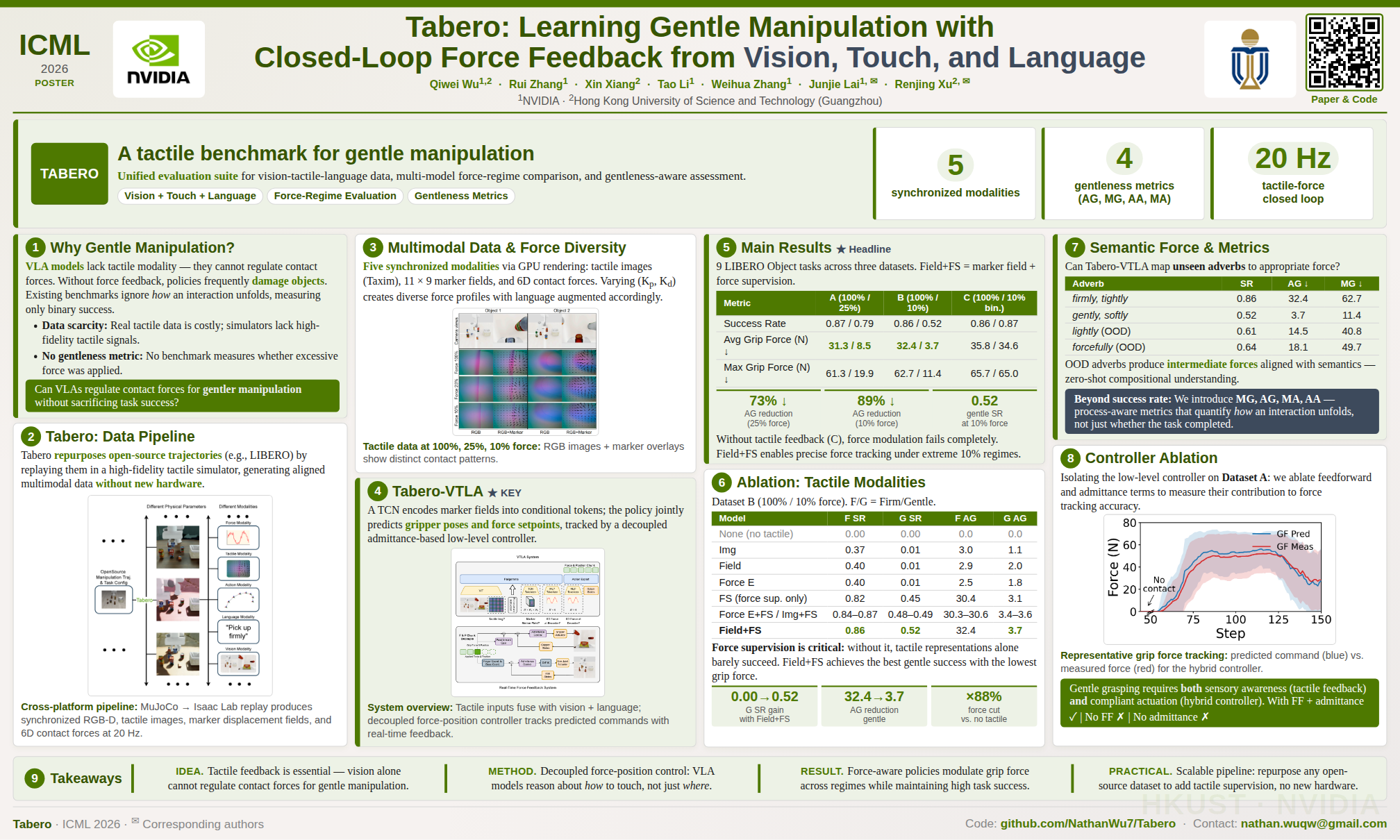
Tactile sensing is essential for robots to achieve human-like gentle manipulation. However, existing Vision-Language-Action (VLA) models struggle to exploit tactile feedback for gentle manipulation due to scarce aligned vision-tactile-language data and the lack of effective closed-loop force feedback mechanisms. To address these challenges, we introduce Tabero, a benchmark and model suite for gentle, language-conditioned robotic manipulation that demands fine-grained contact force perception. First, the Tabero benchmark addresses the scarcity of tactile data by presenting a data-efficient pipeline that repurposes open-source robot manipulation trajectories to generate diverse vision-tactile-language tasks, and establishes a multidimensional evaluation protocol that measures task success alongside physical interaction quality. Second, we propose Tabero-VTLA, an architecture with a decoupled force-position command interface; the resulting force-position commands are executed by a fixed hybrid controller to enable real-time, force-aware manipulation. Evaluated on Tabero, our model maintains high task success while reducing average grip force by over 70\% under gentle instructions, demonstrating its ability to modulate interaction forces based on multimodal experience.
Lay Summary
Tactile perception helps robots perform soft, careful handling like humans do. Current vision-language-action robot models cannot well use tactile signals for gentle manipulation, mainly because matching visual, tactile and language data is limited, and there is no effective real-time force feedback system. To solve these problems, we build Tabero, a complete set of benchmarks and models for language-guided gentle robot manipulation that requires precise force sensing. We first created a data-saving workflow to turn existing public robot operation records into abundant vision-tactile-language tasks, and designed a multi-standard evaluation system to assess both task completion and physical interaction quality. We also developed the Tabero-VTLA model with a separated force and position control module, paired with a stable hybrid controller to realize real-time force-sensitive operation. Tests on our Tabero platform show that under soft-operation commands, our model keeps high task success rates and cuts average gripping force by more than 70%, proving it can flexibly adjust interaction force using multi-sensor information.