
RiboSphere: Learning Unified and Efficient Representations of RNA Structures
Abstract
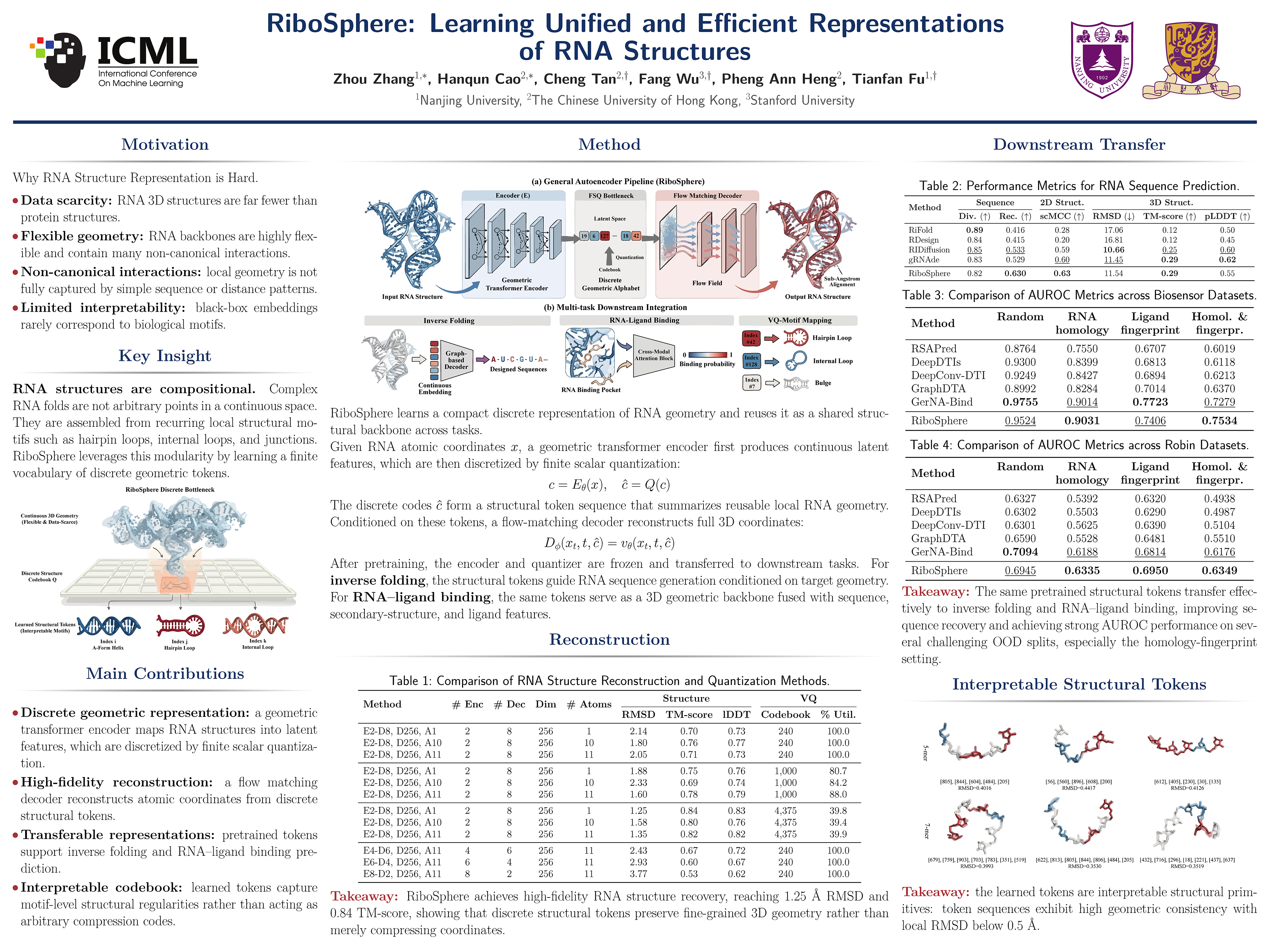
Accurate RNA structure modeling remains difficult because RNA backbones are highly flexible, non-canonical interactions are prevalent, and experimentally determined 3D structures are comparatively scarce. We introduce RiboSphere, a framework that learns discrete geometric representations of RNA by combining vector quantization with flow matching. Our design is motivated by the modular organization of RNA architecture: complex folds are composed from recurring structural motifs. RiboSphere uses a geometric transformer encoder to produce approximately SE(3)-invariant (rotation/translation-invariant) features, which are discretized with finite scalar quantization (FSQ) into a finite vocabulary of latent codes. Conditioned on these discrete codes, a flow-matching decoder reconstructs atomic coordinates, enabling high-fidelity structure generation. We find that the learned code indices are enriched for specific RNA motifs, suggesting that the model captures motif-level compositional structure rather than acting as a purely compressive bottleneck. Across benchmarks, RiboSphere achieves strong performance in structure reconstruction (RMSD 1.25\,\AA, TM-score 0.84), and its pretrained discrete representations transfer effectively to inverse folding and RNA--ligand binding prediction, with robust generalization in data-scarce regimes.
Lay Summary
RNA molecules play many important roles in biology, and their three-dimensional shapes are closely tied to how they function. However, predicting these shapes is difficult because RNA can bend in many ways, often forms unusual interactions, and has far fewer experimentally solved structures than proteins. This paper introduces RiboSphere, an AI system that learns to describe RNA structures using a small set of reusable structural building blocks. The idea is inspired by the fact that complex RNA shapes are often assembled from recurring local patterns, such as loops and junctions. RiboSphere learns these patterns from known RNA structures and uses them to reconstruct detailed atomic structures with high accuracy. We also find that the learned building blocks often correspond to meaningful RNA structural motifs, suggesting that the model captures useful organization in RNA shapes rather than simply compressing the data. These learned representations can also help with related tasks, such as designing RNA sequences for a target shape and predicting whether RNA will bind to small molecules, especially when only limited training data is available.