
Hyperbolic RQ-VAE enhanced Generative Recommendation with Differential-Length Codebook Strategy
Abstract
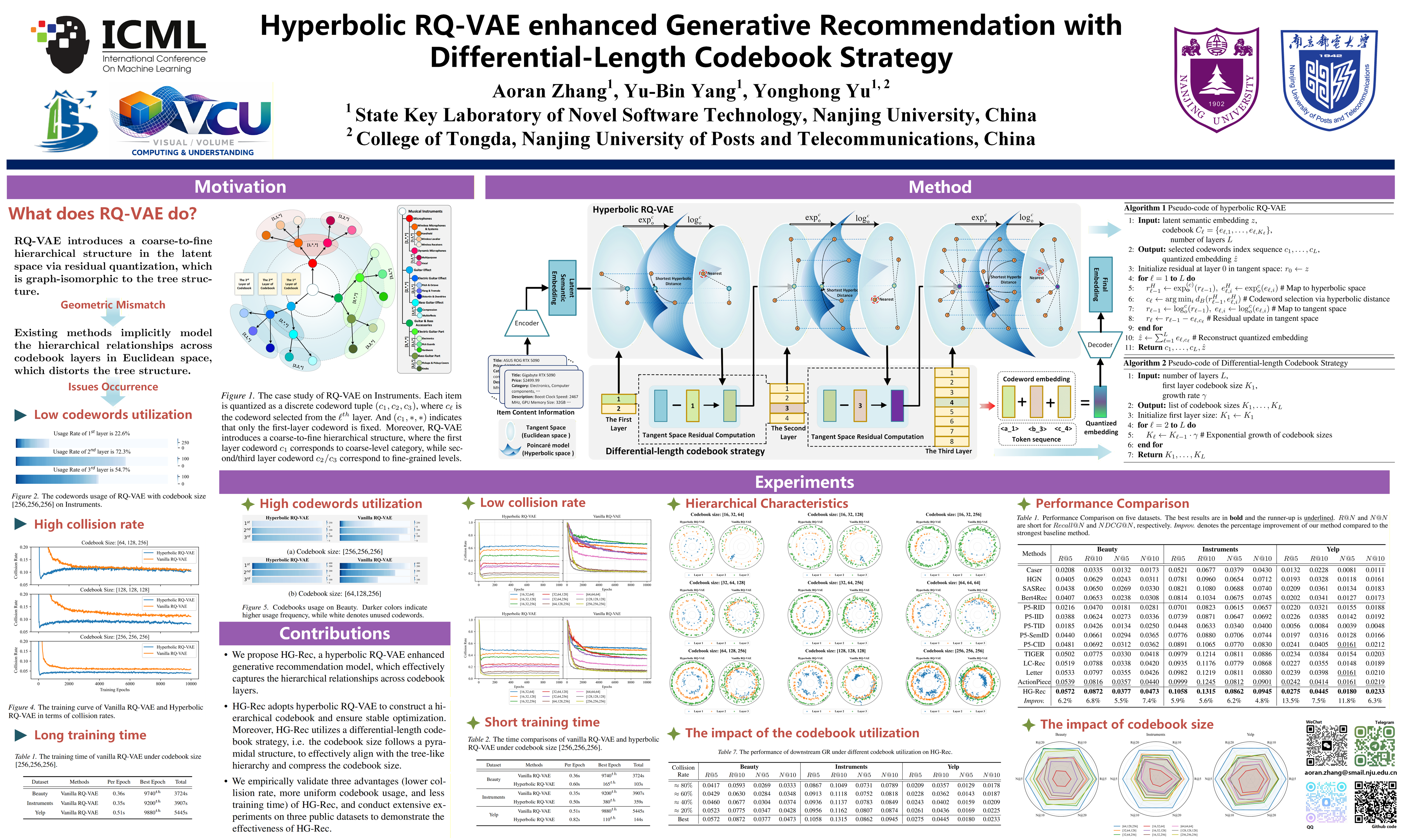
Recently, the integration of large language models (LLMs) with generative recommendation (GR) has demonstrated promising potential. However, most existing GR methods adopt residual quantization to implicitly model hierarchical relationships across codebook layers in Euclidean space, which distorts the intrinsic tree-like hierarchy and leads to low codebook utilization. To address these issues, we propose a Hyperbolic RQ-VAE enhanced Generative Recommendation, namely HG-Rec. Specifically, HG-Rec enhances the residual quantization mechanism by embedding the latent discrete representations into hyperbolic space to explicitly model hierarchical relationships across codebook layers. Motivated by the exponential volume growth of hyperbolic space, we further design a differential-length codebook strategy, i.e. the codebook size follows a pyramidal structure, which aligns with the tree-like structure and effectively compresses the codebook size. Hence, benefiting from the alignment of hyperbolic geometry and codebook hierarchy, HG-Rec achieves lower collision rates, more uniform codebook usage, and less training time compared to existing methods. Extensive experiments across multiple benchmark datasets demonstrate that HG-Rec consistently achieves state-of-the-art performance. The code is available in the https://github.com/zar123123/HG-Rec.
Lay Summary
For generative recommendation, the efficient and rational construction of codebooks is crucial. This is because all items are reconstructed into unique triplets through the codebook. Essentially, the process of item reconstruction can be likened to building a tree structure, which prompts us to question whether modeling this process in Euclidean space is appropriate. Through both theoretical and experimental analyses, we find that modeling this process in hyperbolic space significantly outperforms that of Euclidean space, benefiting from the natural compatibility between hyperbolic space and tree-like structures. Surprisingly, codebooks constructed in hyperbolic space exhibit higher quality, better utilization, and lower computational cost. Notably, even when the codebook size is reduced, competitive performance can still be maintained. Our findings offer a new perspective for efficiently constructing codebooks in generative recommendation systems. Leveraging hyperbolic space improves codebook quality, utilization, and efficiency, enabling compact representations and scalable deployment. Even with reduced codebook size, the approach remains robust, demonstrating strong potential for practical, large-scale industrial applications.