
Revisiting Anisotropy in Language Transformers: The Geometry of Learning Dynamics
Abstract
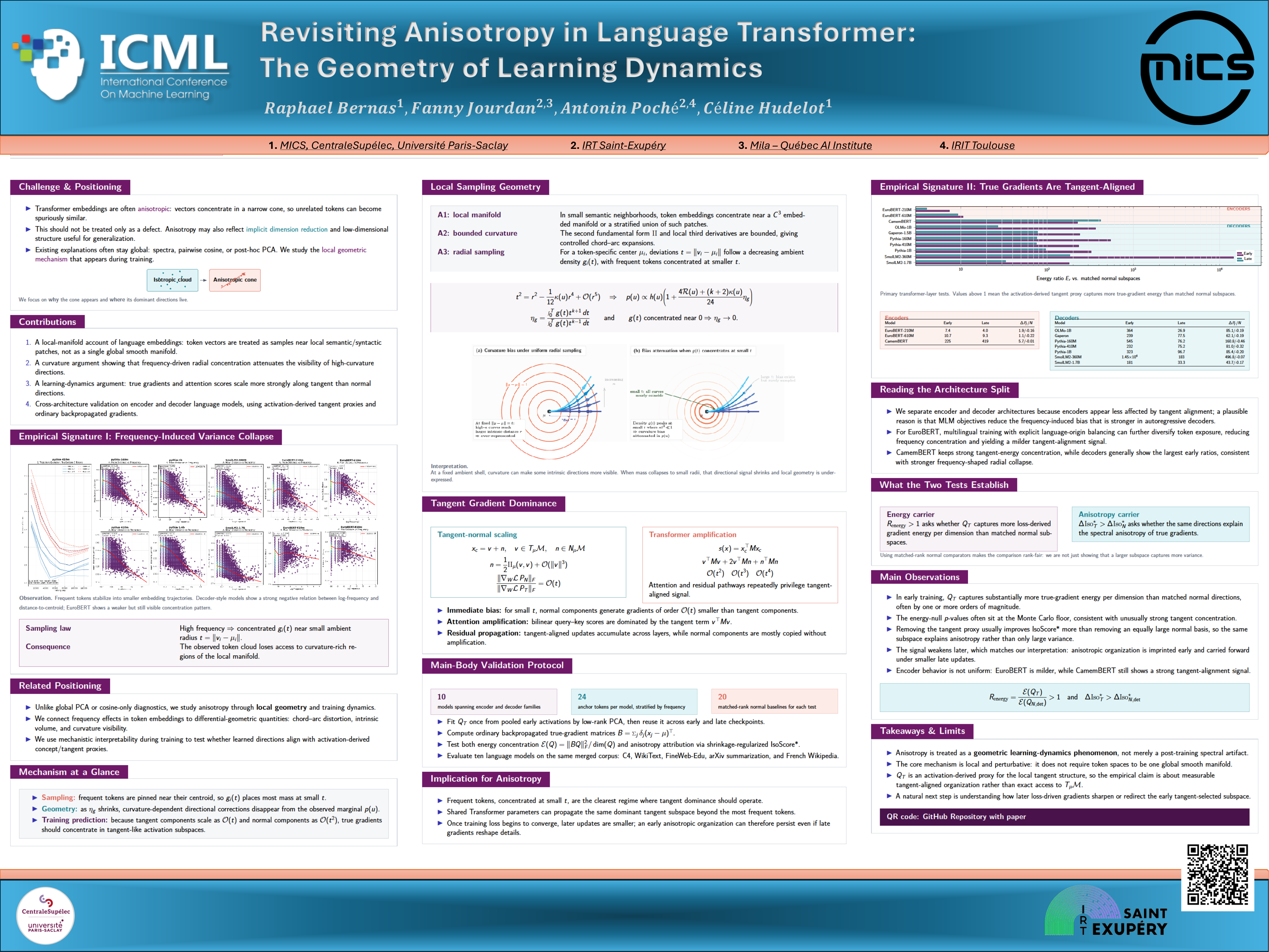
Since their introduction, Transformer architectures have dominated Natural Language Processing (NLP). However, recent research has highlighted an inherent anisotropy phenomenon in these models, presenting a significant challenge to their geometric interpretation. Previous theoretical studies on this phenomenon are rarely based on the underlying representation geometry. In this paper, we extend them by providing such theoretical arguments assessing the problematic nature of this phenomenon. Furthermore, to observe geometric internal model dynamics, we apply mechanistic interpretability (MI) techniques during the model's training checkpoints rather than post-hoc, as it is commonly done in the literature. By analyzing multiple models and their checkpoints -including EuroBERT, the Pythia suite, and SmolLM2- we investigate the structure of embedding representations and their correlation with the on manifold entropy of their underlying distribution.
Lay Summary
AI language models store words as points in a very large space. If the model used that space evenly, these points would look like a round cloud, but in practice they often gather into a narrow beam, so many unrelated words point in similar directions. We ask why this shape appears during training. Our picture is that language lies on a thin curved sheet inside the large space. Very common words are seen again and again, so training pins them close to their usual place; visually, this is like pressing the most-used points tightly onto the sheet and making its bends harder to notice. We then argue that the training signal mostly slides along this sheet, rather than pulling points away from it, so the same few directions keep being strengthened. To test this, we take early training snapshots, extract the main directions in which the model already moves its internal word positions, and compare them with the true training signal later on. Across several language models, these early sheet-like directions carry much more training signal than equally sized sideways directions, and they explain more of the narrow-beam shape. This suggests that the narrow shape of a language model’s internal word map is a trace of how training compresses language structure into a small set of useful directions.