
RaBiT: Residual Aware Binarization Training for Accurate and Efficient LLMs
Youngcheon You ⋅ Banseok Lee ⋅ Minseop Choi ⋅ Seonyoung Kim ⋅ Hyochan Chong ⋅ Changdong Kim ⋅ Youngmin Kim ⋅ Dongkyu Kim
Abstract
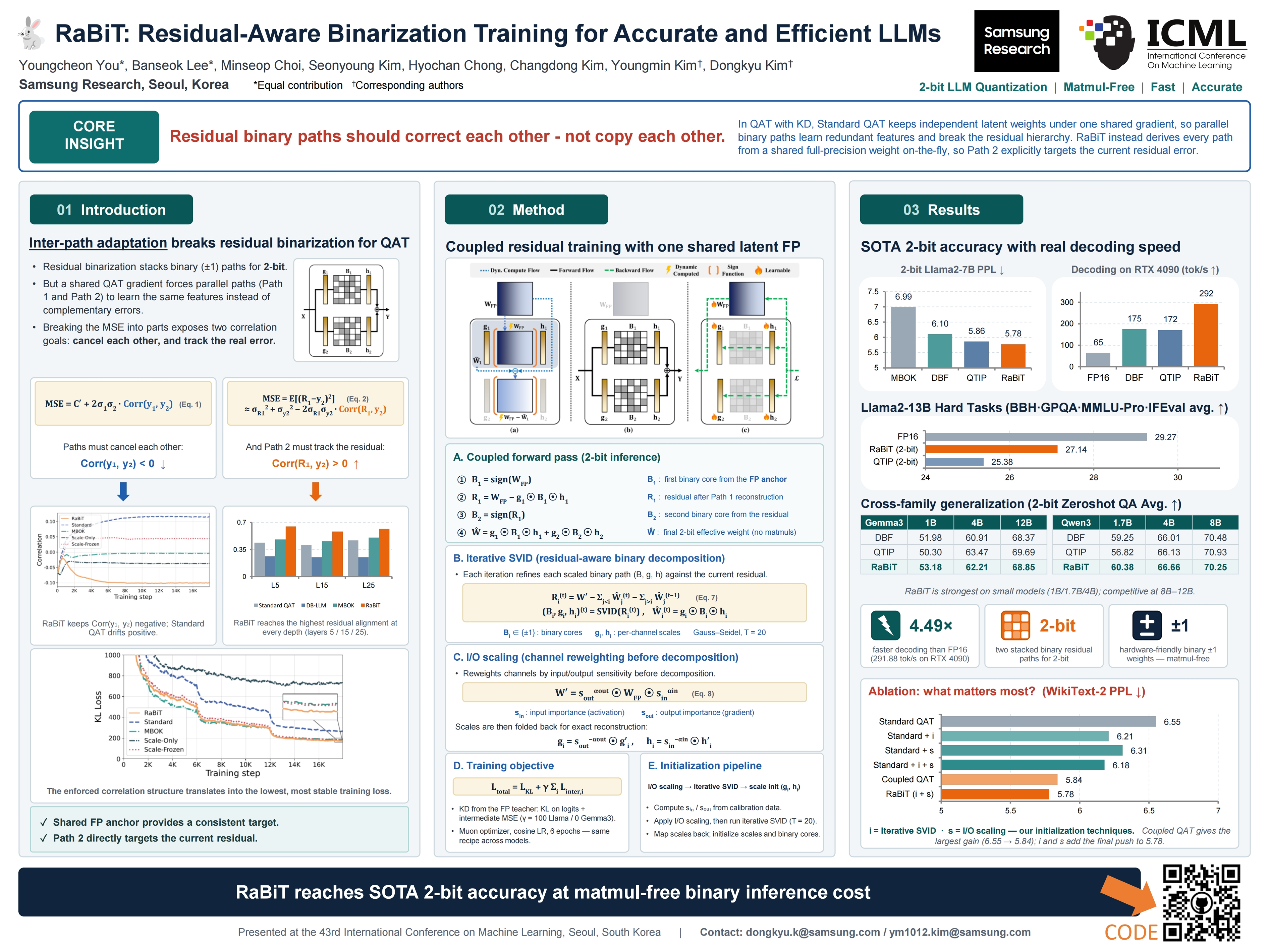
Efficient deployment of large language models (LLMs) requires extreme quantization, forcing a critical trade-off between low-bit efficiency and performance. Residual binarization promises hardware-friendly, matmul-free inference by stacking binary ($\pm$1) layers, but is plagued by pathological feature co-adaptation. We identify a key failure mode, which we term inter-path adaptation: during Quantization-Aware Training (QAT), parallel residual binary paths learn redundant features, degrading the error-compensation structure and crippling the model's expressive capacity. While prior work relies on heuristic workarounds (e.g., path freezing) that limit model capacity, we propose RaBiT, a novel quantization framework that resolves co-adaptation by algorithmically enforcing a residual hierarchy. Its core mechanism sequentially derives each binary path from a single shared full-precision weight, ensuring each path corrects its predecessor's error. This process is stabilized by a robust initialization that prioritizes functional preservation over mere weight approximation. RaBiT redefines the 2-bit accuracy-efficiency frontier: it achieves state-of-the-art performance, rivals even hardware-intensive Vector Quantization (VQ) methods, and delivers a 4.49$\times$ inference speed-up over full-precision models on an RTX 4090.
Lay Summary
Large language models (LLMs) are powerful but computationally expensive. While residual binarization compresses weights into efficient binary components to reduce costs, it often degrades accuracy. We identify a key limitation: during training, these binary components learn redundant information instead of correcting mistakes (inter-path adaptation). To address this, we introduce RaBiT, a novel training method that forces each component to focus strictly on the residual errors of the previous ones. RaBiT preserves this error-correction structure, achieving strong 2-bit accuracy and up to a 4.49× inference speed-up on an RTX 4090 for easier deployment.
Video
Chat is not available.
Successful Page Load