
FasterVAR: Plug-and-Play Acceleration for Visual Autoregressive Models
Abstract
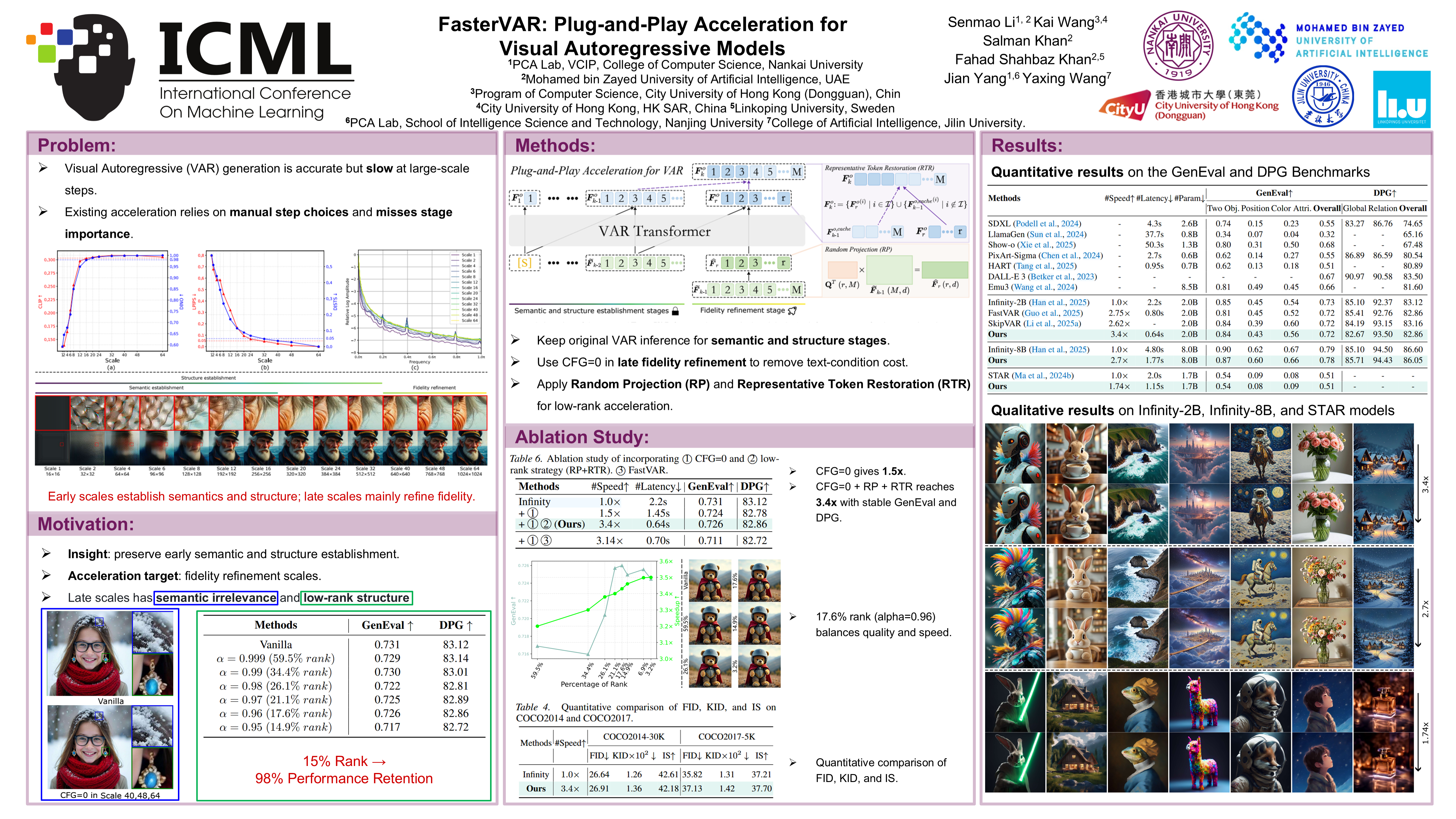
Visual Autoregressive (VAR) modeling departs from the next-token prediction paradigm of traditional Autoregressive (AR) models through next-scale prediction, enabling high-quality image generation. However, the VAR paradigm suffers from sharply increased computational complexity and running time at large-scale steps. Although existing acceleration methods reduce runtime for large-scale steps, but rely on manual step selection and overlook the varying importance of different stages in the generation process. To address this challenge, we present FasterVAR, a systematic study and plug-and-play acceleration framework for VAR models. Our analysis shows that early steps are critical for preserving semantic and structural consistency and should remain intact, while later steps mainly refine details and can be pruned or approximated for acceleration. Building on these insights, FasterVAR introduces a plug-and-play acceleration strategy that exploits semantic irrelevance and low-rank properties in late-stage computations, without requiring additional training. Our proposed FasterVAR achieves up to 3.4× speedup with almost no performance loss, consistently outperforming existing acceleration baselines. These results highlight stage-aware design as a powerful principle for efficient visual autoregressive image generation. Code: https://github.com/sen-mao/FasterVAR
Lay Summary
Modern AI systems that generate high-quality images act much like human painters: they quickly sketch the initial idea but spend a massive amount of time and computing power adding high-resolution details in the final stages. We discovered that these AI models establish the core meaning and overall structure of an image during the early stages of generation, leaving only detail refinement for the later steps. Based on this, we developed a "plug-and-play" tool called FasterVAR. Without needing to retrain the AI, it speeds up the final refinement stage by ignoring redundant text instructions and streamlining the underlying calculations using simplified data representations. This approach allows the AI to generate high-quality images up to 3.4 times faster with almost no loss in visual quality. By significantly boosting efficiency, this work reduces the time and computing costs required, making advanced AI image generation much more practical and accessible.