
Geometric Conformal Prediction with Spatial Ranks and Multivariate Quantiles
Abstract
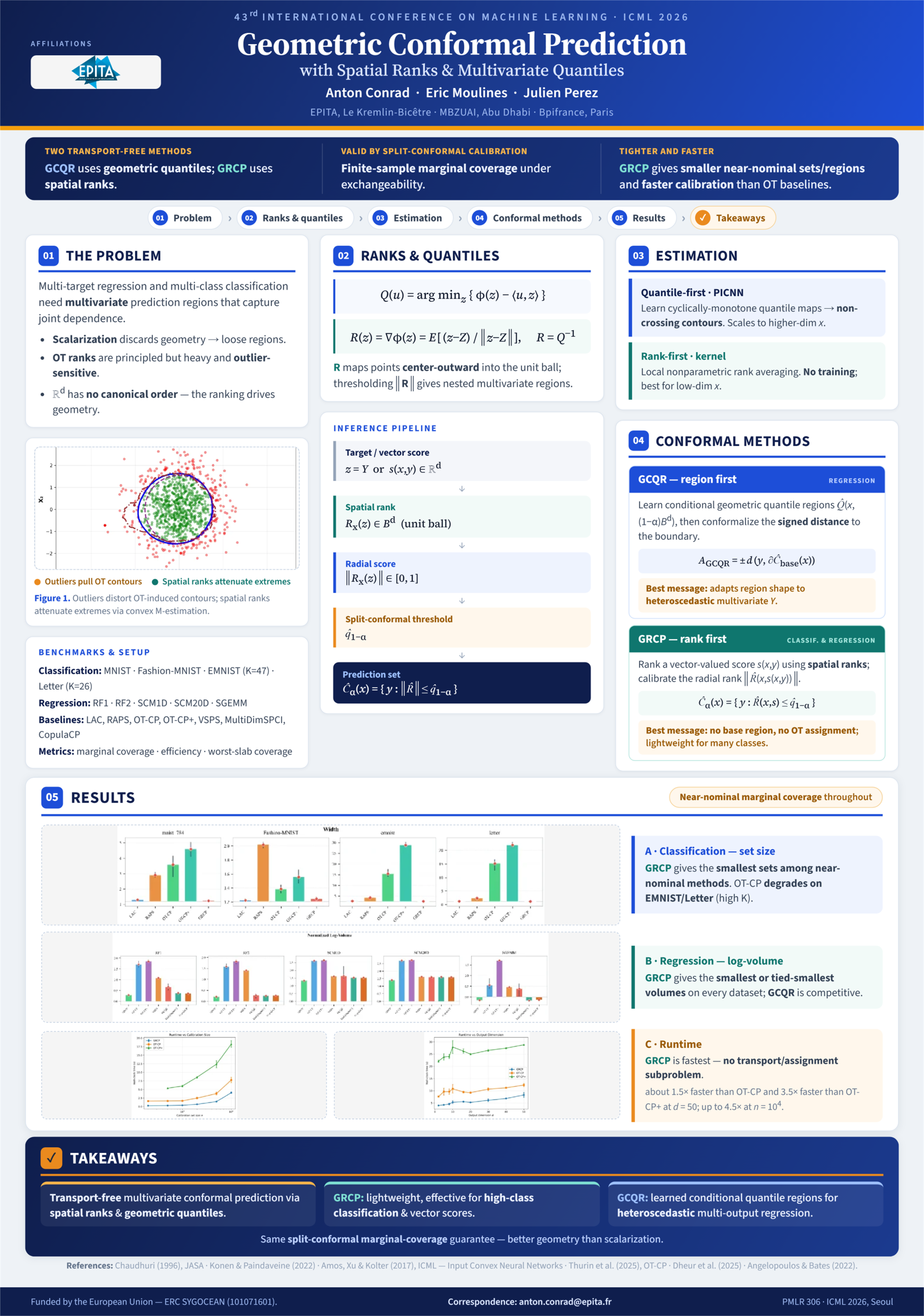
In multi-target regression and multi-class classification, uncertainty is inherently multivariate: prediction regions must capture joint dependencies across correlated outputs. Conformal prediction provides distribution-free guarantees, yet extending it to vector-valued outputs remains challenging—scalar aggregation discards geometric structure, while optimal transport (OT) approaches are computationally demanding and sensitive to outliers. We introduce two conformal methods based on geometric quantiles and spatial ranks: Geometric Conformalized Quantile Regression (GCQR) constructs prediction regions from learned conditional geometric quantiles, while Geometric Rank Conformal Prediction (GRCP) uses the radial rank of vector-valued conformity scores as the nonconformity measure. We propose multiple estimators offering different tradeoffs between computational cost and adaptivity to feature-dependent heterogeneity, with scalable learning via partially input-convex neural networks. On multi-target regression and multi-class classification benchmarks, GCQR and GRCP attain near-nominal coverage with consistently tighter prediction regions than scalarized and multivariate baselines.
Lay Summary
Many machine learning systems should not only make a prediction, but also say how uncertain they are. This is especially hard when the output has several related parts, such as predicting multiple quantities at once or deciding among many possible classes. Common methods often compress this uncertainty into a single number, which can lose important information about how the different outputs depend on each other. This paper introduces a new way to build uncertainty sets for such multi-output problems. Instead of flattening the uncertainty, we rank possible outcomes from “central” to “unusual” using their geometric position among the data. This makes it possible to keep more of the structure of the prediction problem while still giving the usual statistical guarantee: over many new examples, the true answer is included about as often as promised. Across regression and classification tasks, the proposed methods produce reliable uncertainty sets that are typically smaller and faster to compute than competing multivariate approaches, especially those based on more expensive transport calculations.