
Preconditioning Neural Tangent Kernel for Adaptive Optimization
Abstract
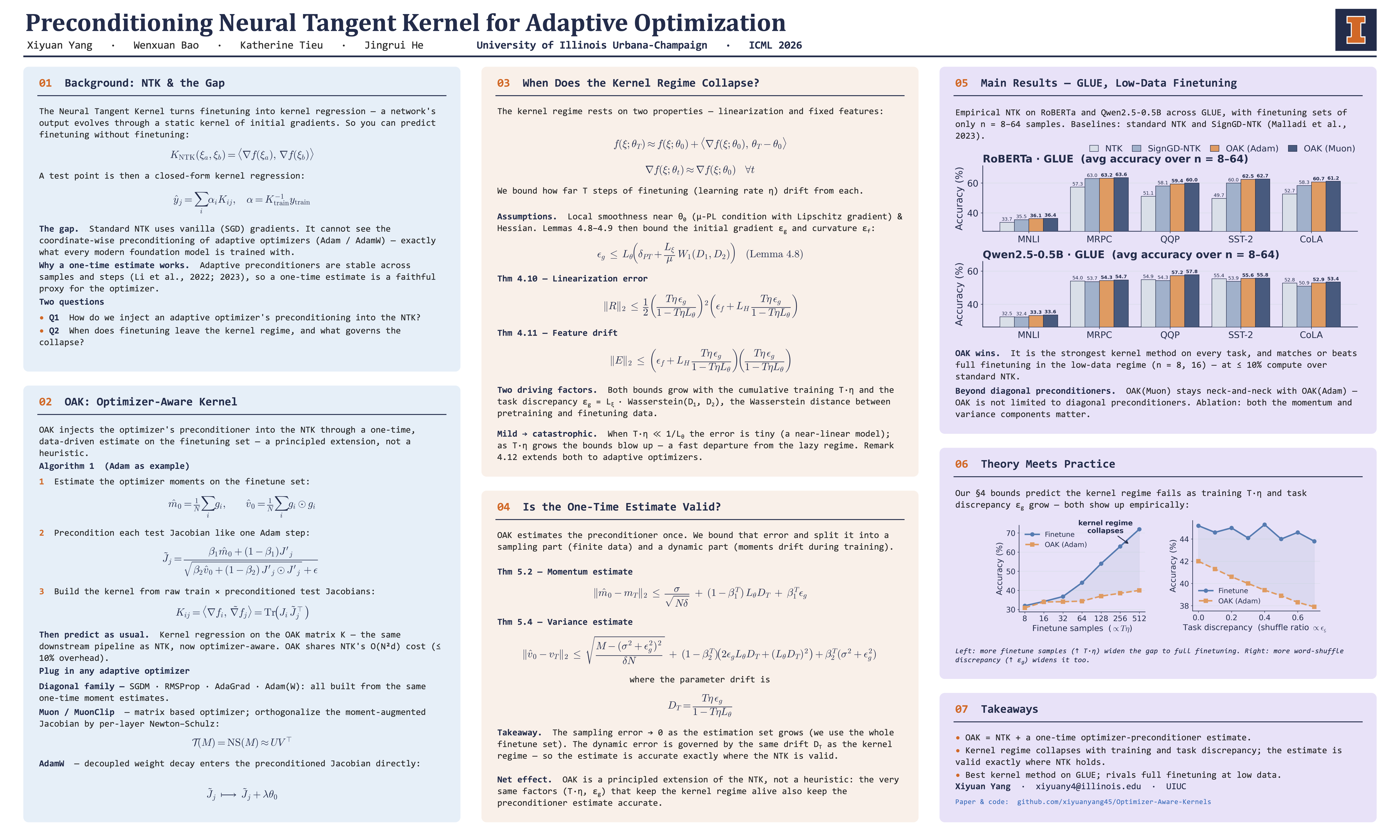
The Neural Tangent Kernel is a theoretical framework for understanding the training dynamics of neural networks. However, standard NTK and its variants fail to properly depict the finetuning of foundation models, as they neglect the preconditioning effects of adaptive gradients. To bridge this gap, we propose the Optimizer Aware Kernel (OAK), which incorporates the optimizer's influence into standard NTK framework by a preconditioner estimation technique. Furthermore, we conduct an analysis to answer: when and why kernel regime fails in finetuning. We derive explicit error bounds showing that the collapse of kernel regime is primarily due to the cumulative training effects and the task discrepancy between pretraining and finetuning. Theoretically, we justify OAK's preconditioner estimation by bounding its error term. Empirically, experiments on various model architectures show both the effectiveness of the OAK method and validity of our arguments on kernel regime collapse.
Lay Summary
Post-training is a critical step in producing a modern AI system, however the math tools used to analyze this process rely on an oversimplified assumption and ignore how real training algorithms actually work. In this work, we propose a new method that captures this missing behavior, and we explain mathematically when the previous simplified view breaks down: gradually as training continues, and faster when the new task differs greatly from the original one. Experiments confirm our method works better and our explanation is effective.