
MAD: Manifold Attracted Diffusion
Abstract
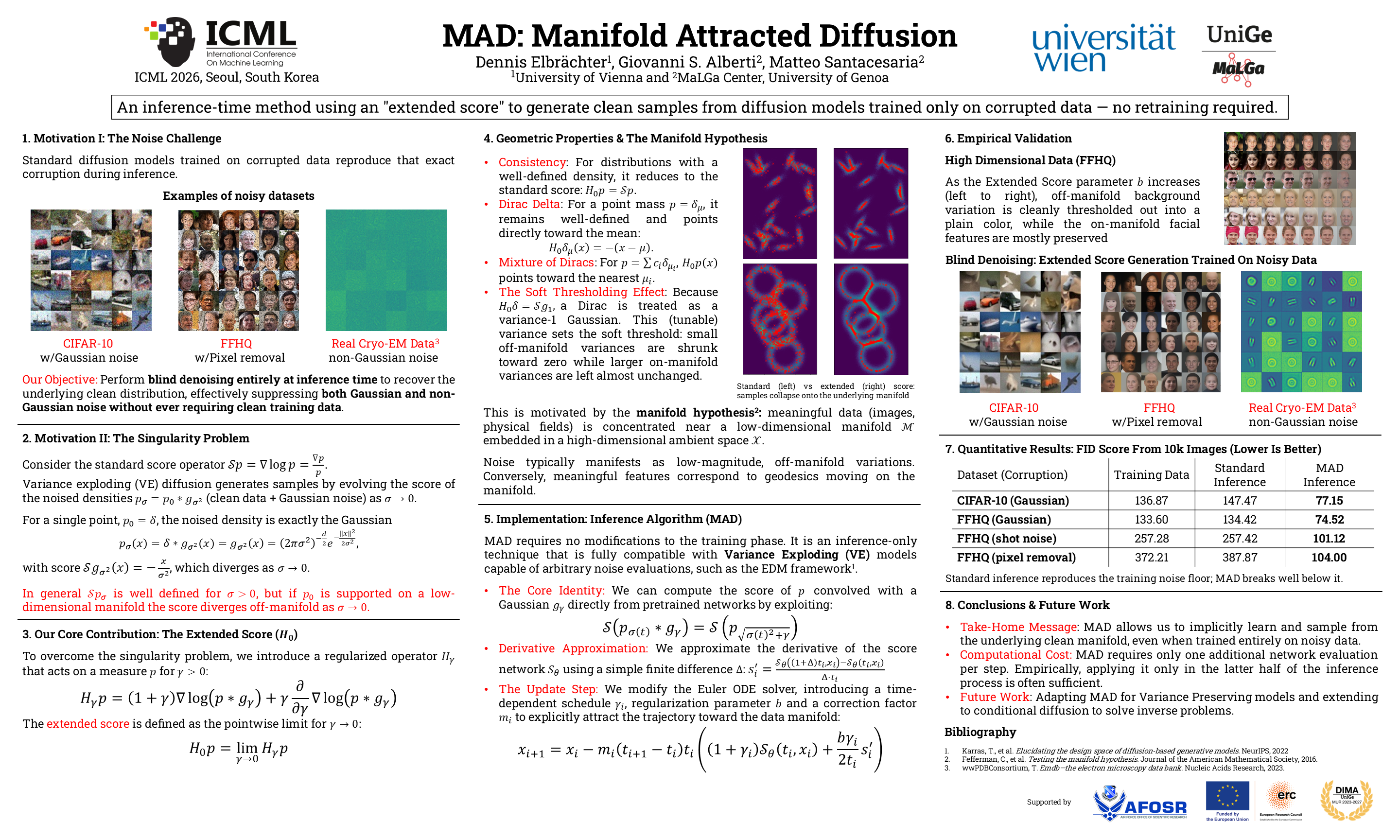
Score-based diffusion models are a highly effective method for generating samples from a distribution of images. We consider scenarios where the training data comes from a noisy version of the target distribution, and present an efficiently implementable modification of the inference procedure to generate noiseless samples. Our approach is motivated by the manifold hypothesis, according to which meaningful data is concentrated around some low-dimensional manifold of a high-dimensional ambient space. The central idea is that noise manifests as low magnitude variation in off-manifold directions in contrast to the relevant variation of the desired distribution which is mostly confined to on-manifold directions. We introduce the notion of an extended score and show that, in a simplified setting, it can be used to reduce small variations to zero, while leaving large variations mostly unchanged. We describe how its approximation can be computed efficiently from an approximation to the standard score and demonstrate its efficacy on toy problems, synthetic data, and real data.
Lay Summary
Artificial intelligence models that generate images learn by studying large collections of example data. However, if these datasets are corrupted by measurement errors or artifacts, the AI learns to copy those flaws, producing noisy images instead of clear ones. To fix this, we created Manifold Attracted Diffusion (MAD). MAD is a modification to the image generation process that does not require the AI to be retrained on clean data. Our approach relies on a mathematical concept where real, meaningful image features follow a highly structured pattern, whereas noise represents small, unstructured variations. We introduced a new tool called the "extended score" that automatically filters out these random variations during generation, while leaving the important, structured features intact. Consequently, our method can produce high-quality, clear samples even when the AI only learned from noisy data. This is highly valuable for real-world scientific applications that struggle with extreme noise caused by physical measurement limits, such as Cryo-Electron Microscopy.