
Data- and Variance-dependent Regret Bounds for Online Tabular MDPs
Abstract
Lay Summary
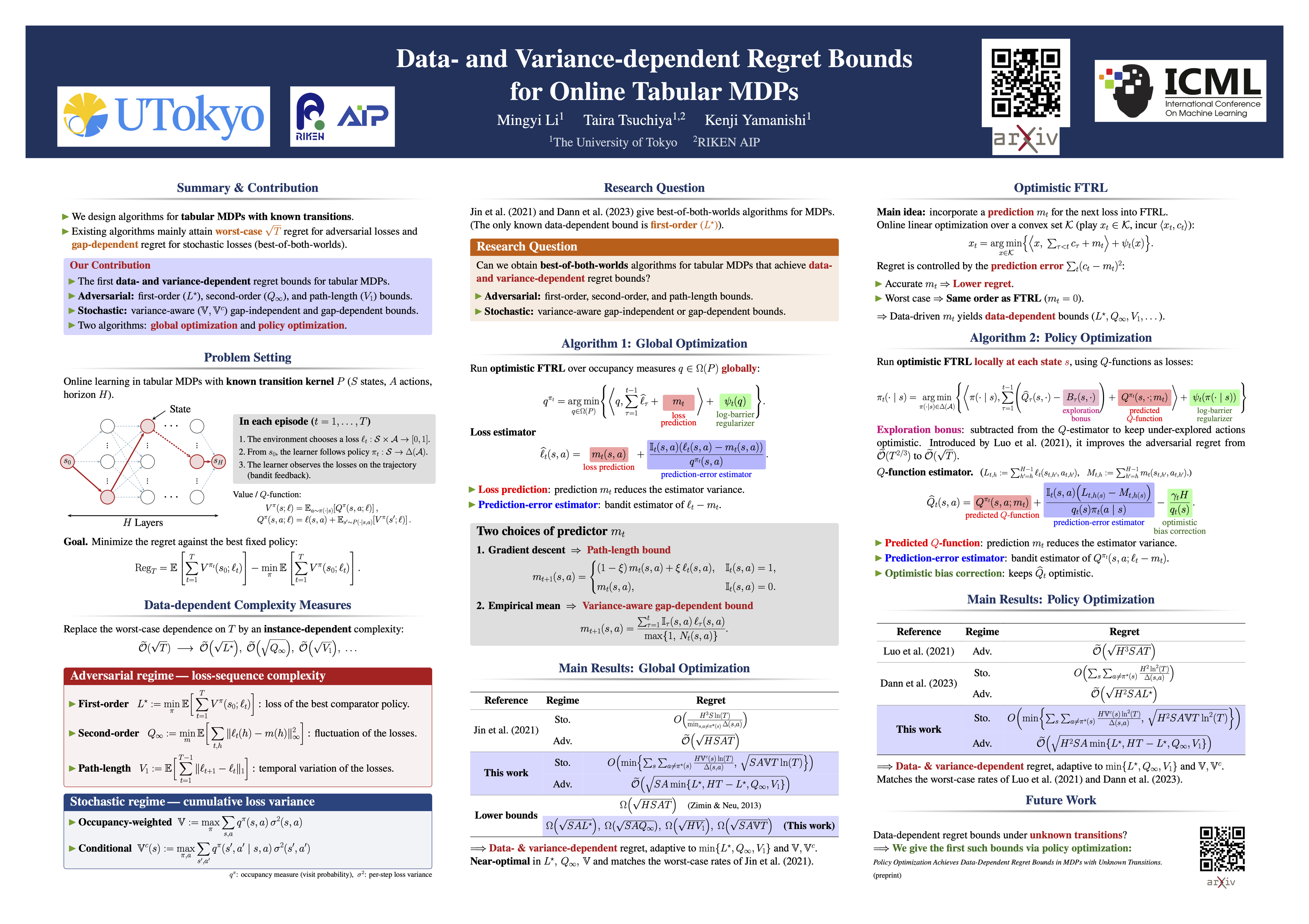
This paper studies learning algorithms for tabular Markov decision processes (MDPs) with known transition dynamics, where a learner repeatedly makes decisions in an environment with finitely many states and actions. We develop algorithms that adapt to both stochastic and adversarial environments: they learn faster when losses are generated from a stable distribution, while remaining robust when losses are chosen unpredictably or adversarially over time. Beyond adapting to the environment type, our algorithms also adapt to the observed loss sequence. Their guarantees strengthen when the best policy incurs small loss, when losses fluctuate little around a baseline, when losses change slowly across episodes, or when the random noise in the losses is small. To achieve these guarantees, we design new loss and Q-function estimators and use them to obtain adaptive results for both global optimization and policy optimization methods. We also provide lower bounds for several loss- and variance-dependent quantities, supporting the near-optimality of the main global-optimization guarantees.