
Fairness in Aggregation: Optimal Top-$k$ and Improved Full Ranking
Abstract
Lay Summary
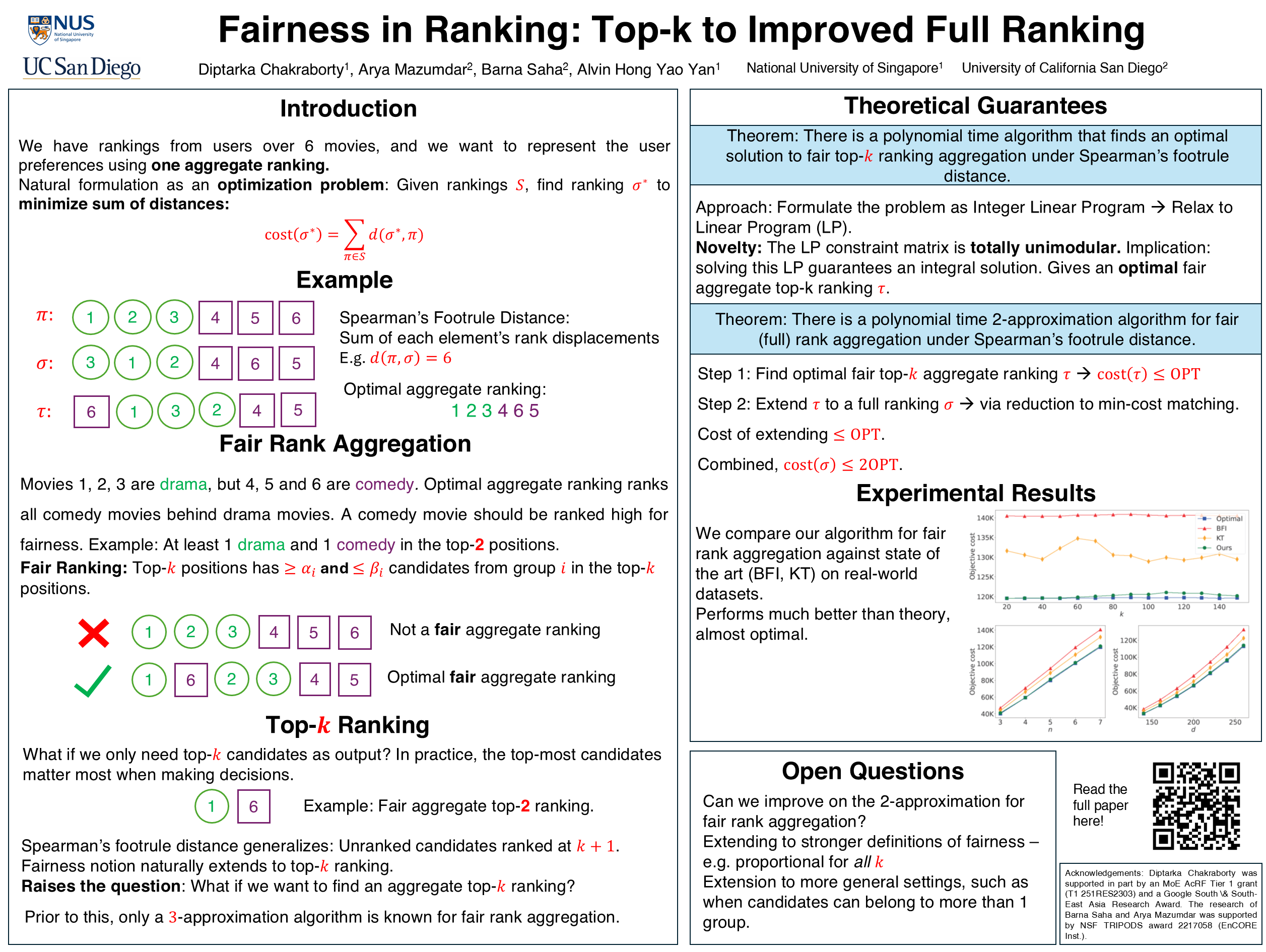
Ranking systems help determine what or who appears first in areas such as job hiring, online recommendations, search engines, and data organization. But when these systems combine many different opinions into one final list, they can sometimes leave out already underrepresented groups. Our paper explores how to make those rankings fairer. We focus on fairness rules that ensure different groups appear among the top most ranks, since the highest-ranked positions usually matter the most. We first design an algorithm that can find the best possible fair top-k ranking, which is especially useful when only the top ranks matter, such as in shortlisting job candidates or showing recommended items. Second, we design an algorithm that improves on existing methods for creating a fair ranking of all candidates, that gives stronger quality guarantees than previous work. We also test our methods on real-world datasets. The results show that the new approaches work well in practice and often outperform existing methods. Overall, our work makes progress toward ranking systems that are both effective and more inclusive.